Get your free personalized podcast brief
We scan new podcasts and send you the top 5 insights daily.
In regulated industries, the best model isn't always the most accurate. A model with slightly lower predictive performance but highly stable and defensible explanations is more valuable operationally. Attribution stability should be a key criterion in model selection, alongside traditional metrics like F1-score.
Related Insights
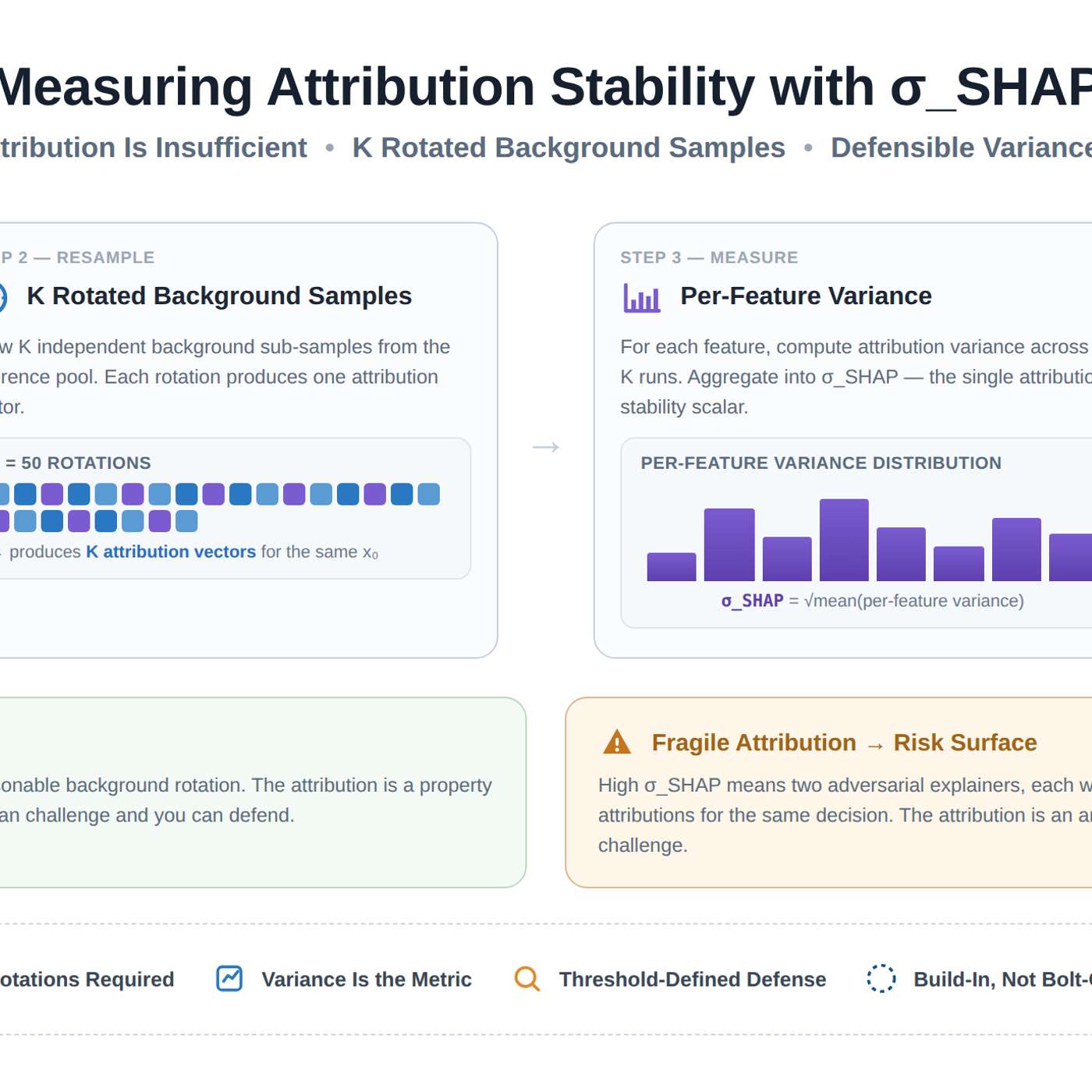
AI explanation methods like SHAP aren't deterministic and vary with background data. For regulated industries, an explanation that changes when re-run can invalidate an audit defense, even if the model's decision was correct. Stability, not one-time accuracy, is what matters for defensibility.
In a medical AI project, researchers deliberately rolled back a model's accuracy from 94% to 91% after a fairness audit revealed the final performance gains relied on sensitive user data like income. Doctors preferred the slightly less accurate but fairer model, demonstrating that trust and ethical alignment can be more valuable than marginal performance gains.

The researchers' failure case analysis is highlighted as a key contribution. Understanding why the model fails—due to ambiguous data or unusual inputs—provides a realistic scope of application and a clear roadmap for improvement, which is more useful for practitioners than high scores alone.
Using the SMOTE technique to balance datasets inadvertently makes AI model explanations more unstable. While improving predictive performance, the resulting model becomes harder to defend under audit because its explanations vary more significantly when re-run—a critical flaw in regulated environments.
As AI models are used for critical decisions in finance and law, black-box empirical testing will become insufficient. Mechanistic interpretability, which analyzes model weights to understand reasoning, is a bet that society and regulators will require explainable AI, making it a crucial future technology.

When selecting foundational models, engineering teams often prioritize "taste" and predictable failure patterns over raw performance. A model that fails slightly more often but in a consistent, understandable way is more valuable and easier to build robust systems around than a top-performer with erratic, hard-to-debug errors.

For AI systems to be adopted in scientific labs, they must be interpretable. Researchers need to understand the 'why' behind an AI's experimental plan to validate and trust the process, making interpretability a more critical feature than raw predictive power.

Teams often fall into the trap of optimizing for model accuracy, a metric popularized by academic settings like Kaggle. In business, this is misleading. A highly accurate model might be too passive and miss opportunities. The focus must shift from pure accuracy to real-world business outcomes and ROI.

Instead of treating model explainability as a one-off documentation task, teams should engineer for stability. This involves measuring attribution variance, and for audit purposes, versioning and persisting the specific background data sample used to create a deterministic, reproducible explanation for regulators.
Achieving explainability in AI for drug development isn't about post-hoc analysis. It requires building models from the ground up using inherently interpretable data like RNA sequencing and mutational profiles. When the inputs are explainable, the model's outputs become explainable by design.