Get your free personalized podcast brief
We scan new podcasts and send you the top 5 insights daily.
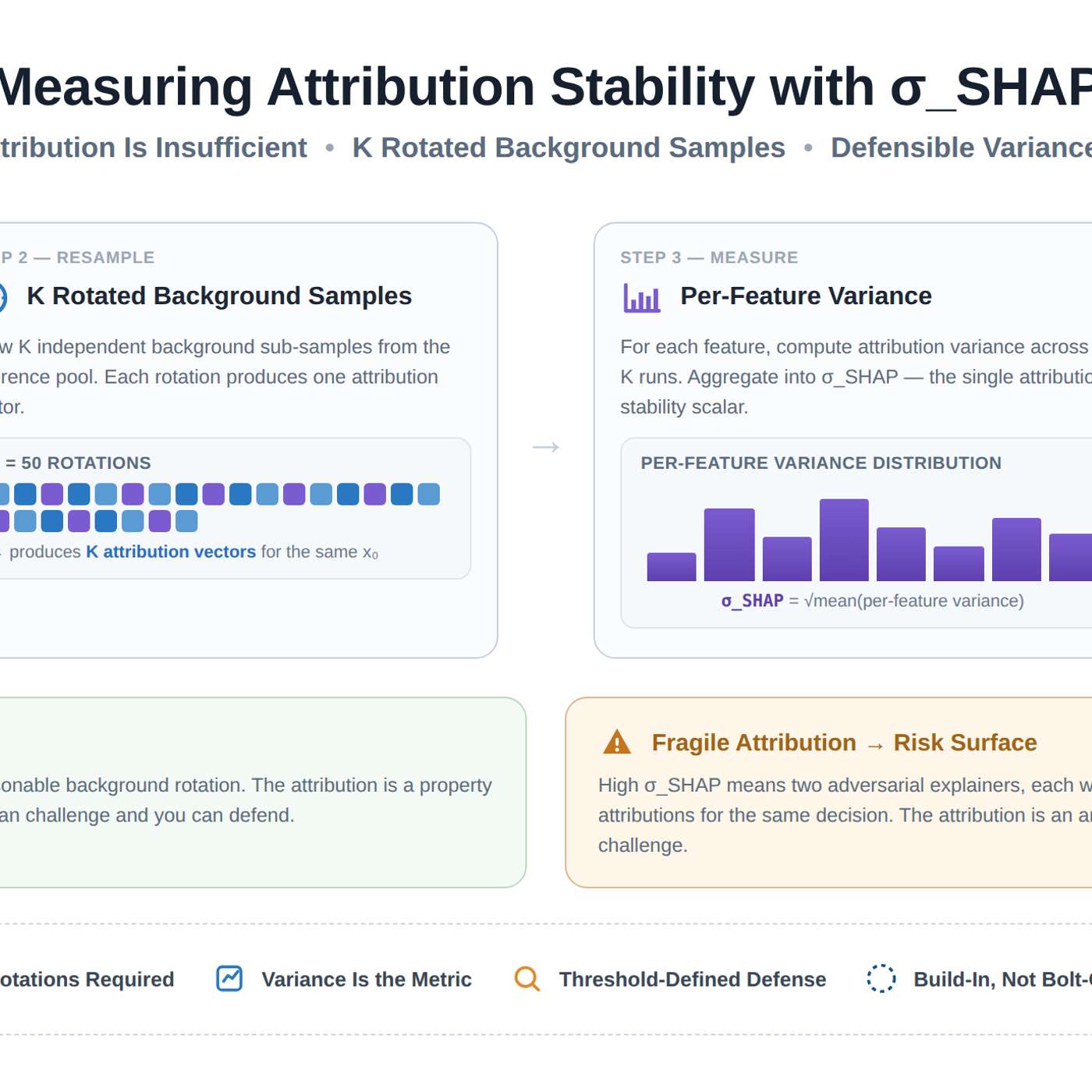
Instead of treating model explainability as a one-off documentation task, teams should engineer for stability. This involves measuring attribution variance, and for audit purposes, versioning and persisting the specific background data sample used to create a deterministic, reproducible explanation for regulators.
Related Insights
Unlike traditional software that produces identical, auditable results, AI is non-deterministic and often can't explain its reasoning. This poses a major challenge for finance, an industry where processes must be repeatable and transparent to meet regulatory and client expectations for showing work.

AI explanation methods like SHAP aren't deterministic and vary with background data. For regulated industries, an explanation that changes when re-run can invalidate an audit defense, even if the model's decision was correct. Stability, not one-time accuracy, is what matters for defensibility.
To build resilient AI systems, require every proposed state change to include its specific data origin—the file ID, paragraph hash, or database record. If this source lineage cannot be automatically verified by the system's transaction manager, the AI's proposed update must be instantly rejected, ensuring data integrity.

In regulated industries, the best model isn't always the most accurate. A model with slightly lower predictive performance but highly stable and defensible explanations is more valuable operationally. Attribution stability should be a key criterion in model selection, alongside traditional metrics like F1-score.
Using the SMOTE technique to balance datasets inadvertently makes AI model explanations more unstable. While improving predictive performance, the resulting model becomes harder to defend under audit because its explanations vary more significantly when re-run—a critical flaw in regulated environments.
To assess audit-readiness, pick an AI-driven decision from months ago and attempt to reconstruct every detail: data input, model version, validation status, and review trail. If you cannot gather all this information within 48 hours, your governance framework will fail a real-world audit.

Companies believe high-level AI policies and frameworks provide audit protection. However, auditors bypass these to demand granular proof for specific AI-assisted decisions, asking for data lineage, model versions, and human decision trails at a precise moment in time, which is where most governance systems fail.
Instead of supervising an AI's hidden thought process, we can demand it produces a 'certificate of reasoning'—a checkable proof—along with its output. This could include citations or sensitivity analyses, shifting verification from observing the process to checking the provided proof.

Don't let fears of "directory overload" prevent you from creating attributable AI agents. The governance requirement to trace every agent action is non-negotiable. The solution is not infinite directory entries, but a system of stable identities linked to temporal records for a full audit trail. The technical implementation should not compromise the governance requirement.
Treat accountability as an engineering problem. Implement a system that logs every significant AI action, decision path, and triggering input. This creates an auditable, attributable record, ensuring that in the event of an incident, the 'why' can be traced without ambiguity, much like a flight recorder after a crash.
