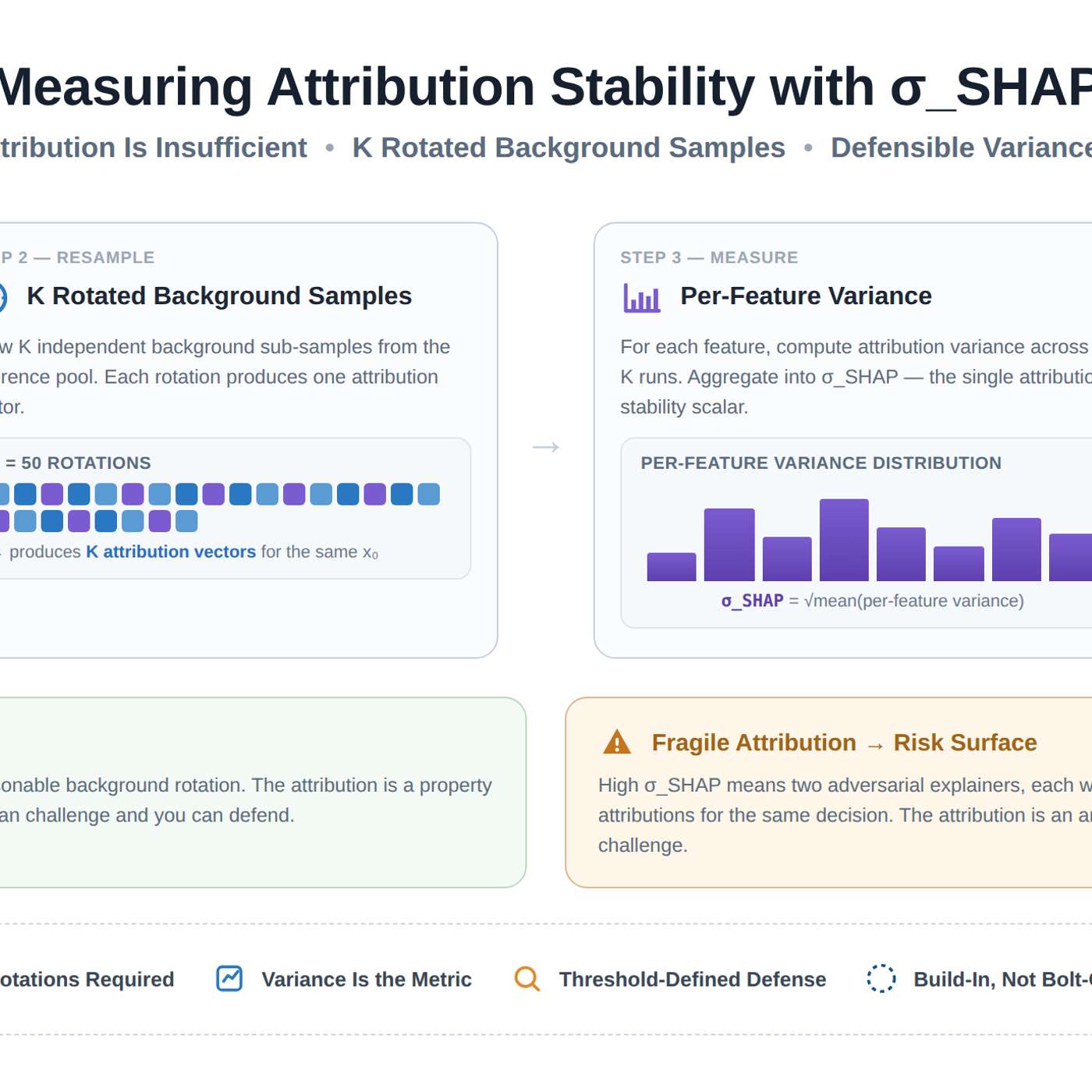
AI explanation methods like SHAP aren't deterministic and vary with background data. For regulated industries, an explanation that changes when re-run can invalidate an audit defense, even if the model's decision was correct. Stability, not one-time accuracy, is what matters for defensibility.
Using the SMOTE technique to balance datasets inadvertently makes AI model explanations more unstable. While improving predictive performance, the resulting model becomes harder to defend under audit because its explanations vary more significantly when re-run—a critical flaw in regulated environments.
Instead of treating model explainability as a one-off documentation task, teams should engineer for stability. This involves measuring attribution variance, and for audit purposes, versioning and persisting the specific background data sample used to create a deterministic, reproducible explanation for regulators.
In regulated industries, the best model isn't always the most accurate. A model with slightly lower predictive performance but highly stable and defensible explanations is more valuable operationally. Attribution stability should be a key criterion in model selection, alongside traditional metrics like F1-score.