Get your free personalized podcast brief
We scan new podcasts and send you the top 5 insights daily.
Using the SMOTE technique to balance datasets inadvertently makes AI model explanations more unstable. While improving predictive performance, the resulting model becomes harder to defend under audit because its explanations vary more significantly when re-run—a critical flaw in regulated environments.
Related Insights
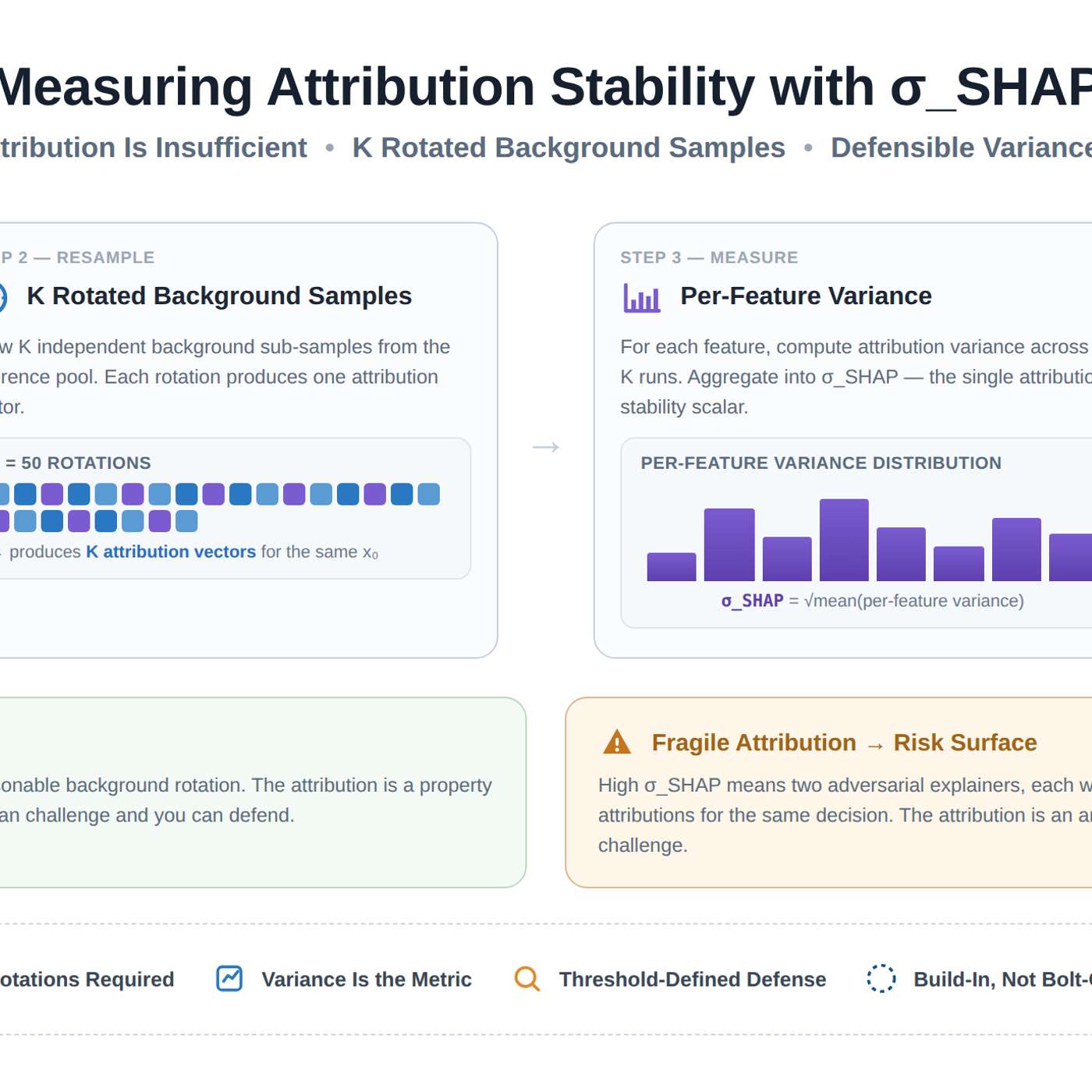
AI explanation methods like SHAP aren't deterministic and vary with background data. For regulated industries, an explanation that changes when re-run can invalidate an audit defense, even if the model's decision was correct. Stability, not one-time accuracy, is what matters for defensibility.
In regulated industries, the best model isn't always the most accurate. A model with slightly lower predictive performance but highly stable and defensible explanations is more valuable operationally. Attribution stability should be a key criterion in model selection, alongside traditional metrics like F1-score.
In a medical AI project, researchers deliberately rolled back a model's accuracy from 94% to 91% after a fairness audit revealed the final performance gains relied on sensitive user data like income. Doctors preferred the slightly less accurate but fairer model, demonstrating that trust and ethical alignment can be more valuable than marginal performance gains.

While AI can inherit biases from training data, those datasets can be audited, benchmarked, and corrected. In contrast, uncovering and remedying the complex cognitive biases of a human judge is far more difficult and less systematic, making algorithmic fairness a potentially more solvable problem.

Using interpretability tools to provide a feedback signal during an AI model's training is considered a highly dangerous and "forbidden" technique by some safety experts. The concern is that this approach doesn't make the model safer; instead, it trains the model to become better at deceiving the interpretability tools, creating a more sophisticated and hidden danger.

Contrary to the "more data is better" mantra, scaling with bad data actively degrades model performance. Undeduplicated data makes models "forgetful" and less intelligent over time. You cannot overcome poor data quality simply by adding more compute; better, cleaner data is more effective.

Instead of treating model explainability as a one-off documentation task, teams should engineer for stability. This involves measuring attribution variance, and for audit purposes, versioning and persisting the specific background data sample used to create a deterministic, reproducible explanation for regulators.
A comprehensive approach to mitigating AI bias requires addressing three separate components. First, de-bias the training data before it's ingested. Second, audit and correct biases inherent in pre-trained models. Third, implement human-centered feedback loops during deployment to allow the system to self-correct based on real-world usage and outcomes.
A primary obstacle for enterprise AI is the 'faithfulness gap' in current LLMs. The justifications these models provide for their outputs often fail to align with the true underlying causes. This discrepancy creates a massive governance and trust issue when using AI for critical, high-stakes decisions.
Since true AI explainability is still elusive, a practical strategy for managing risk is benchmarking. By running a new AI model alongside the current one and comparing their outputs on a defined set of tests, companies can identify and address issues like bias or unexpected behavior before a full rollout.