Get your free personalized podcast brief
We scan new podcasts and send you the top 5 insights daily.
Achieving explainability in AI for drug development isn't about post-hoc analysis. It requires building models from the ground up using inherently interpretable data like RNA sequencing and mutational profiles. When the inputs are explainable, the model's outputs become explainable by design.
Related Insights
AI modeling transforms drug development from a numbers game of screening millions of compounds to an engineering discipline. Researchers can model molecular systems upfront, understand key parameters, and design solutions for a specific problem, turning a costly screening process into a rapid, targeted design cycle.

To evolve AI from pattern matching to understanding physics for protein engineering, structural data is insufficient. Models need physical parameters like Gibbs free energy (delta-G), obtainable from affinity measurements, to become truly predictive and transformative for therapeutic development.

Goodfire frames interpretability as the core of the AI-human interface. One direction is intentional design, allowing human control. The other, especially with superhuman scientific models, is extracting novel knowledge (e.g., new Alzheimer's biomarkers) that the AI discovers.
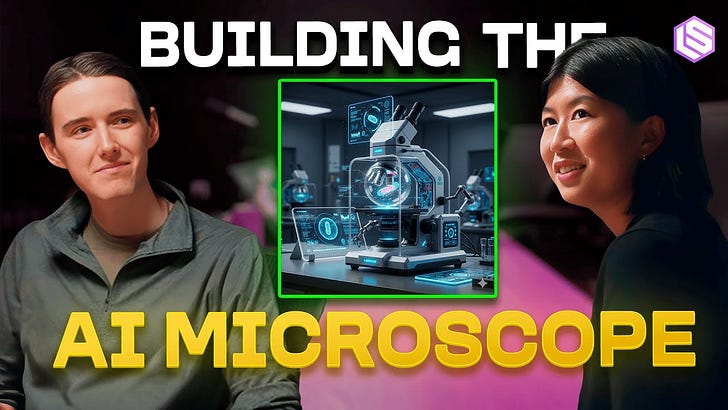
Just as biology deciphers the complex systems created by evolution, mechanistic interpretability seeks to understand the "how" inside neural networks. Instead of treating models as black boxes, it examines their internal parameters and activations to reverse-engineer how they work, moving beyond just measuring their external behavior.
By analyzing a model predicting Alzheimer's, Goodfire discovered it relied on the length of cell-free DNA fragments—a previously overlooked signal. This demonstrates how interpretability can extract new, testable scientific hypotheses from high-performing "black box" models.

AI models trained on descriptive data (e.g., RNA-seq) can classify cell states but fail to predict how to transition a diseased cell to a healthy one. True progress requires generating massive "causal" datasets that show the effects of specific genetic perturbations.
The progress of AI in predicting cancer treatment is stalled not by algorithms, but by the data used to train them. Relying solely on static genetic data is insufficient. The critical missing piece is functional, contextual data showing how patient cells actually respond to drugs.

In partnership with institutions like Mayo Clinic, Goodfire applied interpretability tools to specialized foundation models. This process successfully identified new, previously unknown biomarkers for Alzheimer's, showcasing how understanding a model's internals can lead to tangible scientific breakthroughs.
The bottleneck for AI in drug development isn't the sophistication of the models but the absence of large-scale, high-quality biological data sets. Without comprehensive data on how drugs interact within complex human systems, even the best AI models cannot make accurate predictions.

For AI systems to be adopted in scientific labs, they must be interpretable. Researchers need to understand the 'why' behind an AI's experimental plan to validate and trust the process, making interpretability a more critical feature than raw predictive power.
