Get your free personalized podcast brief
We scan new podcasts and send you the top 5 insights daily.
To control spiraling AI costs, teams should first determine if a task can be solved with deterministic, rules-based logic. Using AI for problems that have a straightforward, non-AI solution is an inefficient use of resources and introduces unnecessary variability and expense.

Related Insights
AI model providers are shifting from subsidized subscriptions to metered, usage-based pricing for their most powerful models. This forces go-to-market teams to stop experimenting freely and start rigorously calculating the ROI for each AI-powered workflow, as costs are now directly tied to usage.
Don't use your most powerful and expensive AI model for every task. A crucial skill is model triage: using cheaper models for simple, routine tasks like monitoring and scheduling, while saving premium models for complex reasoning, judgment, and creative work.

A powerful cost-saving strategy is to use AI as a one-time tool to generate complex, deterministic code for a recurring problem. This avoids the high, cumulative cost of running the same reasoning task through a pay-per-use LLM, shifting the expense from operational credits to a one-time development effort.
Not every business problem requires an LLM. Using a simple classifier (Layer 2) for email sorting or a deep learning model (Layer 4) for recommendations is more efficient than defaulting to the latest generative AI (Layer 5/6). This layered thinking saves costs, reduces complexity, and builds better products.
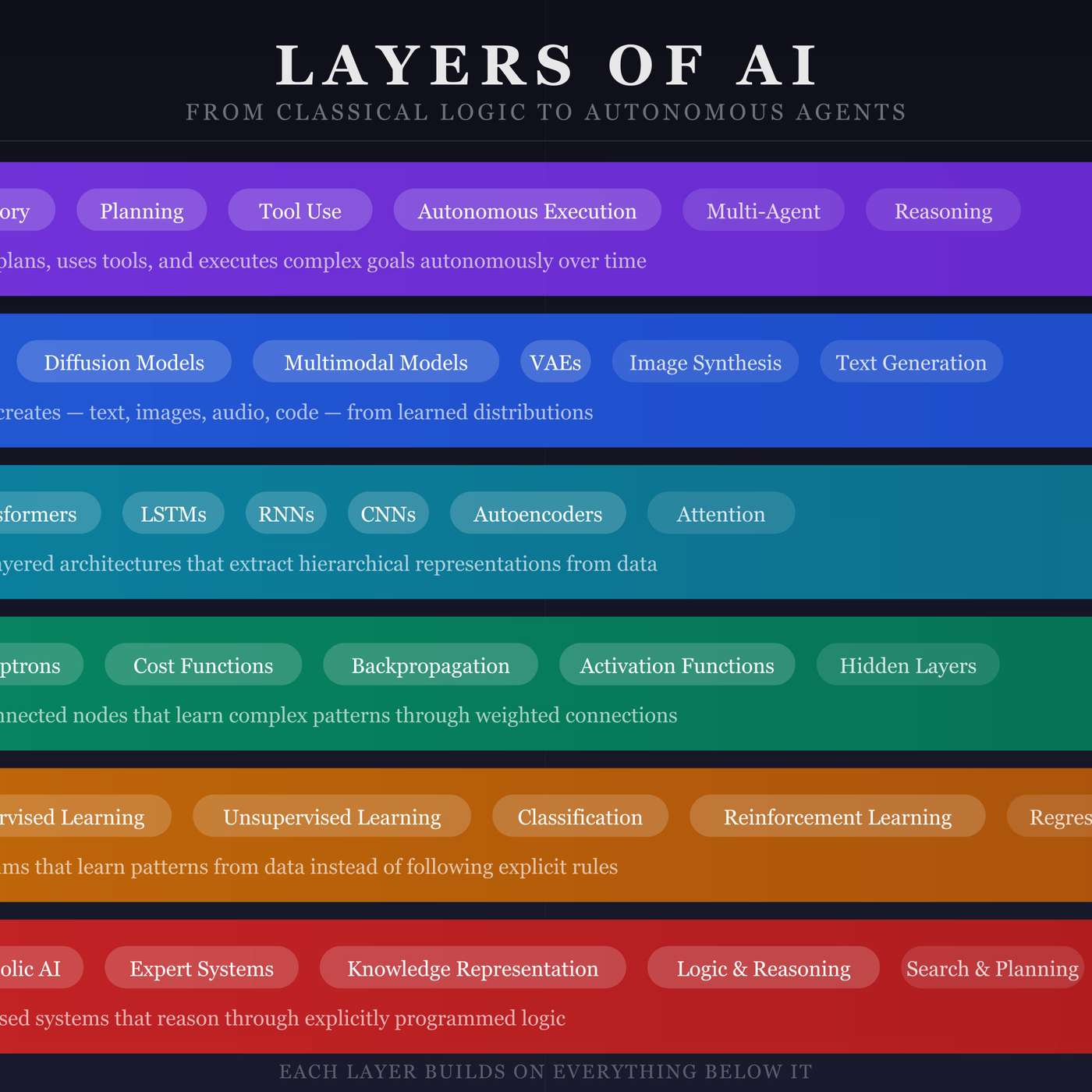
Don't default to AI. A simple rule-based system (heuristics) is superior when results must be fully explainable (e.g., tax software), when clear domain rules already exist, when data is limited, or when development speed is the absolute top priority.

While autonomous AI agents generate significant hype, their real-world business value is currently limited and unreliable. Marketers should instead focus on building deterministic AI automations—workflows with a clear, predefined sequence of steps—which deliver consistent and valuable results for specific marketing tasks today.

Resist the urge to apply LLMs to every problem. A better approach is using a 'first principles' decision tree. Evaluate if the task can be solved more simply with data visualization or traditional machine learning before defaulting to a complex, probabilistic, and often overkill GenAI solution.

Complex but repeatable GTM tasks like data enrichment and waterfalling do not require a resource-intensive, non-deterministic AI agent. A reliable and cheaper deterministic automation is superior for these core functions because you want the same, predictable result every time without unnecessary agency.
The most powerful automations are not complex agents but simple, predictable workflows that save time reliably. The goal is determinism; AI introduces a "black box" of uncertainty. Therefore, the highest ROI comes from extremely linear processes where "boring is beautiful" and predictability is guaranteed.
State-of-the-art models like Claude Opus are often overkill and unnecessarily expensive for simple, routine tasks like summarizing emails. Using cheaper, less powerful models for these straightforward automations provides significant cost savings without sacrificing performance where it's not needed.
