Get your free personalized podcast brief
We scan new podcasts and send you the top 5 insights daily.
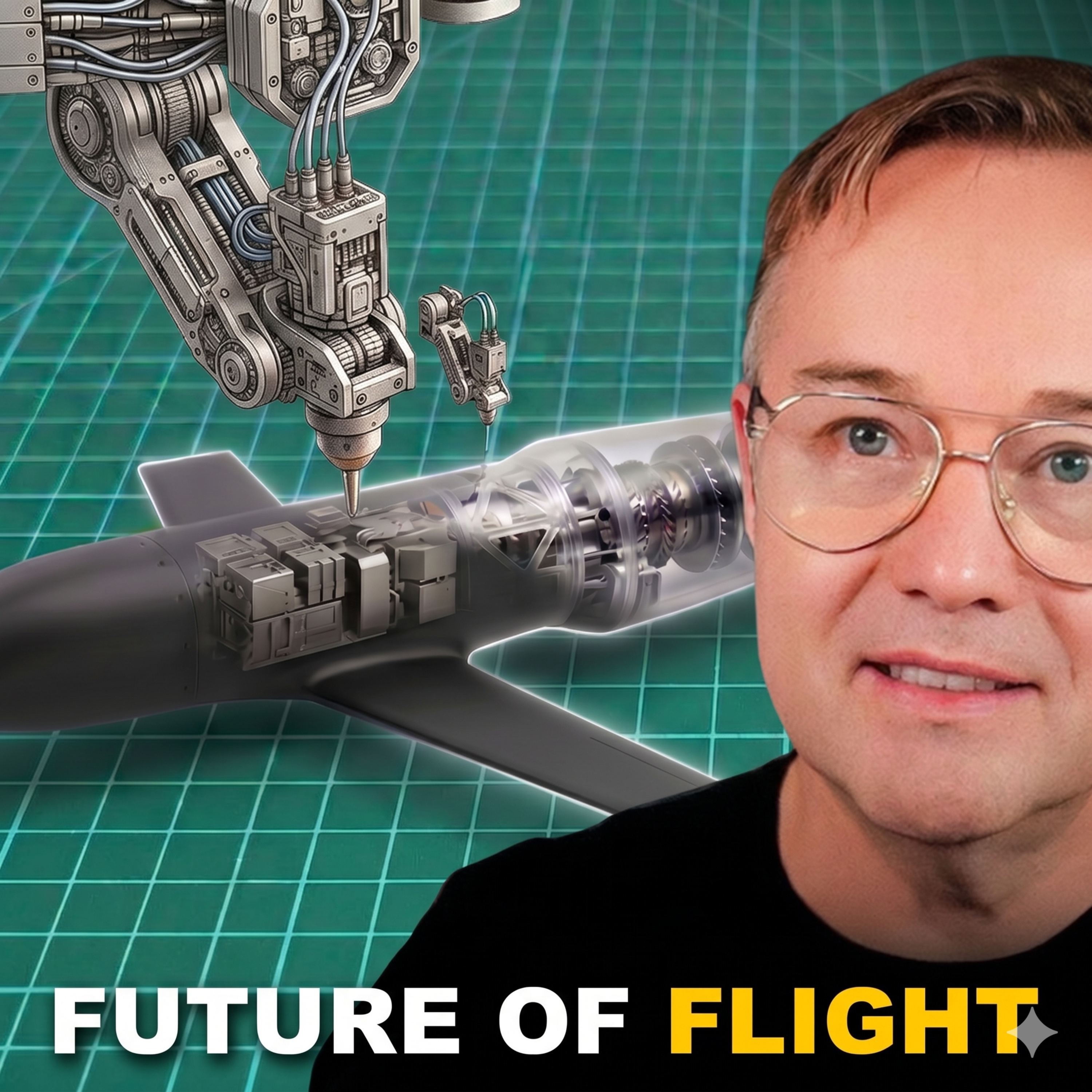
Hadrian's manufacturing model enables it to take on more underwriting risk. Because its factories are highly automated and design-agnostic, at least 80% of the capital expenditure for one customer's program can be repurposed for another if the original program is canceled, creating a "virtual factory" model.

Related Insights
Divergent created a product-agnostic manufacturing system where factories can adaptively switch between vastly different products, like a car chassis or a missile airframe, using the same vertically integrated hardware. This creates a flexible, scalable industrial platform.
Cellares finances its global factory network using minimal equity. The strategy involves long-term leases where landlords fund the facility build-out in exchange for commitment, while major clients finance the installation of manufacturing equipment. This capital-efficient model allows for rapid, asset-light global expansion.

Modern factories like Hadrian's use software not just for automation but for agility. This allows them to quickly reconfigure production lines for small batches of highly varied parts ('high mix, low volume'), a necessity for complex systems like submarines where components are not mass-produced.

Despite operating in industrial sectors, Lifco maintains a surprisingly low CapEx-to-sales ratio of 1-2%. This is because its "manufacturing" businesses are primarily assembly operations that piece together finished components from other suppliers, avoiding the heavy capital investment required for traditional manufacturing machinery.

Senra Systems operates two types of facilities: one for rapid prototyping and new product introduction (NPI) to solve immediate customer problems, and another designed for cost-effective, scaled production to solve future demand. This dual approach offers both agility and long-term scalability.
Instead of viewing a pilot plant as just an R&D cost center, design it to be profitable. This self-sustaining model provides commercial validation and helps secure pre-sale agreements, which can then be leveraged to finance a full-scale industrial facility with less investor risk.

Instead of building new autonomous vehicles from scratch, Bedrock Robotics develops technology to retrofit existing heavy machinery. This allows a contractor to turn their existing half-million-dollar Caterpillar excavator into an autonomous asset, a much more capital-efficient approach than replacing the entire fleet.

During its growth phases, Anduril's COO prefers buying capital equipment like manufacturing machinery from secondary markets. This capital-efficient strategy provides flexibility, acknowledging the high probability that their technical requirements will change, thus avoiding being locked into expensive new equipment that may become obsolete for their needs.
LEGO ensures all its global factories are exact operational and physical copies. This extreme standardization means an employee from any factory can transfer to another continent and be fully productive the next day. This "rigidity," as the CEO calls it, provides enormous executional power and flexibility.
AHC rejects the "micro-factory" trend for a centralized "Gigafactory" model. This allows massive investment in automation and keeps engineers close to production for rapid iteration. To make this viable, their building components are designed to fit in standard shipping containers, enabling cost-effective national distribution.
