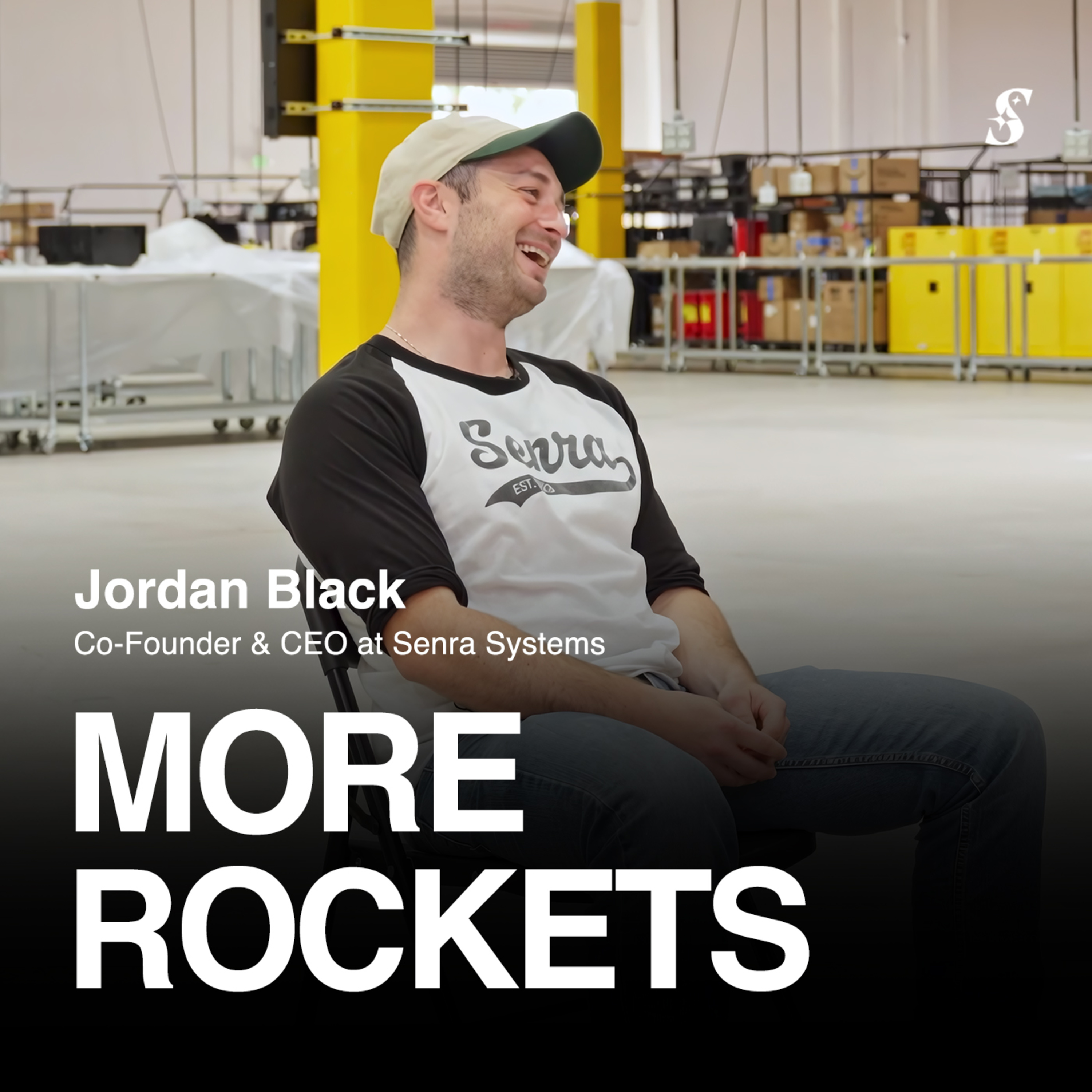
Senra Systems' founder secured early funding not by pitching slides, but by physically demonstrating the contrast between the old, manual process (a 600-page book) and the new, streamlined one (a single machine). This tangible approach makes the value proposition undeniable for investors unfamiliar with the industry's pain points.
True hyper-growth requires two leadership archetypes. The visionary (like Elon Musk) drives aggressive innovation, while the operator (like Gwynne Shotwell) stabilizes the organization, picks up the pieces, and prevents burnout. One without the other leads to chaos or stagnation.
At SpaceX, a single engineer owns a part from initial requirements through post-flight analysis. This eliminates handoffs and finger-pointing, creating a culture of absolute ownership. Success or failure rests with one person, which drives intense commitment and accountability.
Senra Systems is installing camera systems to gather data on manual assembly tasks today, even though the robotic dexterity to automate them doesn't exist yet. This strategy ensures they will have the proprietary dataset needed to train AI models and be first to automate when the technology matures.
Companies like SpaceX built their own operating systems (like Warp Drive) because off-the-shelf solutions couldn't handle their complexity and speed. For Senra, this means building custom software and automation. Vertical integration is not a choice but a necessity when the external industrial base is a bottleneck to growth.
Senra Systems operates two types of facilities: one for rapid prototyping and new product introduction (NPI) to solve immediate customer problems, and another designed for cost-effective, scaled production to solve future demand. This dual approach offers both agility and long-term scalability.
Instead of pitching for a company's largest production contract, Senra's founder started by knocking on doors and asking for their 'worst harness.' This go-to-market strategy de-risks the engagement for the customer, proves the startup's capabilities on a painful problem, and builds trust for larger contracts later.
Former SpaceX CIO Ken Venner advises that process should evolve with company size. Early on, trust smart people with minimal systems. As you grow to hundreds and then thousands, you need more process, but it must enable, not constrain. The goal is to provide information and track actions without stunting growth.
The wire harness industry, critical to defense and aerospace, relies on a skilled but aging workforce with no formal training programs. The knowledge is 'tribal.' Senra's growth thesis is that re-industrialization is impossible without digitizing this knowledge and creating scalable training, like their 4-week certification program.
Senra Systems' name is 'harness' spelled backward, with the 'h' and 's' removed. This stands for their mission to 'delete the horseshit' from the wire harnessing industry. This clever origin story transforms a simple name into a memorable, daily reminder of the company's core value of radical simplification.