Get your free personalized podcast brief
We scan new podcasts and send you the top 5 insights daily.
Instead of building new autonomous vehicles from scratch, Bedrock Robotics develops technology to retrofit existing heavy machinery. This allows a contractor to turn their existing half-million-dollar Caterpillar excavator into an autonomous asset, a much more capital-efficient approach than replacing the entire fleet.

Related Insights
Successful "American Dynamism" companies de-risk hardware development by initially using off-the-shelf commodity components. Their unique value comes from pairing this accessible hardware with sophisticated, proprietary software for AI, computer vision, and autonomy. This approach lowers capital intensity and accelerates time-to-market compared to traditional hardware manufacturing.

To overcome the construction industry's conservatism, Monumental operates as a subcontractor. This model is easier to sell than a large capital expenditure like a robot, as it fits existing project budgets and workflows, de-risking adoption for general contractors.

Contrary to the belief that hardware is inherently capital-intensive, Monumental's founder argues their biggest expense is salaries for high-quality talent, much like a software startup. The cost of the robots is manageable and their payback time is good, challenging typical VC perceptions of the business model.
While consumer robots are flashy, the real robotics revolution will start in manufacturing. Specialized B2B robots offer immediate, massive ROI for companies that can afford them. The winner will be the company that addresses factories first and then adapts that technology for the home, not the other way around.

The most transformative opportunities for founders lie not in crowded SaaS markets but in applying an advanced technology mindset to legacy industries. Sectors like lumber milling, mining, and metalwork are ripe for disruption through automation and robotics, creating massive, untapped value.
Instead of building its own capital-intensive robotaxi fleet, Waive's go-to-market strategy is to sell its autonomous driving stack to major auto manufacturers. This software-centric approach allows them to leverage the scale, distribution, and hardware infrastructure of established OEMs to reach millions of consumers.

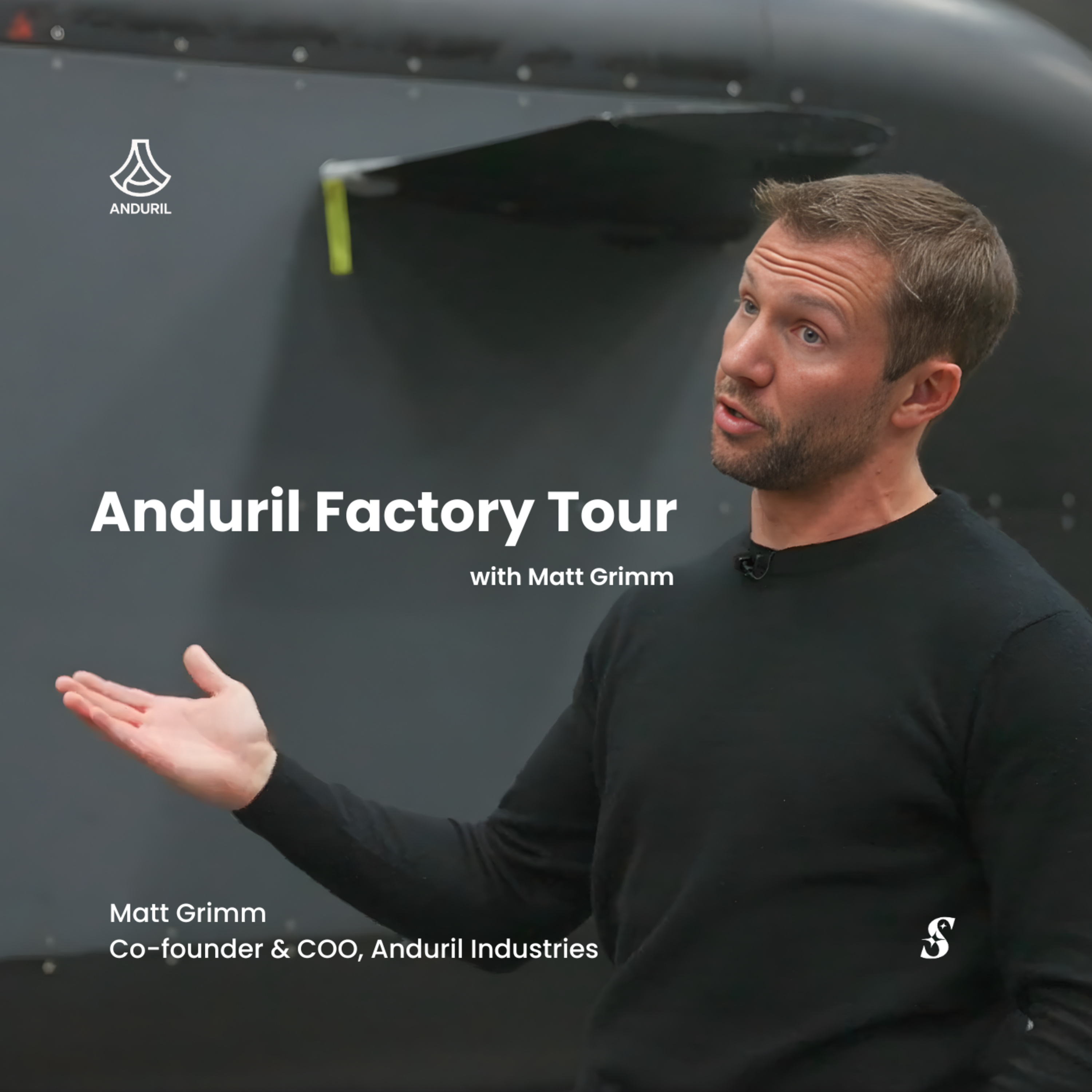
During its growth phases, Anduril's COO prefers buying capital equipment like manufacturing machinery from secondary markets. This capital-efficient strategy provides flexibility, acknowledging the high probability that their technical requirements will change, thus avoiding being locked into expensive new equipment that may become obsolete for their needs.
To achieve scalable autonomy, Flywheel AI avoids expensive, site-specific setups. Instead, they offer a valuable teleoperation service today. This service allows them to profitably collect the vast, diverse datasets required to train a generalizable autonomous system, mirroring Tesla's data collection strategy.

The venture capital mantra that "hardware is hard" is outdated for the American Dynamism category. Startups in this space mitigate risk by integrating off-the-shelf commodity hardware with sophisticated software. This avoids the high capital costs and unpredictable sales cycles of consumer electronics.
Competitors target easy-to-automate "drive-by-wire" excavators, which comprise only 5% of the market. Flywheel AI builds its moat by creating a solution that retrofits the other 95% of hydraulic machines. This universal compatibility is key in a price-sensitive industry with mixed fleets.