Get your free personalized podcast brief
We scan new podcasts and send you the top 5 insights daily.
Microsoft CEO Satya Nadella has structured a brilliant hedge. If frontier models from labs like OpenAI dominate, Microsoft wins via its significant equity stake. If models commoditize, Microsoft wins by leveraging its unparalleled enterprise distribution channels. The company is positioned to profit from either outcome.
Related Insights
Like IBM Global Services helped firms adopt PCs, Microsoft is now building a massive services arm to implement OpenAI and Anthropic models. This signals a strategic shift: when unable to lead with your own product, you use your enterprise relationships to become the trusted adoption partner for new innovators.

Nadella posits a future where the winner isn't the company with the best model. Instead, value accrues to the platform that provides the data, context, and tools (the 'scaffolding') that make any model useful, especially as capable open-source alternatives proliferate.
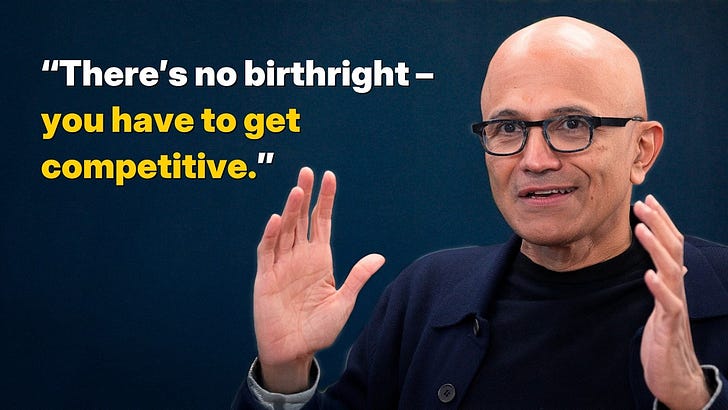
Microsoft's decision to promote Anthropic models on Azure as aggressively as OpenAI's reflects a core belief from CEO Satya Nadella. He anticipates AI models will become commoditized, making the underlying intelligence interchangeable and the cloud platform the primary point of differentiation and value capture.

Contrary to typical corporate fears, Microsoft's AI lead views the rapid commoditization of AI models and resulting price wars as a positive outcome for humanity. The ultimate goal is to make intelligence abundant and near-zero cost, with Microsoft's business model focused on value-added software integrations.
Microsoft solidified its 27% stake, secured exclusive IP rights until 2032, and locked in a $250B Azure commitment. This captures near-term value while de-risking Microsoft from having to solely fund OpenAI's massive future build-out, positioning Azure as a platform for all AI models, not just OpenAI's.

Microsoft AI CEO Mustafa Suleiman explains that while the OpenAI partnership is strong, Microsoft must develop its own superintelligence capabilities to avoid long-term structural dependency on a third party, referencing Satya Nadella's fear of becoming the commoditized 'Intel' to OpenAI's 'Microsoft'.

Microsoft's early OpenAI investment was a calculated, risk-adjusted decision. They saw that generalizable AI platforms were a 'must happen' future and asked, 'Can we remain a top cloud provider without it?' The clear 'no' made the investment a defensive necessity, not just an offensive gamble.
Beyond the equity stake and Azure revenue, Satya Nadella highlights a core strategic benefit: royalty-free access to OpenAI's IP. For Microsoft, this is equivalent to having a "frontier model for free" to deeply integrate across its entire product suite, providing a massive competitive advantage without incremental licensing costs.

Satya Nadella’s critique of frontier models learning from customer data is a strategic move to sell Microsoft's infrastructure. It promotes a vision where enterprises control their own AI destiny, thereby making Microsoft the essential platform provider.

Counter to the idea of a few dominant frontier models, Satya Nadella believes the AI model market will mirror the database market's evolution. He expects a proliferation of specialized models, including open-source and proprietary ones, with firms eventually embedding their unique tacit knowledge into custom models they control.