Get your free personalized podcast brief
We scan new podcasts and send you the top 5 insights daily.
CFOs and GTM leaders may prefer tools that abstract AI costs into a simplified, capped credit model. This provides a fixed, predictable cost, mitigating the risk of runaway expenses from direct, usage-based API access to LLMs, which can be difficult to control and forecast.

Related Insights
The optimal strategy for managing AI costs is neither total restriction nor a free-for-all. It's providing engineers with dedicated "learning budgets" and experimentation pools, coupled with clear visibility into costs. This fosters innovation responsibly without incurring surprise invoices and turns cost into a first-class constraint.
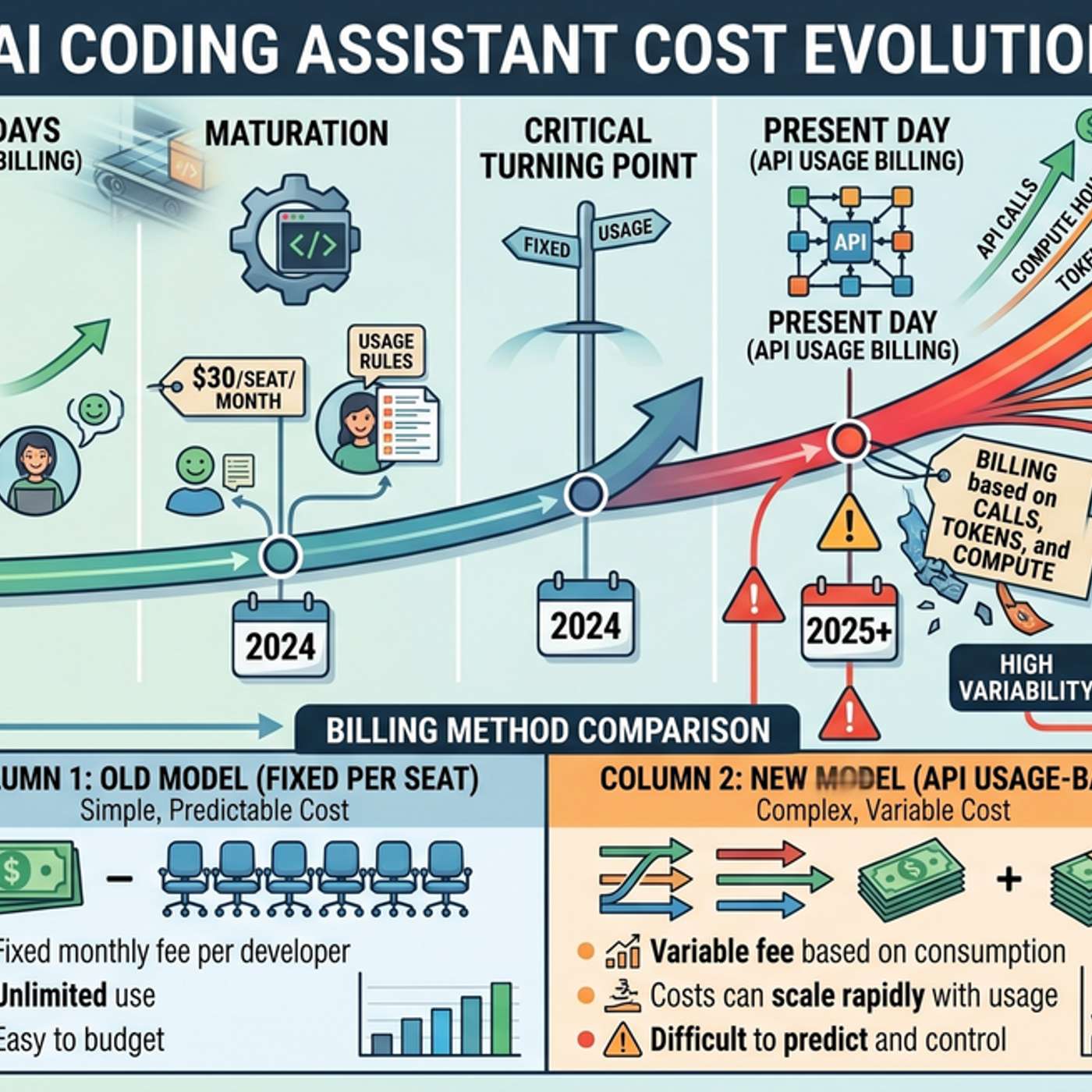
Contrary to the belief that enterprises have unlimited budgets, they are focused on the ROI of their AI spend. As agentic workflows cause token bills to skyrocket, orchestration tools that intelligently route queries to the most cost-effective model for a given task are becoming essential infrastructure.

Confusing credit-based AI pricing models will likely be replaced by a straightforward value proposition: selling AI agents at a fixed price equivalent to the cost of one human worker who can perform the work of ten. This simplifies budgeting and clearly communicates ROI to CFOs.

For companies at the trillion-token scale, cost predictability is more important than the lowest per-token price. Superhuman favors providers offering fixed-capacity pricing, giving them better control over their cost structure, which is crucial for pre-IPO financial planning.

Pega's CTO advises using the powerful reasoning of LLMs to design processes and marketing offers. However, at runtime, switch to faster, cheaper, and more consistent predictive models. This avoids the unpredictability, cost, and risk of calling expensive LLMs for every live customer interaction.

Beyond upfront pricing, sophisticated enterprise customers now demand cost certainty for consumption-based AI. They require vendors to provide transparent cost structures and protections for when usage inevitably scales, asking, 'What does the world look like when the flywheel actually spins?'

Pay-per-use AI models create a psychological blocker, making teams hesitant to experiment for fear of racking up high costs. A fixed-price, unlimited-use model allows for unrestricted creativity and experimentation, similar to how a chef with inexpensive ingredients can innovate freely.

AI's usage-based pricing doesn't fit traditional seat-based software budgets. Frame it like a marketing program (e.g., paid ads). If increased spending on AI tools generates high ROI, it justifies a larger, flexible budget, shifting the conversation with finance from fixed cost to performance investment.

Enterprises struggle to adopt AI agents due to unpredictable, consumption-based pricing. The inability to budget for fluctuating token or credit usage makes scalable deployment nearly impossible for finance departments to approve, creating a significant hurdle to widespread adoption.

SaaS companies like HubSpot are shifting to credit-based pricing for AI features where costs are variable and opaque. This makes it nearly impossible for business leaders to budget for AI usage and operationalize new intelligent workflows effectively.