Get your free personalized podcast brief
We scan new podcasts and send you the top 5 insights daily.
Continuous action models efficiently control sub-second motor movements but struggle with long-horizon logical scheduling. A hierarchical agent harness handles high-level step planning, temporal waiting, and tool switching, allowing the robot to execute hour-long unsupervised tasks.

Related Insights
Diffusion transformer architectures excel at producing smooth, precise physical motions, but standard diffusion requires sensitive schedule tuning. Flow matching provides a simpler, easier-to-tune variant that enables reactive, high-frequency continuous action generation.
The effectiveness of agent loops lies in their ability to spin up specialized sub-agents. A common framework involves a 'planning agent' that outlines steps and an 'evaluating agent' that quality-checks the output. This division of labor allows the AI system to tackle complex tasks more reliably than a single agent could.

A new model architecture allows robots to vary their internal 'thinking' iterations at test time. This lets practitioners trade response speed for decision accuracy on a case-by-case basis, boosting performance on complex tasks without needing to retrain the model.
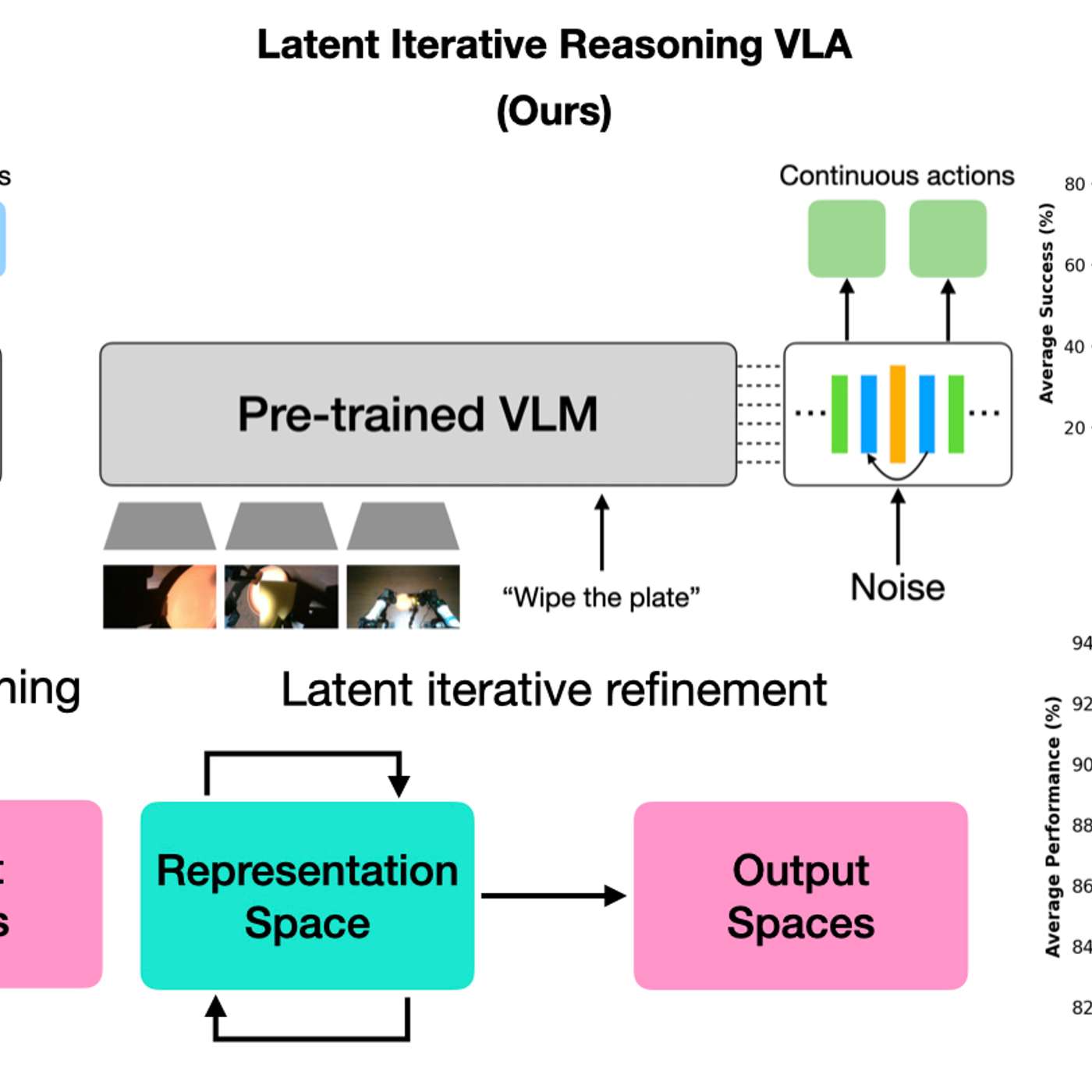
Separating robotic autonomy into a high-level reasoning model (like Gemini Robotics ER) and a low-level vision-language-action (VLA) policy causes practical bottlenecks. Beyond the communication and processing latency of reasoning models, sequential multi-step tasks suffer from compounded errors where the success rates of both models multiply across every handoff, creating compounding failure points during execution.

Tasklet's CEO argues that while traditional workflow automation seems safer, agentic systems that let the model plan and execute will ultimately prove more robust. They can handle unexpected errors and nuance that break rigid, pre-defined workflows, a bet on future model improvements.

Robotic intelligence has two components. "Reasoning," which involves creating a plan, is quickly being solved by AI. The other, harder part is "movement"—the robot's physical dexterity to execute that plan reliably in a complex environment without tripping or failing.

Instead of a single "think then act" cycle, Minimax trains its M2 model to repeatedly pause and rethink after receiving feedback from the environment. This iterative "interleaved thinking" approach improves robustness and performance on long-horizon tasks where tool responses or conditions are unpredictable.

Robots have become so capable at low-level physical tasks that the primary bottleneck has shifted to "mid-level reasoning"—interpreting a scene and choosing the correct next action. This means improvement can come from high-level language-based coaching, not just more physical demonstration data, which is a major breakthrough.
Robotic World Action Models output predicted future visual states before executing physical movements. Generating representations of future world states serves as visual reasoning in physics space, guiding precise actions and improving generalization in unfamiliar environments.
A harness isn't necessarily another AI layer. It's often deterministic code that wraps an AI agent to enforce a specific, repeatable workflow. This 'micromanagement' approach ensures consistency and efficiency for specialized tasks, which general-purpose AI tools lack.