Get your free personalized podcast brief
We scan new podcasts and send you the top 5 insights daily.
Diffusion transformer architectures excel at producing smooth, precise physical motions, but standard diffusion requires sensitive schedule tuning. Flow matching provides a simpler, easier-to-tune variant that enables reactive, high-frequency continuous action generation.

Related Insights
Continuous action models efficiently control sub-second motor movements but struggle with long-horizon logical scheduling. A hierarchical agent harness handles high-level step planning, temporal waiting, and tool switching, allowing the robot to execute hour-long unsupervised tasks.
Flow matching is a technical evolution of diffusion that learns a 'flow map' which guides a noisy input toward the manifold of 'real images.' It's analogous to creating a wind map that directs a paper airplane to a specific house from anywhere in a city, resulting in a cleaner, more direct generation process.

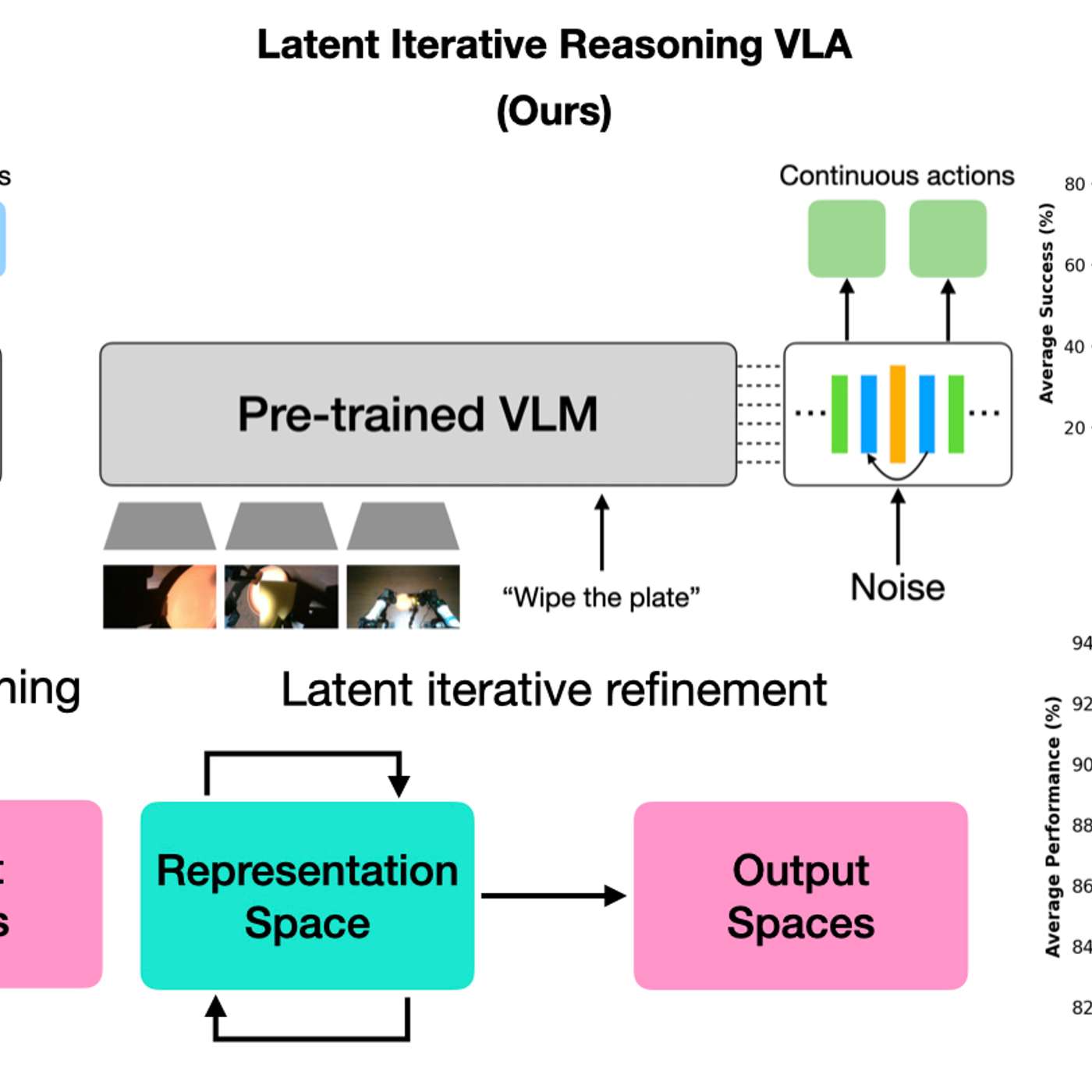
A new model architecture allows robots to vary their internal 'thinking' iterations at test time. This lets practitioners trade response speed for decision accuracy on a case-by-case basis, boosting performance on complex tasks without needing to retrain the model.
Autoregressive models must complete an output before it can be evaluated against constraints. Diffusion's iterative, coarse-to-fine process allows for applying reward functions or constraints *during* generation, enabling more precise control and alignment.

The adoption of powerful AI architectures like transformers in robotics was bottlenecked by data quality, not algorithmic invention. Only after data collection methods improved to capture more dexterous, high-fidelity human actions did these advanced models become effective, reversing the typical 'algorithm-first' narrative of AI progress.
Robotic World Action Models output predicted future visual states before executing physical movements. Generating representations of future world states serves as visual reasoning in physics space, guiding precise actions and improving generalization in unfamiliar environments.
The model is explicitly positioned for applicability in robotics and physical AI, far beyond simple creative media. Its capability to generate diverse, physically plausible action sequences suggests a long-term vision to function as a 'world simulation' engine for training reinforcement learning models, targeting industrial and research markets.

Unlike older robots requiring precise maps and trajectory calculations, new robots use internet-scale common sense and learn motion by mimicking humans or simulations. This combination has “wiped the slate clean” for what is possible in the field.

Unlike text agents that tolerate multi-second latency, embodied agents handling real-world objects cannot wait on cloud inference without risking physical failure or safety hazards. Deployments require training large models and distilling them down for local execution.
Programming is not a linear, left-to-right task; developers constantly check bidirectional dependencies. Transformers' sequential reasoning is a poor match. Diffusion models, which can refine different parts of code simultaneously, offer a more natural and potentially superior architecture for coding tasks.