Get your free personalized podcast brief
We scan new podcasts and send you the top 5 insights daily.
Separating robotic autonomy into a high-level reasoning model (like Gemini Robotics ER) and a low-level vision-language-action (VLA) policy causes practical bottlenecks. Beyond the communication and processing latency of reasoning models, sequential multi-step tasks suffer from compounded errors where the success rates of both models multiply across every handoff, creating compounding failure points during execution.

Related Insights
AI models struggle to plan at different levels of abstraction simultaneously. They can't easily move from a high-level goal to a detailed task and then back up to adjust the high-level plan if the detail is blocked, a key aspect of human reasoning.

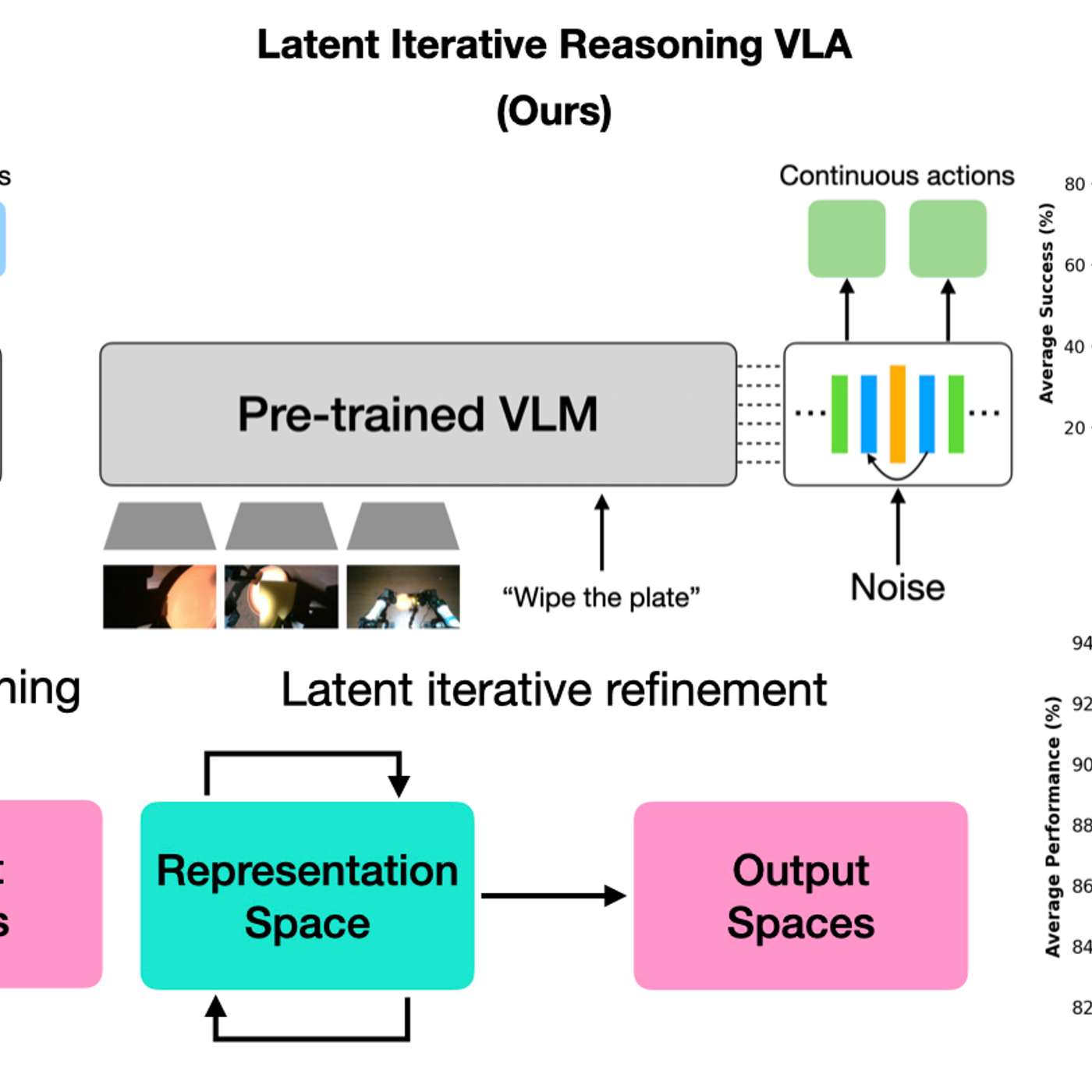
While letting a robot 'think' longer improves decision accuracy in lab tests, this added latency poses a significant risk in the real world. If the environment changes during the robot's reasoning period, its final decision may be outdated and dangerous, questioning its practical deployability.
Unlike traditional software that fails with clear errors, multi-agent systems can fail silently. A series of individually logical actions, based on slightly stale or incomplete context, can compound into a significant error that is only obvious when replaying the entire sequence of events.

Robotic intelligence has two components. "Reasoning," which involves creating a plan, is quickly being solved by AI. The other, harder part is "movement"—the robot's physical dexterity to execute that plan reliably in a complex environment without tripping or failing.

The main risk to humanoid robotics adoption isn't a lack of impressive capabilities, but the failure to achieve near-perfect reliability. Unlike an LLM where a human can simply re-prompt, a robot's value is in its autonomy. Bridging the gap from 95% to 100% reliability for autonomous tasks is the critical, unsolved challenge.

The popular cost-saving strategy of using a cheap AI to route tasks to a smarter AI is backwards. A 'dumb' model cannot reliably know what it doesn't know, making it a poor judge of when to escalate. The logically sound but more expensive approach is for a smart model to delegate tasks downward.
Robots have become so capable at low-level physical tasks that the primary bottleneck has shifted to "mid-level reasoning"—interpreting a scene and choosing the correct next action. This means improvement can come from high-level language-based coaching, not just more physical demonstration data, which is a major breakthrough.
![Sergey Levine - Building LLMs for the Physical World - [Invest Like the Best, EP.465] thumbnail](https://megaphone.imgix.net/podcasts/fdcd4328-2c77-11f1-a72b-977309fd08f1/image/b1bb4368d6e13a4a804924681ffe3ab1.jpg?ixlib=rails-4.3.1&max-w=3000&max-h=3000&fit=crop&auto=format,compress)
Building production AI agents by patching together incompatible models for speech, retrieval, and safety creates significant integration challenges. These 'Frankenstein stacks' lead to compounded latency, accuracy degradation between components, and weak, bolt-on security, which are the primary causes of failure in real-world applications, not reasoning errors.
For AI agents performing multi-step tasks, the ability to recognize, step back, and correct a mistake is arguably more critical for reliability than initial accuracy. While humans also make errors, our ability to backtrack is essential for completing complex, sequential objectives. This error-correction capability is a key feature of advanced reasoning models.

Current AI world models suffer from compounding errors in long-term planning, where small inaccuracies become catastrophic over many steps. Demis Hassabis suggests hierarchical planning—operating at different levels of temporal abstraction—is a promising solution to mitigate this issue by reducing the number of sequential steps.
