Simon Eskildsen told his first investor that he'd return the money if the company didn't find product-market fit within a year. This extreme transparency, while unconventional, was seen as a sign of deep commitment and integrity, ultimately winning the investor's trust.
Truly massive database companies only emerge every ~15 years when three conditions are met: a new ubiquitous workload (like AI), a new underlying storage architecture that predecessors can't adopt (like NVMe SSDs and S3), and a long-term roadmap to handle all possible data queries.
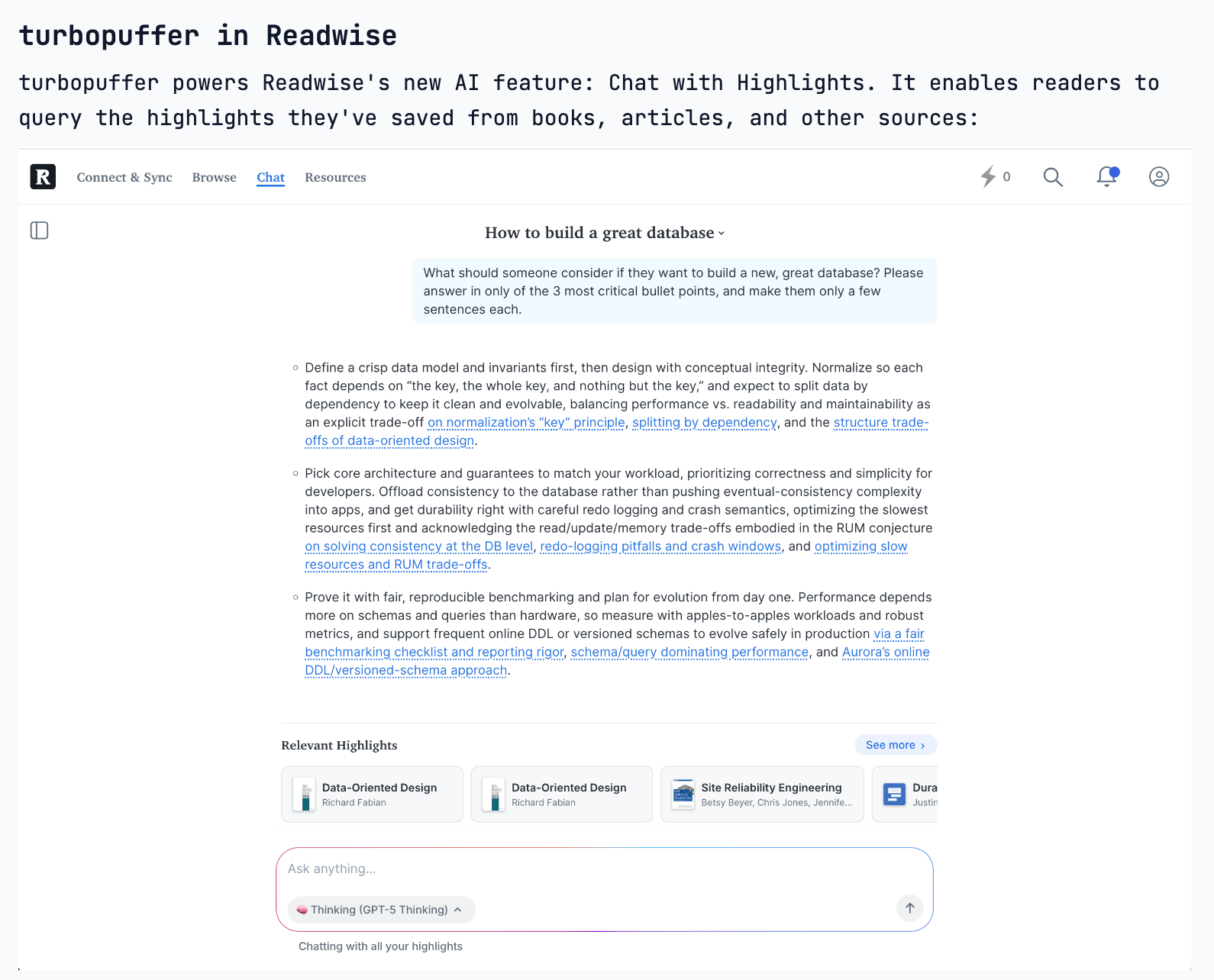
The idea for Turbopuffer originated when its founder calculated that adding an embedding-based feature to Readwise would cost $30k/month, a 6x increase in their total infra bill. This single data point revealed a clear market need for a drastically cheaper vector search solution.
Turbopuffer's design avoids a complex consensus layer (like Zookeeper) by relying on two recent cloud primitive upgrades: S3's strong consistency (post-2020) and a compare-and-swap feature for metadata updates. This creates a simpler, more robust, and stateless system.
To serve Notion on AWS while its core infra was on GCP, Turbopuffer bought dark fiber to reduce cross-cloud latency. This extreme measure was preferable to compromising their core architectural principle of avoiding a stateful consensus layer, showcasing deep product conviction.
The nature of Retrieval-Augmented Generation (RAG) is evolving. Instead of a single search to populate an initial context window, AI agents are now performing numerous concurrent queries in a single turn. This allows them to explore diverse information paths simultaneously, driving new database requirements.
Early on, the founder ran Turbopuffer's cloud infrastructure on his personal credit card. When a large customer's usage bill skyrocketed, the immense financial pressure forced the team to optimize relentlessly, leading them to become profitable out of necessity rather than strategy.
Despite building a database, Turbopuffer chose a generalist investor over domain experts. The founders already had deep technical knowledge; they valued help with acquiring customers and candidates more, areas where a well-connected generalist provided more value than redundant technical advice.
To maintain an exceptionally high talent density, Turbopuffer's hiring process defaults to rejecting a candidate. An offer is only considered if at least one interviewer is willing to passionately "fight" for them, shifting the burden of proof from "why not hire" to "why we must hire."
High-agency engineering is defined as the relentless process of making software perform closer to its theoretical limits, as calculated by first-principles "napkin math." Elite engineers systematically eliminate bottlenecks until the observed performance matches the theoretical maximum.
While the long-term vision for a major database is to support every query plan, the only sustainable advantage for a startup is focus. The founder explicitly states their biggest risk is overeagerness and that they will regret trying to do too much, not too little.