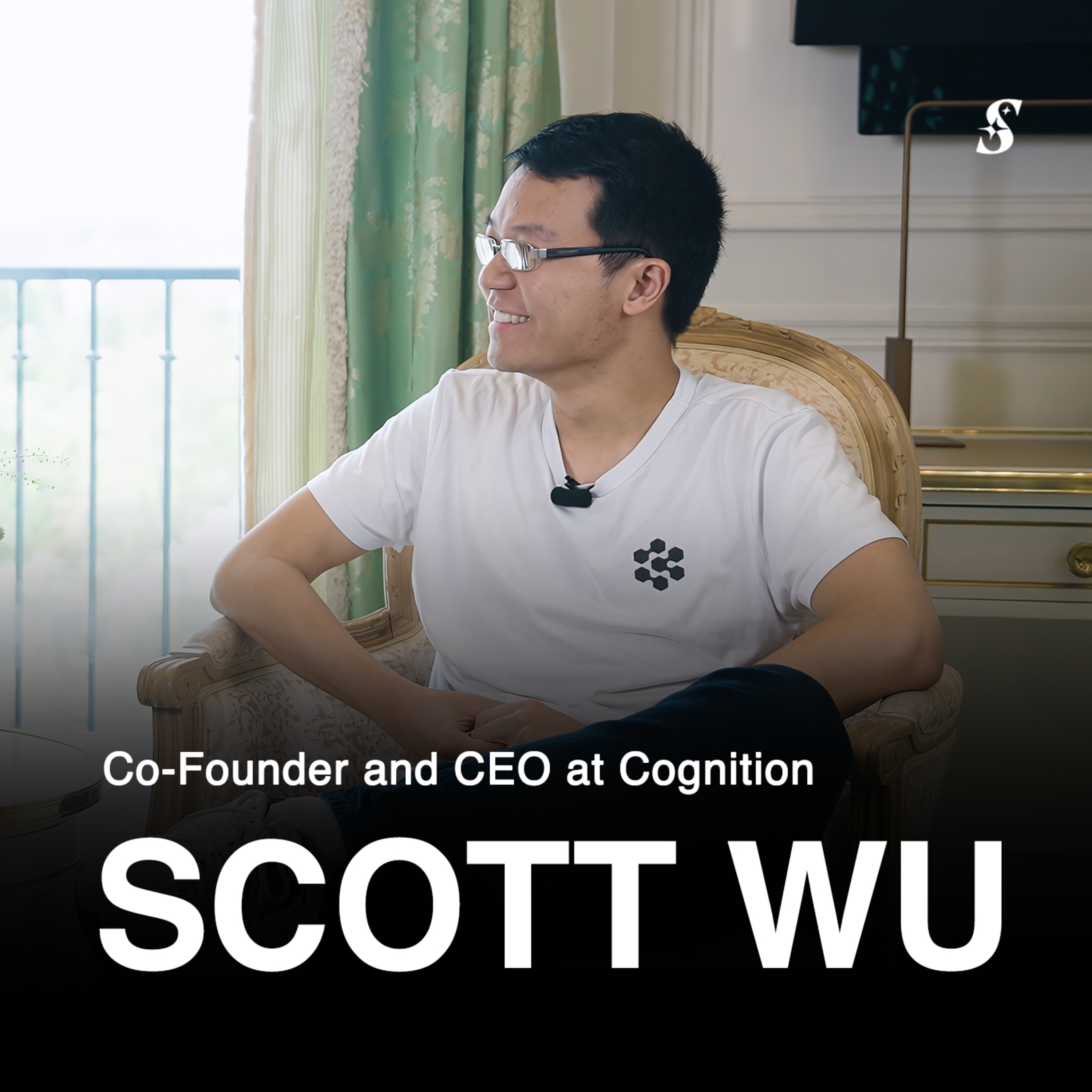
Instead of forcing a rapid, top-down integration of Windsurf's IDE, Cognition adopted a gradual approach. They let natural product evolution and overlapping user needs pull the two products together over time, avoiding disruption and ensuring the final integrated product genuinely solved user problems.
Cognition intentionally remains independent from major AI labs (like OpenAI, Google, Anthropic) to offer a model-neutral platform. This strategy reassures enterprise customers who want long-term partnerships without being locked into a single, potentially superseded, AI model ecosystem, providing flexibility and future-proofing.
Scott Wu argues that focusing on AI's ability to make existing work more efficient misses the point. The real transformation comes from creating new capacity—enabling the development of things previously impossible, like "single-use software" or "self-driving software," fundamentally changing what businesses can build.
Cognition's early hiring strategy deliberately targeted former founders, resulting in over half its initial team having prior startup experience. This created a culture of ambition, entrepreneurial spirit, and first-principles thinking, which was crucial for tackling complex challenges like M&A and rapid scaling.
The "aha" moment for Devin, Cognition's AI engineer, wasn't a theoretical exercise but a practical one: a co-founder got stuck setting up MongoDB. The agent's ability to diagnose and fix the complex, real-world issue proved the concept's viability, showing that breakthrough innovation often starts with solving your own problems.
CEO Scott Wu dismisses "literal tokens" as a vanity metric for AI productivity. Instead, Cognition measures the impact of its AI agent, Devin, by tracking core business KPIs and customer outcomes. This shifts the focus from raw output to tangible business value and ROI.
Scott Wu identifies government as a massive, underserved market for AI-driven software development. He views agencies as having the greatest need for engineering resources to overcome archaic software and processes. This positions government modernization not just as a business opportunity but as a crucial policy imperative.
Cognition demonstrated extreme agility by initiating contact on a Friday evening and finalizing the acquisition of Windsurf by Monday morning. This rapid, decisive action secured a key asset, including an enterprise go-to-market team and a complementary IDE product, showcasing a strong bias for action in M&A.