Get your free personalized podcast brief
We scan new podcasts and send you the top 5 insights daily.
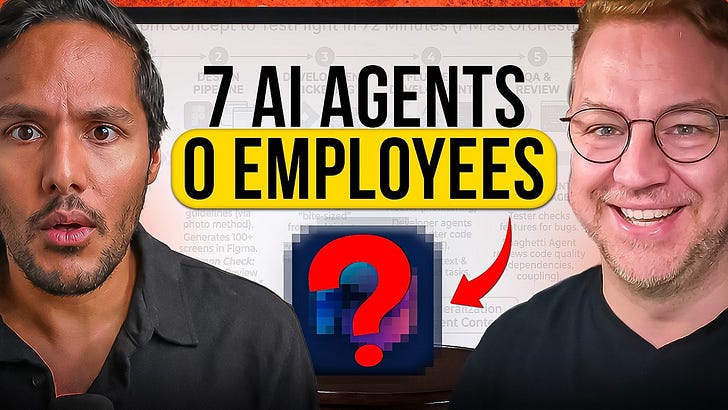
Before assigning a task, Gabor prompts the LLM to define the characteristics of a 'good' versus a 'bad' system analyst. He then instructs it to embody the 'good' persona, a meta-prompting technique that dramatically improves the quality of the AI's output and alignment.
Related Insights
Frame your interaction with AI as if you're onboarding a new employee. Providing deep context, clear expectations, and even a mental "salary" forces you to take the task seriously, leading to vastly superior outputs compared to casual prompting.

Effective prompt engineering for AI agents isn't an unstructured art. A robust prompt clearly defines the agent's persona ('Role'), gives specific, bracketed commands for external inputs ('Instructions'), and sets boundaries on behavior ('Guardrails'). This structure signals advanced AI literacy to interviewers and collaborators.

Instead of manually crafting a system prompt, feed an LLM multiple "golden conversation" examples. Then, ask the LLM to analyze these examples and generate a system prompt that would produce similar conversational flows. This reverses the typical prompt engineering process, letting the ideal output define the instructions.
Before delegating a complex task, use a simple prompt to have a context-aware system generate a more detailed and effective prompt. This "prompt-for-a-prompt" workflow adds necessary detail and structure, significantly improving the agent's success rate and saving rework.

Instead of immediately asking an AI to perform a complex task, first prompt it to create a functional spec or a sequential plan. Go back and forth to align on this plan before instructing it to execute, which significantly improves the final output's quality and relevance.

Move beyond simple prompts by designing detailed interactions with specific AI personas, like a "critic" or a "big thinker." This allows teams to debate concepts back and forth, transforming AI from a task automator into a true thought partner that amplifies rigor.

To create a highly personalized agent, don't just write its personality file. Instead, ask the new agent to generate a questionnaire about your goals, then answer its questions to give it deep, specific context for its own setup.
When a prompt yields poor results, use a meta-prompting technique. Feed the failing prompt back to the AI, describe the incorrect output, specify the desired outcome, and explicitly grant it permission to rewrite, add, or delete. The AI will then debug and improve its own instructions.

Don't just give AI a task; give it a job title. Prompting it to act as a "calorie tracker" or "critical mentor" transforms generic advice into personalized, role-specific guidance that actively helps you achieve your goal, rather than just providing abstract information.
AI models often default to being agreeable (sycophancy), which limits their value as a thought partner. To get valuable, critical feedback, users must explicitly instruct the AI in their prompt to take on a specific persona, such as a skeptic or a harsh editor, to challenge their ideas.
