Get your free personalized podcast brief
We scan new podcasts and send you the top 5 insights daily.
Don't repeat the industry's mistakes. An AI model can act as a collective memory, learning from every historical success and failure. By causally linking the early signals in a current program to the known outcomes of past trials, leaders can make go/no-go portfolio decisions based on data, not just intuition.

Related Insights
By digitizing 94 years of internal research, Capital Group uses AI to analyze an individual investor's own historical decisions. It identifies past mistakes made in similar market conditions, providing personalized insights to prevent repeating errors and mitigate behavioral biases.

AI's primary value in pre-buy research isn't just accelerating diligence on promising ideas. It's about rapidly surfacing deal-breakers—like misaligned management incentives or existential risks—allowing analysts to discard flawed theses much earlier in the process and focus their deep research time more effectively.
![How Investors are using AI - [Business Breakdowns, EP.240] thumbnail](https://megaphone.imgix.net/podcasts/f879fb14-024c-11f1-9c47-7bea8da34fd0/image/56ffcbcc6e03475c408ac0e35a01510d.jpg?ixlib=rails-4.3.1&max-w=3000&max-h=3000&fit=crop&auto=format,compress)
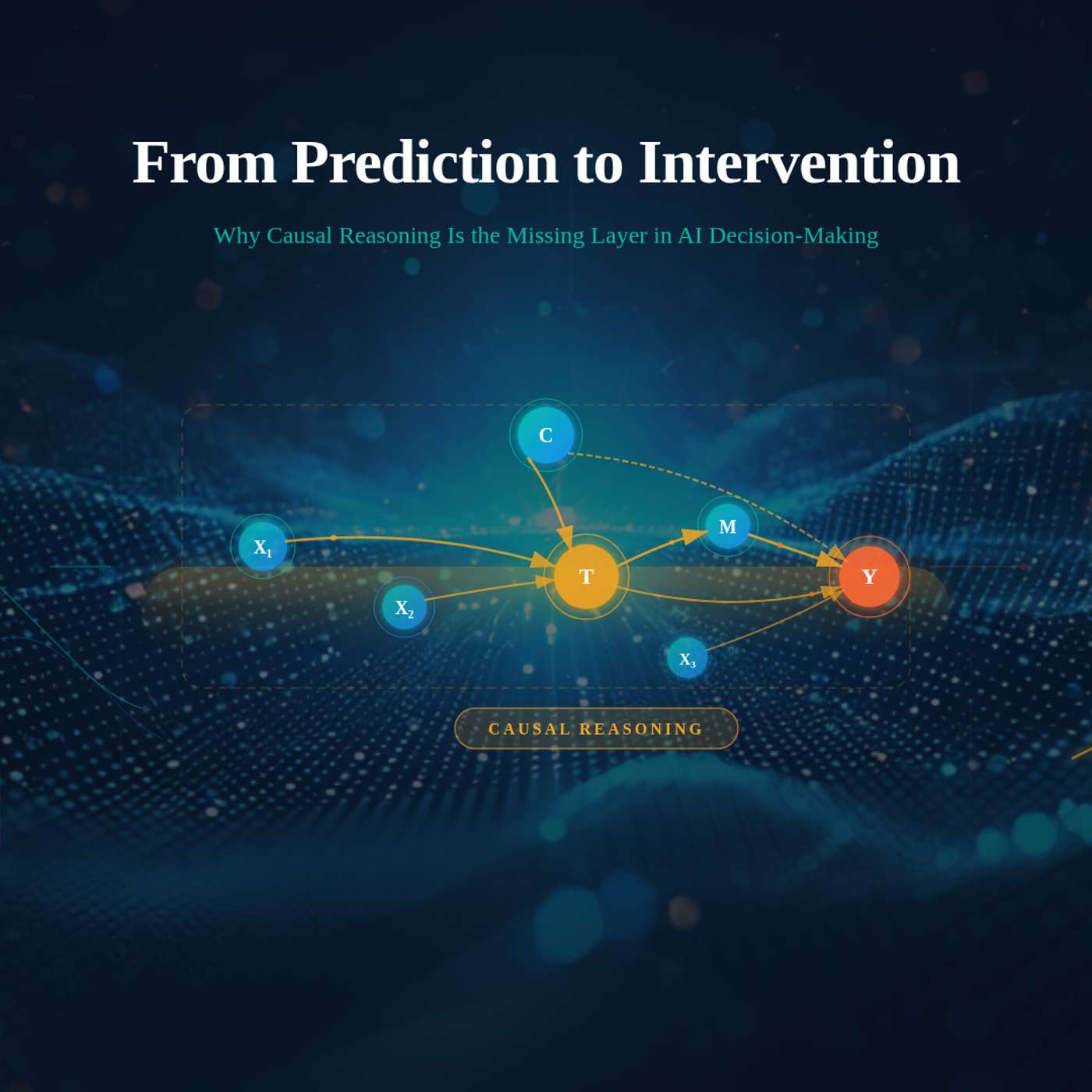
An estimated 80% of companies fail to scale their AI initiatives because they are caught in a 'prediction trap.' Their models produce accurate forecasts but do not support or inform actual business decisions, rendering them commercially ineffective. Causal reasoning is positioned as the solution to bridge this gap from prediction to actionable intelligence.
Venture capitalists will leverage AI by meticulously documenting their reasoning for each investment decision in "pre-mortems." This structured data will train personalized models to identify biases, surface blind spots, and cross-examine future decisions against their own track record.

Predictive models often mistake correlation for causation, leading to poor decisions. For example, a model might link marketing spend to revenue, but causal analysis can reveal that customer seasonality is the true cause of both. This deeper understanding prevents wasteful investments based on misleading correlations.
Unlike humans who can prune irrelevant information, an AI agent's context window is its reality. If a past mistake is still in its context, it may see it as a valid example and repeat it. This makes intelligent context pruning a critical, unsolved challenge for agent reliability.
Venture firms are building their own small language models trained on internal meeting notes and application data. This allows them to retroactively analyze deals they passed on to refine their investment thesis and identify companies for potential late-stage investments.

By digitizing its 94-year library of proprietary research, Capital Group enables its investors to use AI for behavioral self-analysis. An investor can query the system to identify what mistakes they personally made in past market cycles with similar conditions, helping them avoid repeating errors.

An AI use case for document analysis that failed for PPAC Bank in 2023 became a core part of their strategy when re-attempted months later. This shows that "it didn't work" is a temporary state. Teams should maintain a backlog of failed projects to revisit as model capabilities improve.

Advent created an AI trained on its entire investment history, including deals they passed on. This 'IC Robot' analyzes new proposals and flags assumptions—like margin growth—that deviate from historical precedent, serving as a powerful, data-driven check on the investment committee's biases.
