Get your free personalized podcast brief
We scan new podcasts and send you the top 5 insights daily.
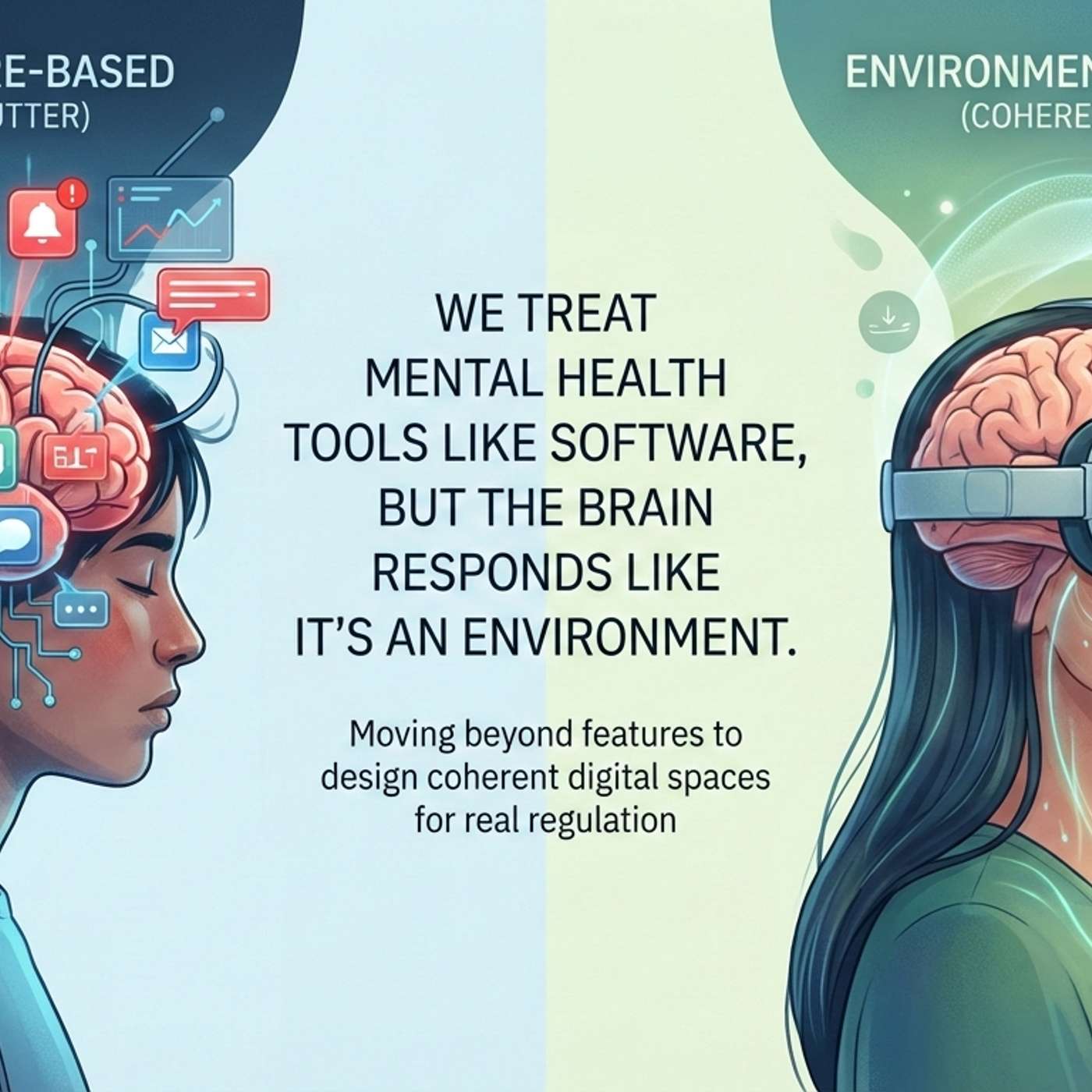
The brain perceives digital products as environments, not isolated features. A calming feature within a fragmented, attention-hungry app will fail because the surrounding context constantly pulls the nervous system into stress. The 'container' is more critical for lasting results than the specific intervention or content.
Related Insights
Effective recovery from burnout or stress requires restoring a sense of self, not just managing symptoms. Most apps focus on tasks and interventions, which can reinforce a user's feeling of disconnection. Lasting change happens when a digital environment supports a user's self-continuity, rather than treating them as an operator completing exercises.
Designs like Charlie Munger's windowless "Dormzilla" embody a tech-centric focus on minimizing distractions to maximize output. This philosophy directly contradicts architectural research showing that varied, aesthetically pleasing environments can reduce stress, highlighting a fundamental tension between productivity culture and human well-being.

Tech culture incorrectly equates sensory immersion with therapeutic impact. High intensity can overwhelm the nervous system, causing fatigue or dissociation, even with positive content. The goal of immersive tech in mental health should be to orient the user and create predictability, not to 'impress' them, as the nervous system benefits from orientation, not just stimulation.
The mental load of managing and switching between a vast number of applications causes more exhaustion than the sheer volume of notifications. The daily 57 minutes spent switching apps and 30 minutes deciding which tool to use for a task creates significant decision fatigue.

A smartphone is a uniquely challenging environment because it acts as a single context for dozens of competing habits—work, social media, games, and news. This blending of cues makes it incredibly difficult to focus on productive tasks, as your brain is simultaneously being primed for distraction.

Constant switching between digital apps and tasks drains finite cognitive and emotional energy, similar to how a battery loses its charge. This cognitive depletion is a physical process based on how the brain consumes energy, not a sign of personal weakness or laziness.
Modern digital platforms are not merely distracting; they are specifically engineered to keep users in a state of agitation or outrage. This emotional manipulation is a core mechanism for maintaining engagement, making mindfulness a crucial counter-skill for mental well-being in the modern era.

The common feeling of needing to 'detox' from a phone or computer is a sign of a broken user relationship. Unlike a sofa, we can't simply replace it. This aversion stems from devices being filled with applications whose incentives are not aligned with our well-being, a problem AI will amplify.

The current trend of building huge, generalist AI systems is fundamentally mismatched for specialized applications like mental health. A more tailored, participatory design process is needed instead of assuming the default chatbot interface is the correct answer.
Sam Harris argues that demonizing the smartphone is a mistake. The key distinction is between apps that shatter attention (social media) and those that unify it (podcasts, audiobooks, meditation). The device itself is neutral; the application's effect on focus is what matters for mental well-being.