Get your free personalized podcast brief
We scan new podcasts and send you the top 5 insights daily.
Charlie Munger's advice to "introduce randomness" means deliberately placing yourself in unfamiliar situations. This breaks you out of echo chambers and creates opportunities for serendipity and breakthrough ideas, such as a tech founder getting a multi-million dollar idea at a farmers' conference.

Related Insights
To rediscover the curiosity needed for work, practice it in low-stakes daily life. Take a different route to work, order a coffee you'd never choose, or read a different genre of book. Consciously observing how these novel experiences feel primes your brain to question assumptions and see new possibilities in your professional environment.

Consistently staying in a home office or car between calls limits random, career-advancing encounters. Intentionally visiting new physical spaces—like coffee shops or community events—creates opportunities for the "accidents" that lead to valuable connections and business.

Breakthroughs often occur in routine environments like the shower or during a walk. These activities promote what psychologists call "divergent thinking," where the relaxed mind makes novel connections. This scientific process can be intentionally triggered to solve complex problems and foster creativity.

True innovation stems from cognitive and interest diversity. Pairing passionate people from disparate fields—like AI and cheese—sparks more creative conversations and breakthroughs than grouping people with similar interests, which merely creates an echo chamber.

When entrepreneurs become too successful and comfortable, they lose their ability to spot common problems. Purposefully choosing to experience everyday friction, like commercial air travel, keeps the 'problem-spotting' senses sharp and is a key source for new business ideas.
To avoid narrow, left-brain thinking, investors should pursue diverse interests outside of finance. Hobbies like studying wine or playing backgammon build right-brain pattern recognition and provide fresh analogies for portfolio construction and business analysis, ultimately making you a better investor.

You can systematically increase your luck by evaluating choices based on which one presents a wider range of potential positive outcomes. Opting for an unconventional seminar over a predictable night out is a bet on higher variance and a greater chance for a life-changing encounter.

While having a clear, formulaic professional identity (e.g., 'the B2B SaaS investor') helps with fundraising, being interesting and unlabelable attracts more serendipitous and potentially groundbreaking opportunities. People with diverse passions create a magnet for other interesting people and ideas.
Curiosity is an action, not just a mindset. Citing designer Issey Miyake, the speaker advises deliberately spending time with foreign concepts, people, and environments. True innovation comes from expanding your horizons beyond familiar patterns, not just passively claiming to be curious.
![What is Marketing? Part 2: Marketing is Poetry with Kory Marchisotto [Uncensored Renegades] thumbnail](https://img.transistorcdn.com/VIH3Rn5ET8-eHQxgBGNydnhXL95pc10_Kq7qTpjezuc/rs:fill:0:0:1/w:1400/h:1400/q:60/mb:500000/aHR0cHM6Ly9pbWct/dXBsb2FkLXByb2R1/Y3Rpb24udHJhbnNp/c3Rvci5mbS9zaG93/LzQ3MzEvMTU3MDAz/MjQ3NC1hcnR3b3Jr/LmpwZw.jpg)
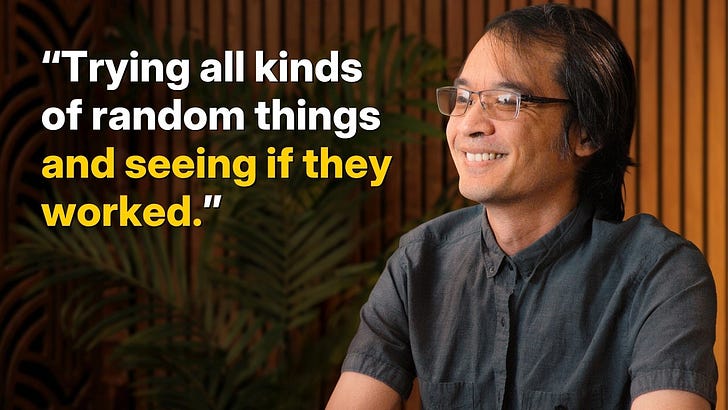
Terence Tao argues against hyper-optimizing one's time. Serendipitous interactions—like bumping into someone in a hallway or browsing a physical journal—spark new ideas. Over-scheduling and efficiency tools eliminate these random encounters, potentially stifling the unexpected connections that lead to breakthroughs.