Get your free personalized podcast brief
We scan new podcasts and send you the top 5 insights daily.
Unlike simple coding agents, a software factory orchestrates the entire development process from task kickoff in Slack to issue tracking, implementation, PR creation, and automated QA with video verification. It's a comprehensive, end-to-end system reflecting a team's specific workflow.

Related Insights
For AI to manage the software development process from idea to completion, the entire SDLC cannot be an unspoken or abstract set of habits. It must be explicitly documented with defined inputs, tasks, outputs, and quality gates that an AI agent can interpret and execute against.
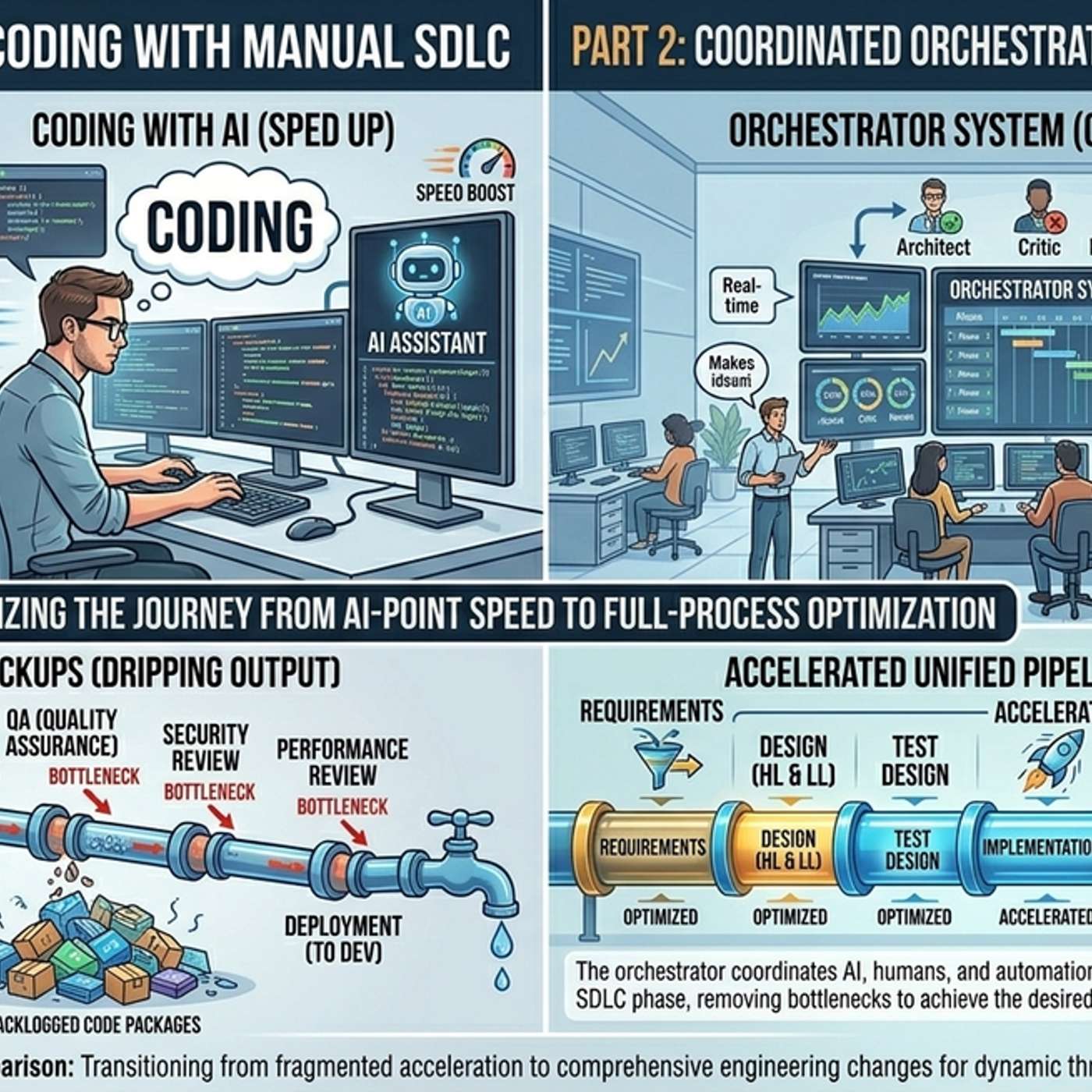
Klaviyo's internal "Dark Factory" system uses a team of agents to take a high-level prompt, decompose it into specs and engineering subsystems, write code, and establish API contracts. This automates the software toolchain, from prototyping to load testing, with minimal human intervention.

To achieve a state where AI agents handle nearly all coding, a solo founder must implement a surprisingly formal Software Development Lifecycle (SDLC), like one for a large team. This includes rigorous processes like mandatory Pull Requests (PRs), providing a structured system for agent-driven development.

A three-person team built a system where AI agents handle the entire software development lifecycle, from roadmap to deployment, without humans writing or reviewing code. The role of engineers shifts to managing the AI, with budgets allocated for AI tokens instead of traditional resources.

The endgame for software development isn't just code completion, but an "AI factory." A chain of specialized agents will handle design, coding, review, and security. This requires an interoperable platform where different models can check each other's work, with humans as "agent managers."

Inspired by fully automated manufacturing, this approach mandates that no human ever writes or reviews code. AI agents handle the entire development lifecycle from spec to deployment, driven by the declining cost of tokens and increasingly capable models.

Go beyond single prompts by creating two automated loops: a 'build loop' that codes tasks and a 'review loop' where another agent refines the code. The final human step is a simple approval, like a rocket emoji in Slack, which triggers an agent to merge the code.

Snowflake's CEO describes a shift to "spec-driven development," where engineers write English-language requirements and AI automates the coding, testing, and deployment. This transforms the entire software creation process, moving beyond simple code completion to full workflow automation.

Elicit's system, 'The Line,' automates the full software development lifecycle. It takes feature requests initiated by a Slack emoji, then handles speccing, implementation, video-based testing, code review, and merging to production, calling for human intervention only when necessary.

The current model of a developer using an AI assistant is like a craftsman with a power tool. The next evolution is "factory farming" code, where orchestrated multi-agent systems manage the entire development lifecycle—planning, implementation, review, and testing—moving it from a craft to an industrial process.
