Get your free personalized podcast brief
We scan new podcasts and send you the top 5 insights daily.
A high production rate is a core R&D tool for SpaceX, not just a manufacturing goal. By creating a "hardware rich" environment with abundant, cheaper prototypes, it enables an aggressive build-test-learn cycle. Failure becomes a low-cost data-gathering exercise, not a catastrophic setback.

Related Insights
Boom's founder describes Mojave's aerospace community as "hacking on airplanes" like software. This mindset involves resourceful, rapid, and iterative prototyping, challenging the slow, traditional processes in capital-intensive industries and enabling faster progress with less capital.

Not all failures are equal. Innovation teams must adopt a framework for evaluating failures based on their cost-to-learning ratio. A 'brilliant failure' maximizes learning while minimizing cost, making it a productive part of R&D. An 'epic failure' spends heavily but yields little insight, representing a true loss.

While competitors analyze exhaustively before building, SpaceX invests upfront in prototypes to discover problems that analysis can't predict. This treats reality as the primary validation tool, using failures as data points to eliminate uncertainty through doing, not just planning.
SpaceX manages its aggressive "fail fast" culture by creating distinct risk profiles. Development projects like Starship are intentionally pushed to failure for learning. In contrast, operational, human-rated systems like Dragon are built with massive safety margins and exhaustive, conservative testing.
A key lesson from SpaceX is its aggressive design philosophy of questioning every requirement to delete parts and processes. Every component removed also removes a potential failure mode, simplifies the system, and speeds up assembly. This simple but powerful principle is core to building reliable and efficient hardware.

For ambitious 'moonshot' projects, the vast majority of time and effort (90%) is spent on learning, exploration, and discovering the right thing to build. The actual construction is a small fraction (10%) of the total work. This reframes failure as a critical and expected part of the learning process.

SpaceX's success isn't from one tactic but a reinforcing system. First principles identify waste in cost, vertical integration provides the control to eliminate it, and standardization creates the volume needed to make that control profitable. Removing any one part breaks the system.
Boom Supersonic accelerates development by manufacturing its own parts. This shrinks the iteration cycle for a component like a turbine blade from 6-9 months (via an external supplier) to just 24 hours. This rapid feedback loop liberates engineers from "analysis paralysis" and allows them to move faster.

Moving from a science-focused research phase to building physical technology demonstrators is critical. The sooner a deep tech company does this, the faster it uncovers new real-world challenges, creates tangible proof for investors and customers, and fosters a culture of building, not just researching.

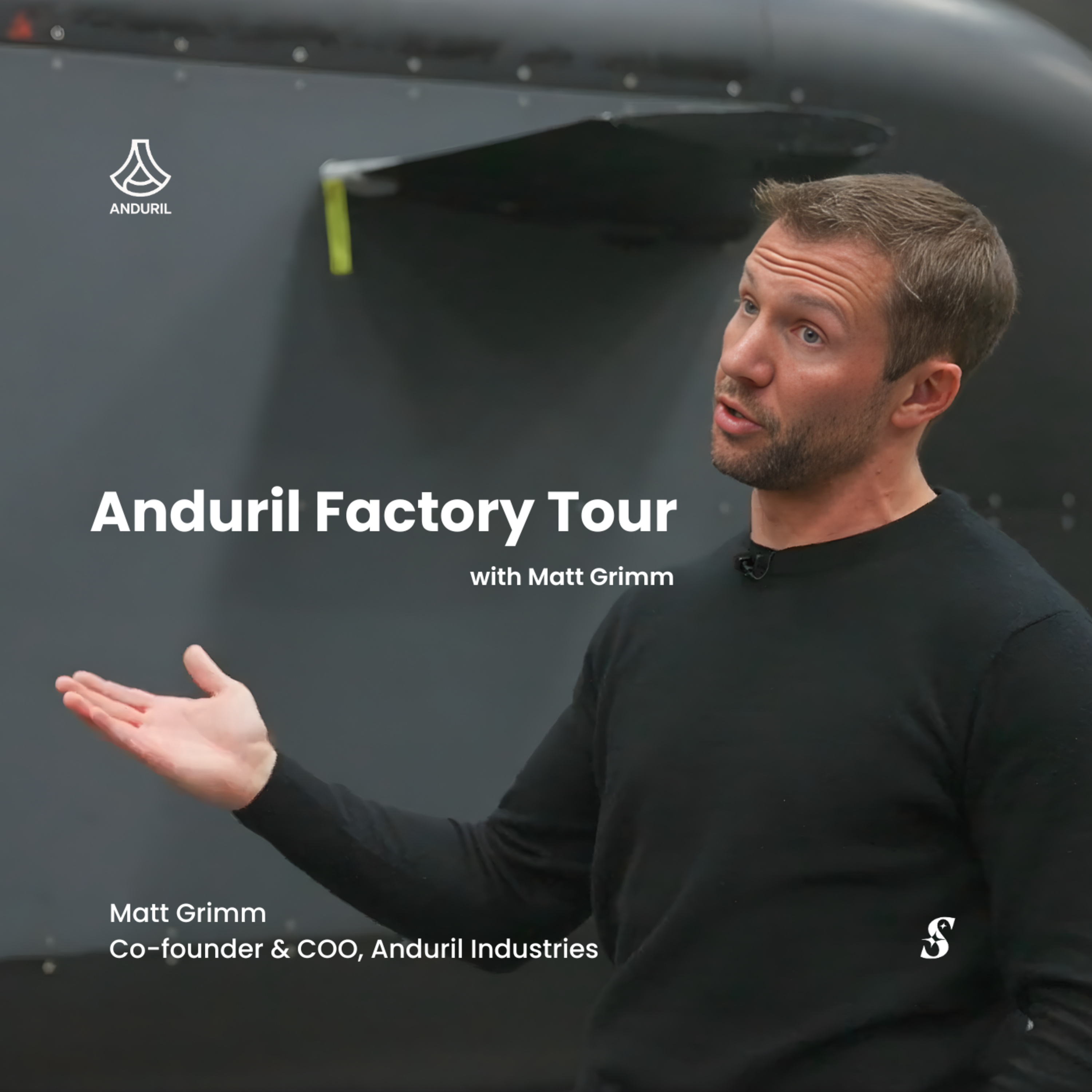
Anduril's R&D building houses machine shops, labs, and a 'dev test area' designed specifically to break products. By putting engineers across the parking lot from facilities that can rapidly prototype and test for failures (e.g., saltwater corrosion, vibration), they create an extremely tight feedback loop, speeding up iteration.