Get your free personalized podcast brief
We scan new podcasts and send you the top 5 insights daily.
Manali emphasizes that CD20 expression must be reconfirmed by flow cytometry or IHC before any CD20 bispecific, because the drug cannot work without its target. In her case, a patient retained CD20 after CAR T and then received glofitamab, showing prior CAR T does not rule out bispecific therapy.

Related Insights
Not all CD20-targeting bispecifics can be combined with rituximab. Mosunetuzumab binds the same epitope, causing competition. However, glofitamab and epcoritamab bind different epitopes, allowing for logical and potentially synergistic combinations with rituximab-based regimens.
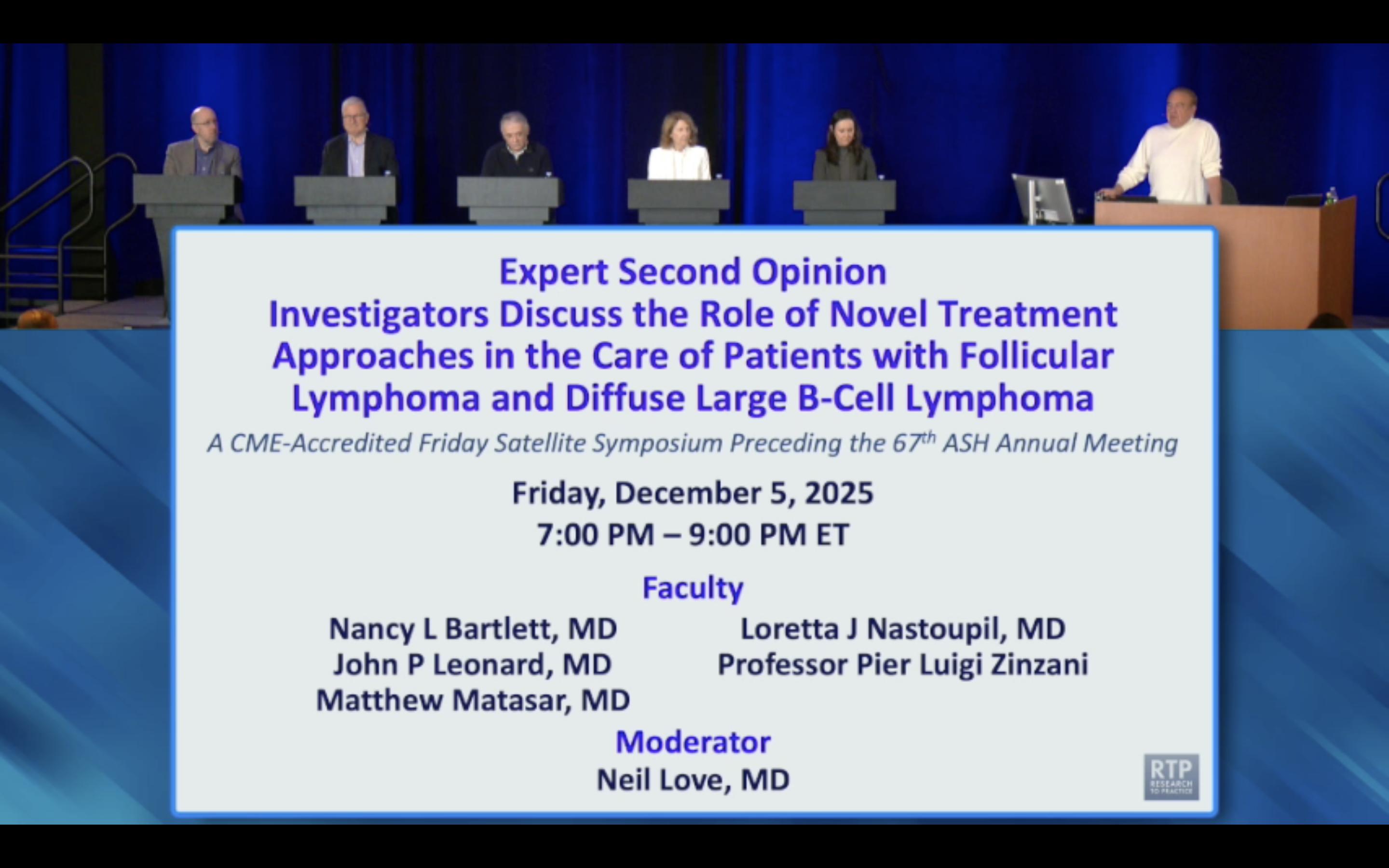
Manali says third-line DLBCL still favors CD19 CAR T when patients are eligible and CAR-naive, because about 40% have a flat five-year curve suggesting cure. Bispecifics show durable complete responses at three years, but follow-up is shorter. She sequences CAR T first, then a CD20 bispecific.
Target antigen loss or modulation on tumor surfaces is a frequent mechanism of resistance following CD19 CAR-T or CD20 bispecific antibody failure. Dr. Budde highlights that treating relapsed patients with further targeted therapy without a biopsy frequently leads to treatment failure, as tumors often become CD19- or CD20-negative. Re-biopsying is vital to confirm target presence before initiating next-line therapies.

Manali explains glofitamab binds the same CD20 epitope as obinutuzumab and had high CRS, so the label requires obinutuzumab seven days before the first step-up. Mosunetuzumab shares rituximab's epitope, meaning a mosunetuzumab-rituximab combination would compete for the same binding domain. That mechanistic detail shapes regimen design.
Using a BCMA bispecific antibody first can exhaust a patient's T-cells or cause tumors to lose the BCMA target, rendering a subsequent BCMA-targeted CAR-T therapy ineffective. The optimal sequence is CAR-T first, which preserves T-cell function and BCMA expression, leaving bispecifics as a viable later-line option.

Rather than viewing bispecific antibodies and CAR-T cell therapy as mutually exclusive, Dr. Budde uses bispecific combinations as an off-the-shelf bridging strategy. High tumor burden and refractory disease reduce CAR-T response rates; administering an initial truncated course of bispecific combinations debulks aggressive lymphoma into deep remissions before transitioning patients to single-infusion CAR-T to complete treatment.
Prior CAR T-cell therapy does not compromise the clinical efficacy of CD20 x CD3 bispecific antibodies in diffuse large B-cell lymphoma. In phase 2 trials, epcoritamab achieved a 36% complete remission rate in post-CAR T patients compared to 39% overall. Similarly, glofitumab demonstrated complete remission rates in patients with prior CAR T exposure comparable to those who were CAR T-naive, with durable remissions observed in both groups.
Before initiating a CD20-targeting bispecific antibody in patients who have failed CAR-T therapy, a new biopsy is mandatory. Up to 30% of these patients experience CD20 antigen loss, which would render the bispecific therapy ineffective and necessitates choosing a drug with a different target.
In heavily pretreated relapsed/refractory follicular lymphoma, it's crucial to perform a tumor biopsy to check for CD20 expression before choosing a CD20-targeting bispecific antibody. Prior treatments can lead to loss of the antigen, which would render the bispecific ineffective.

Because CD20 x CD3 bispecific antibodies require CD20 target engagement, antigen downregulation or loss is a primary resistance mechanism in patients experiencing early relapse. Dr. Elizabeth Budde highlights that verifying CD20 expression via repeat biopsy is clinically mandatory prior to initiating bispecific treatment or determining post-relapse therapy, ensuring the target antigen remains present on lymphoma cells.