Get your free personalized podcast brief
We scan new podcasts and send you the top 5 insights daily.
Rather than viewing bispecific antibodies and CAR-T cell therapy as mutually exclusive, Dr. Budde uses bispecific combinations as an off-the-shelf bridging strategy. High tumor burden and refractory disease reduce CAR-T response rates; administering an initial truncated course of bispecific combinations debulks aggressive lymphoma into deep remissions before transitioning patients to single-infusion CAR-T to complete treatment.

Related Insights
The LOTUS-7 trial (loncastuximab + glofitimab) illustrates a key principle for using bispecific antibodies safely: combining them with another active, tumor-debulking drug mitigates Cytokine Release Syndrome (CRS). The speaker identifies this as a "thematic" finding, where reducing tumor bulk directly lowers the risk of this major toxicity, making potent combinations more tolerable.
Combining the ADC Loncastuximab before a bispecific antibody may lower the bispecific's toxicity, potentially through a debulking effect. This surprising finding suggests a strategy to improve the tolerability and delivery of bispecifics, especially in community settings.

In follicular lymphoma, the treatment goal is durable remission with manageable toxicity, not necessarily a cure. Therefore, clinicians frequently prefer using a bispecific antibody first, reserving the more complex and toxic CAR-T cell therapy for transformed disease or after a bispecific fails.
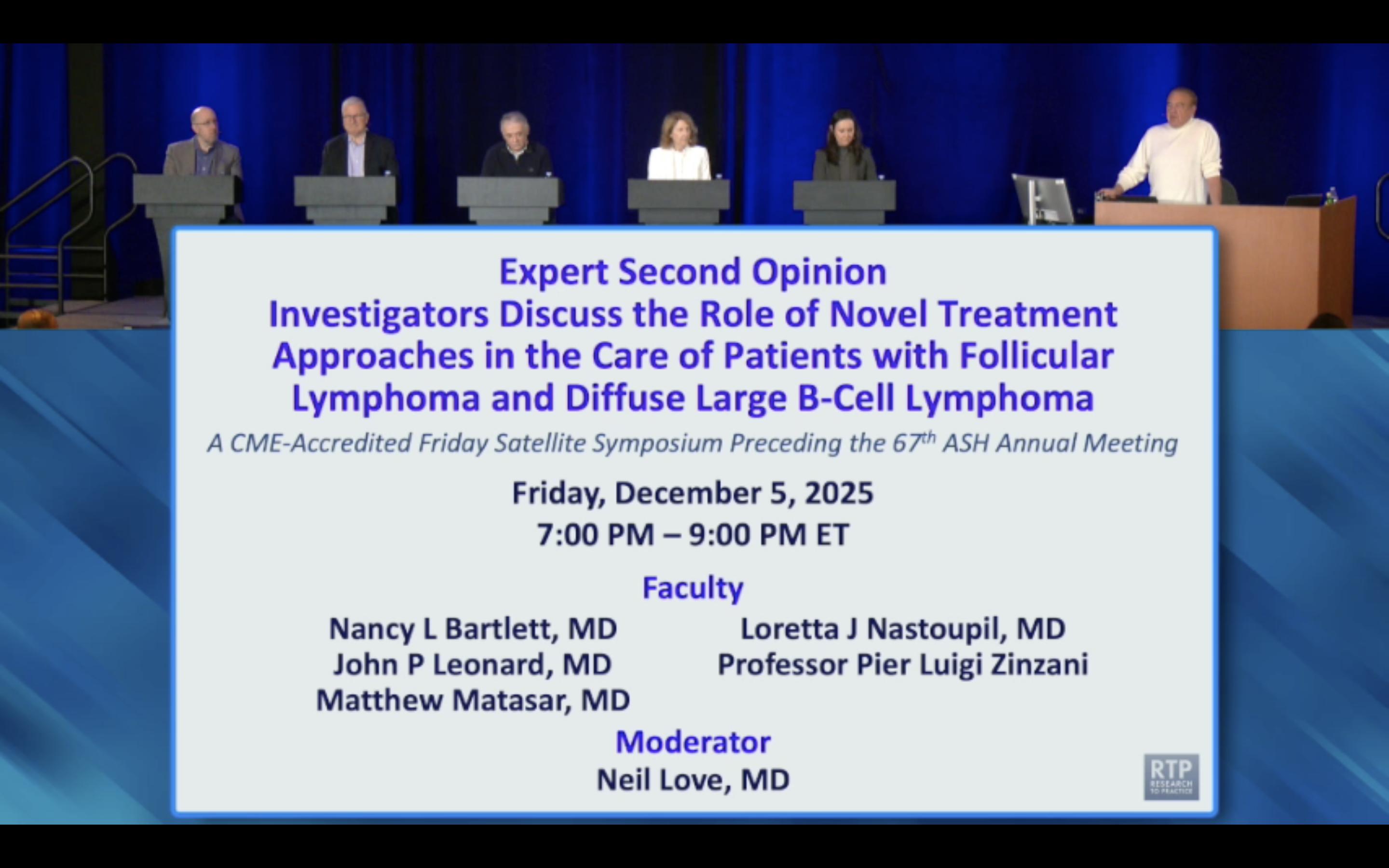
To mitigate the risk of severe Cytokine Release Syndrome (CRS) from bispecific antibodies in patients with high tumor burden, a debulking strategy is effective. Administering two initial cycles of chemotherapy dramatically reduces disease volume, leading to almost zero CRS when the bispecific is introduced, making the treatment much safer.
For DLBCL patients awaiting CAR-T cell therapy, particularly those with aggressive disease, bispecific antibodies are the preferred bridging strategy. This approach effectively controls disease and reduces tumor burden for better CAR-T outcomes, while avoiding the T-cell depleting effects of traditional chemotherapy.
Data from the MAJESTIC three trial shows bispecific antibodies achieving progression-free survival rates comparable to CAR-T therapy. This creates a new clinical dilemma, forcing a choice between an immediate, off-the-shelf option for rapid progression versus a one-time therapy with a longer track record, making treatment an individualized decision.

Using a BCMA bispecific antibody first can exhaust a patient's T-cells or cause tumors to lose the BCMA target, rendering a subsequent BCMA-targeted CAR-T therapy ineffective. The optimal sequence is CAR-T first, which preserves T-cell function and BCMA expression, leaving bispecifics as a viable later-line option.

Bispecific antibodies are "off-the-shelf" therapies with manageable side effects that don't require specialized manufacturing centers like CAR T. This allows community practices to administer highly effective T-cell redirecting therapies, equalizing access for patients far from major academic institutions.

Prior CAR T-cell therapy does not compromise the clinical efficacy of CD20 x CD3 bispecific antibodies in diffuse large B-cell lymphoma. In phase 2 trials, epcoritamab achieved a 36% complete remission rate in post-CAR T patients compared to 39% overall. Similarly, glofitumab demonstrated complete remission rates in patients with prior CAR T exposure comparable to those who were CAR T-naive, with durable remissions observed in both groups.
In relapsed/refractory mantle cell lymphoma, the bispecific antibody glofitimab is achieving complete remission rates above 75%. This is unprecedented and notably better than existing CAR-T therapy data, suggesting an accessible, off-the-shelf immunotherapy can outperform more complex cellular therapies in this setting.
