Get your free personalized podcast brief
We scan new podcasts and send you the top 5 insights daily.
To compensate for the lack of a human engineering team, create a multi-step review process with different LLMs. Use one model (e.g., Claude) to build, a second (e.g., Codex) to challenge and find flaws, and a third (e.g., GLM) for a final pull request review.

Related Insights
Relying on a single model family for generation and review is suboptimal. Blitzy found that using models from different developers (e.g., OpenAI, Anthropic) to check each other's work produces tremendously better results, as each family has distinct strengths and reasoning patterns.

Instead of relying on a single AI model, Josh Pigford's workflow uses Opus for initial code generation and then runs a review pass with a different powerful model like GPT. This adversarial, multi-model process consistently uncovers 3-5 bugs that the primary model overlooks.

Create a custom Claude Code skill that sends a spec or problem to multiple LLM APIs (e.g., ChatGPT, Gemini, Grok) simultaneously. This "council of AIs" provides diverse feedback, catching errors or omissions that a single model might miss, leading to more robust plans.
To overcome the challenge of reviewing AI-generated code, have different LLMs like Claude and Codex review the code. Then, use a "peer review" prompt that forces the primary LLM to defend its choices or fix the issues raised by its "peers." This adversarial process catches more bugs and improves overall code quality.

Prompting a different LLM model to review code generated by the first one provides a powerful, non-defensive critique. This "second opinion" can rapidly identify architectural issues, bugs, and alternative approaches without the human ego involved in traditional code reviews.

Solo developers can integrate AI tools like BugBot with GitHub to automatically review pull requests. These specialized AIs are trained to find security vulnerabilities and bugs that a solo builder might miss, providing a crucial safety net and peace of mind.

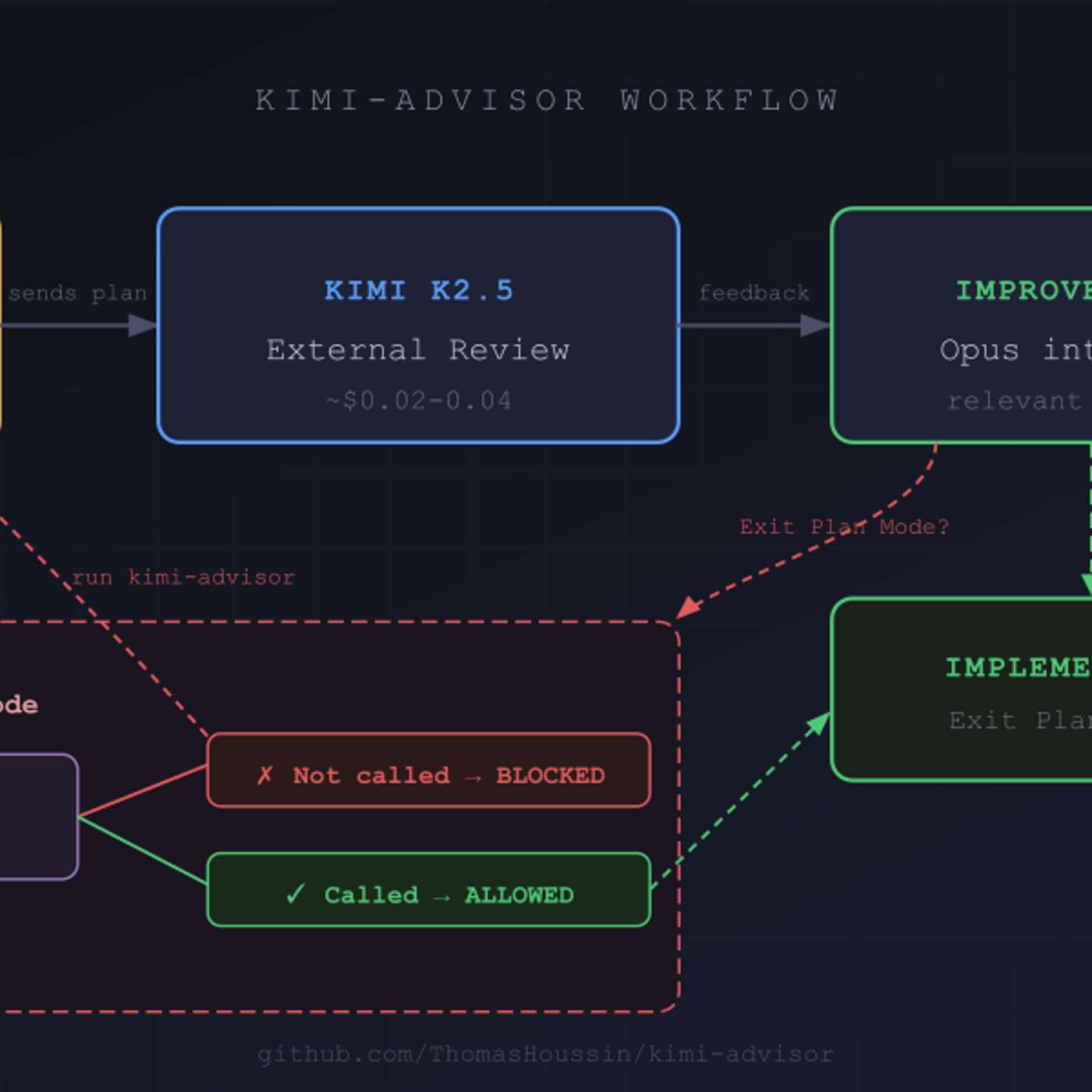
To improve code quality, use a secondary AI model from a different provider (e.g., Moonshot AI's Kimi) to review plans generated by a primary model (e.g., Anthropic's Claude). This introduces cognitive diversity and avoids the shared biases inherent in a single model family, leading to a more robust and enriching review process.
Define different agents (e.g., Designer, Engineer, Executive) with unique instructions and perspectives, then task them with reviewing a document in parallel. This generates diverse, structured feedback that mimics a real-world team review, surfacing potential issues from multiple viewpoints simultaneously.

Instead of a generic code review, use multiple AI agents with distinct personas (e.g., security expert, performance engineer, an opinionated developer like DHH). This simulates a diverse review panel, catching a wider range of potential issues and improvements.
Shopify's CTO argues against running many AI agents in parallel. A more effective, higher-quality method is a "critique loop," where one agent (ideally using a different model) reviews and suggests improvements to another's work. Though slower, this process significantly boosts code quality.