Get your free personalized podcast brief
We scan new podcasts and send you the top 5 insights daily.
While China's humanoid hardware demonstrates impressive locomotion in programmed tasks, the major obstacle to widespread deployment is the "robot brain." Current AI lacks the ability to autonomously navigate unpredictable, real-world environments, making massive data collection the current R&D focus.

Related Insights
According to Figure's CEO, the company's biggest challenge is no longer hardware reliability but acquiring enormous amounts of diverse, high-quality data. This data is essential for pre-training their Helix AI model to generalize and handle countless real-world scenarios in homes and commercial settings.
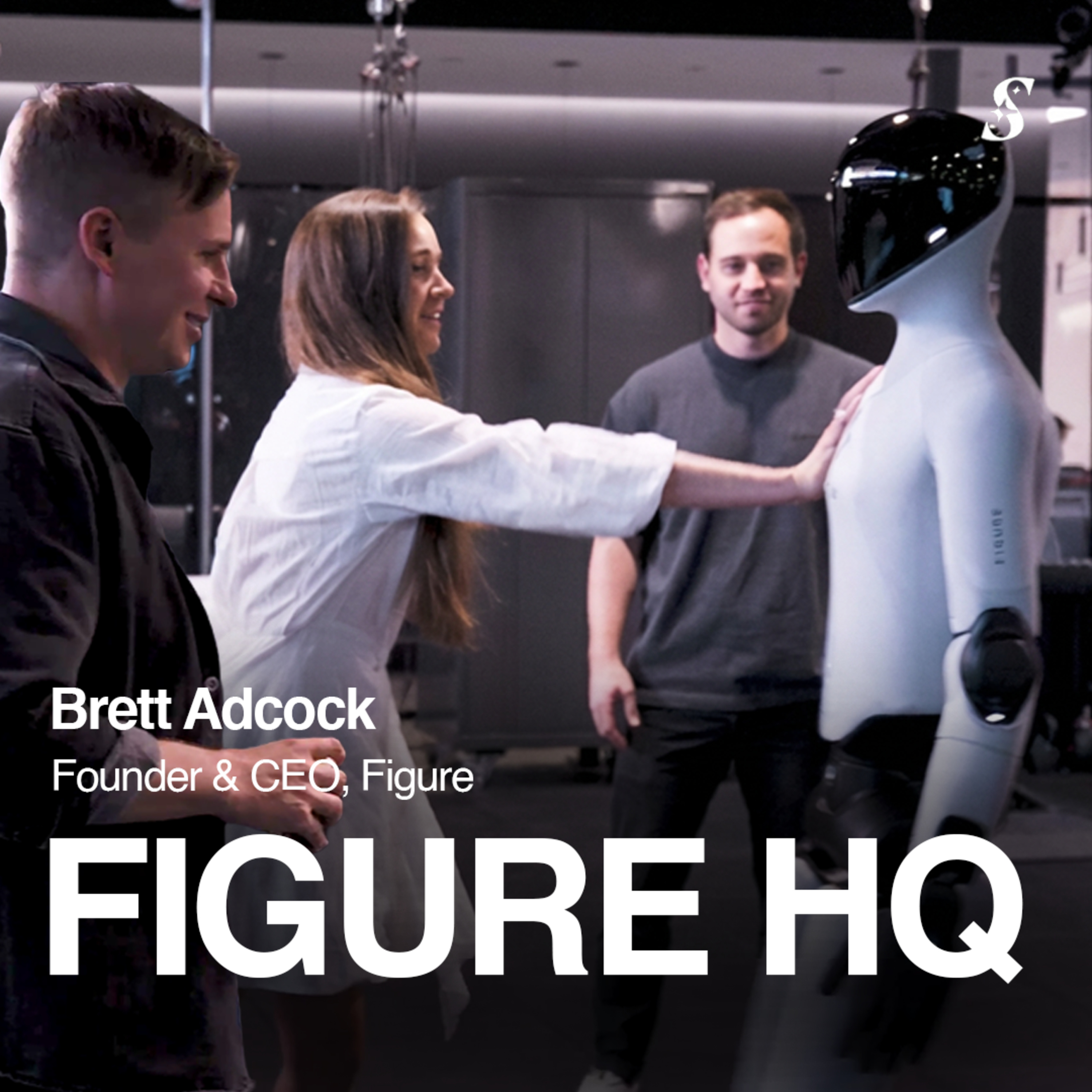
Contrary to popular belief, China is not ahead in the humanoid race. The current bottleneck is solving general-purpose AI and systems integration, not manufacturing at scale. In this domain, US companies are leading. Manufacturing humanoids is closer to consumer electronics than cars, mitigating China's automotive-style manufacturing advantages.

Progress in robotics for household tasks is limited by a scarcity of real-world training data, not mechanical engineering. Companies are now deploying capital-intensive "in-field" teams to collect multi-modal data from inside homes, capturing the complexity of mundane human activities to train more capable robots.

The adoption of powerful AI architectures like transformers in robotics was bottlenecked by data quality, not algorithmic invention. Only after data collection methods improved to capture more dexterous, high-fidelity human actions did these advanced models become effective, reversing the typical 'algorithm-first' narrative of AI progress.

Robotic intelligence has two components. "Reasoning," which involves creating a plan, is quickly being solved by AI. The other, harder part is "movement"—the robot's physical dexterity to execute that plan reliably in a complex environment without tripping or failing.

Robots have become so capable at low-level physical tasks that the primary bottleneck has shifted to "mid-level reasoning"—interpreting a scene and choosing the correct next action. This means improvement can come from high-level language-based coaching, not just more physical demonstration data, which is a major breakthrough.
![Sergey Levine - Building LLMs for the Physical World - [Invest Like the Best, EP.465] thumbnail](https://megaphone.imgix.net/podcasts/fdcd4328-2c77-11f1-a72b-977309fd08f1/image/b1bb4368d6e13a4a804924681ffe3ab1.jpg?ixlib=rails-4.3.1&max-w=3000&max-h=3000&fit=crop&auto=format,compress)
The humanoid robot industry is stalled by a data paradox: robots need vast amounts of real-world data from factory tasks to become useful, but they cannot be deployed in factories until they are already useful. This catch-22 forces companies to rely on simulated data, slowing the transition from entertainment props to industrial tools.

Brett Adcock states that Figure AI's "Helix 2" neural net provides the right technical stack for general robotics. The biggest remaining obstacle is not hardware but the immense data required to train the robot for a wide distribution of tasks. The company plans to spend nine figures on data acquisition in 2026 to solve this.

Despite industry hype, humanoid robots are not imminent. They lack the massive datasets of real-world, unpredictable interactions needed to operate safely and usefully in a home environment, which is far more complex than a structured factory floor.

For physical AI, the primary constraint is not the cost of data but its fundamental non-existence. Unlike software AI, you can't advance without deploying robots "in the wild" to capture edge cases—a classic chicken-and-egg problem that simulation alone cannot solve and capital cannot easily buy.