Get your free personalized podcast brief
We scan new podcasts and send you the top 5 insights daily.
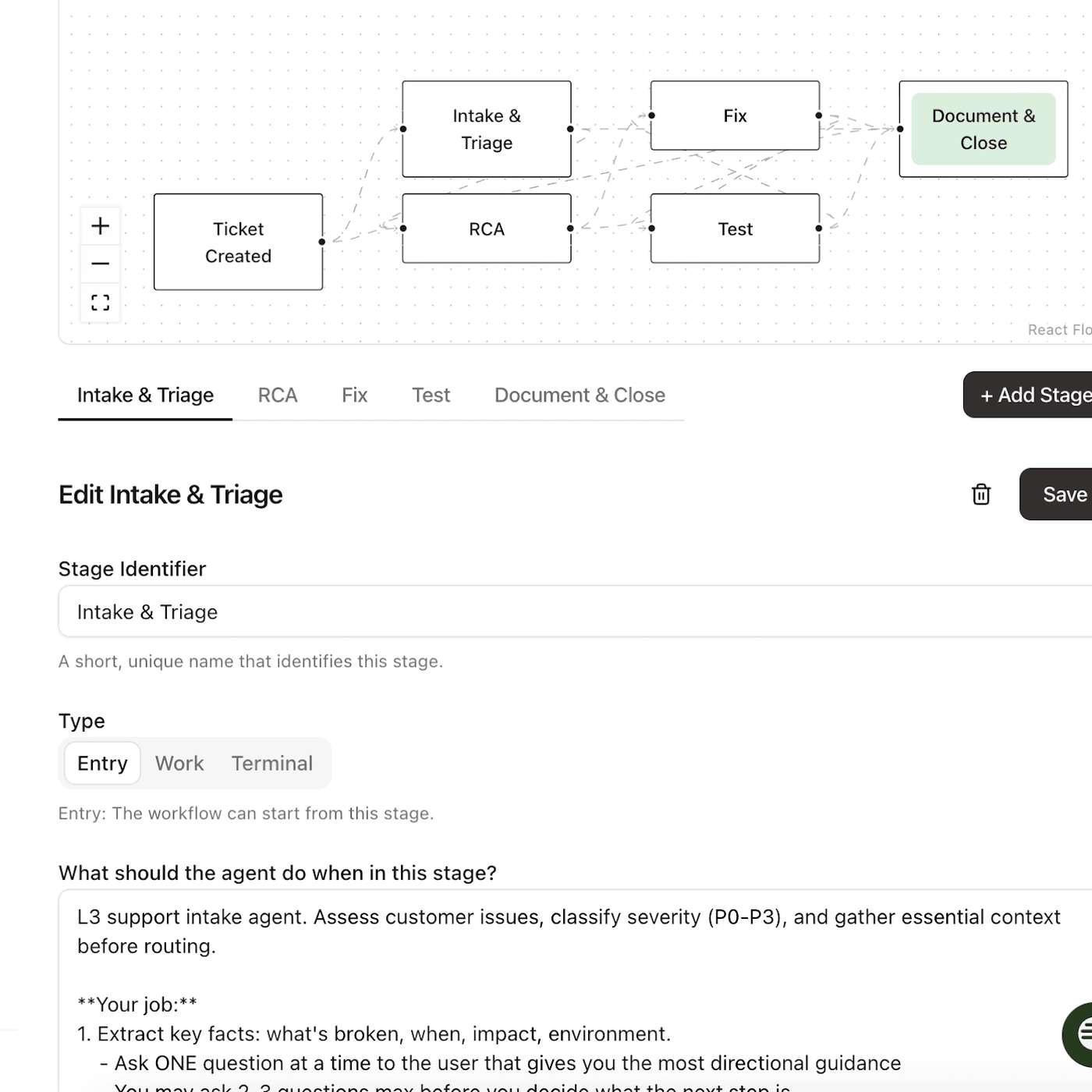
Software should handle agents using identical mechanisms built for team members, such as assigning tickets, mentioning them, and providing shared context. Designing unique, isolated agent-specific workflows often creates unnecessary friction compared to unified team primitives.

Related Insights
Because LLMs are non-deterministic like humans, it's more effective to integrate them using existing human-centric processes. Give an agent an email, permissions, and "onboarding" so it can navigate the organization like an employee, rather than building complex new software interfaces.

To maximize an AI coder's effectiveness, provide it with the same foundational elements you'd give a new human employee: a dedicated workspace (repo), memory (context files), a brief (plan mode), and a clear assignment (ticket). This reframes the AI from a simple tool to an integrated team member.

To properly integrate an AI agent into your workflows, provision it like a new hire. Give it a dedicated email address, a GitHub account, and specific access permissions. This mental model simplifies security, access control, and collaboration, making the agent a true digital team member.

Most AI tools are single-player experiences. Linear is designing its agent sessions to be shared, collaborative spaces. Multiple people, like a PM and a designer, can jump into the same chat with an agent, see its work, and give it feedback together, collapsing the collaboration loop.

Building a bespoke communication layer for multiple AI agents is a complex "scaffolding" problem. A simpler, more direct solution is to treat agents as digital coworkers, assigning them accounts on existing platforms like Slack or Google Docs, enabling them to interact using established human workflows.
Isolated AI workflows create team disconnects. Pablo Stanley argues for integrating agents into shared, Slack-like environments where they become first-class participants. This allows for transparent, collaborative work between humans and AI, rather than having individuals work with agents in private.
Descript's design principle for its AI agent, Underlord, is that it can't do anything a human user can't, and vice versa. This frames the AI as a true collaborator within the existing product interface, not a separate entity with special powers.
Treating AI as a personal assistant solves individual tasks but not team coordination. The solution is to deploy "AI Teammates"—integrated agents with specific roles, permissions, and the ability to work with multiple stakeholders within a shared workflow, autonomously moving projects forward.
To maximize an AI agent's effectiveness, treat it like a team member, not just a tool. Integrate it directly into your company's communication and project management systems (like Slack). This ensures the agent has the full context necessary to perform its tasks.

The AI agent is designed to act like a human team member within existing systems. It performs bi-directional updates in tools like Jira or Linear—adding comments, changing statuses, and assigning tickets. This seamless integration ensures human teams maintain visibility and that established processes aren't disrupted.