Get your free personalized podcast brief
We scan new podcasts and send you the top 5 insights daily.
Most AI tools are single-player experiences. Linear is designing its agent sessions to be shared, collaborative spaces. Multiple people, like a PM and a designer, can jump into the same chat with an agent, see its work, and give it feedback together, collapsing the collaboration loop.

Related Insights
Anthropic's new "Agent Teams" feature moves beyond the single-agent paradigm by enabling users to deploy multiple AIs that work in parallel, share findings, and challenge each other. This represents a new way of working with AI, focusing on the orchestration and coordination of AI teams rather than just prompting a single model.

Early AI adoption by PMs is often a 'single-player' activity. The next step is a 'multiplayer' experience where the entire team operates from a shared AI knowledge base, which breaks down silos by automatically signaling dependencies and overlapping work.
Because AI agents operate autonomously, developers can now code collaboratively while on calls. They can brainstorm, kick off a feature build, and have it ready for production by the end of the meeting, transforming coding from a solo, heads-down activity to a social one.

At Cursor, development is increasingly happening in Slack channels. Team members collectively kick off and redirect a cloud agent in a thread, turning development into a collaborative discussion. The IDE becomes a secondary tool, while communication platforms become the primary surface.
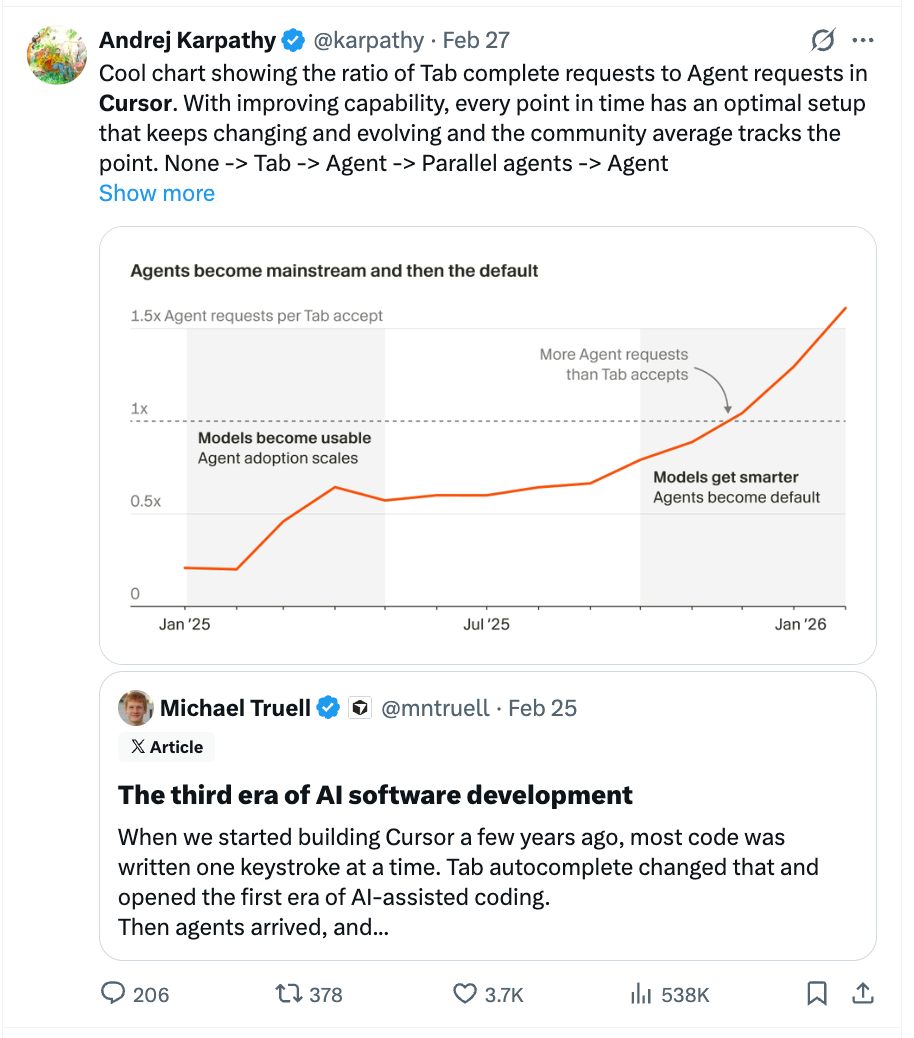
Using AI agents in shared Slack channels transforms coding from a solo activity into a collaborative one. Multiple team members can observe the agent's work, provide corrective feedback in the same thread, and collectively guide the task to completion, fostering shared knowledge.
The IDE Zed was built for synchronous, Figma-like human collaboration to overcome asynchronous Git workflows. This foundation of real-time, in-code presence serendipitously created the perfect environment for integrating AI agents, which function as just another collaborator in the same shared space.

The next frontier for AI isn't just personal assistants but "teammates" that understand an entire team's dynamics, projects, and shared data. This shifts the focus from single-user interactions to collaborative intelligence by building a knowledge graph connecting people and their work.

Asana's CEO argues its key differentiator is a "multiplayer mode" where entire human teams can collaboratively train and correct an AI agent within a project. This contrasts with typical one-on-one chat interactions, creating a unique, compounding learning environment for the agent that Asana believes cannot be easily replicated.

While chat works for human-AI interaction, the infinite canvas is a superior paradigm for multi-agent and human-AI collaboration. It allows for simultaneous, non-distracting parallel work, asynchronous handoffs, and persistent spatial context—all of which are difficult to achieve in a linear, turn-based chat interface.
To maximize an AI agent's effectiveness, treat it like a team member, not just a tool. Integrate it directly into your company's communication and project management systems (like Slack). This ensures the agent has the full context necessary to perform its tasks.