Get your free personalized podcast brief
We scan new podcasts and send you the top 5 insights daily.
Building a bespoke communication layer for multiple AI agents is a complex "scaffolding" problem. A simpler, more direct solution is to treat agents as digital coworkers, assigning them accounts on existing platforms like Slack or Google Docs, enabling them to interact using established human workflows.
Related Insights
To build a useful multi-agent AI system, model the agents after your existing human team. Create specialized agents for distinct roles like 'approvals,' 'document drafting,' or 'administration' to replicate and automate a proven workflow, rather than designing a monolithic, abstract AI.

Current communication tools like Slack are ill-suited for managing AI agents. The future lies in integrated "super apps" that combine chat interfaces with built-in credential management, file systems, and API key provisioning, creating a unified environment for human-agent collaboration.
To get AI agents to collaborate effectively in platforms like Slack, you must explicitly map their human-friendly names (e.g., "Sylvie") to their complex system-level identifiers (e.g., a long bot app ID). This allows them to understand and address each other correctly.
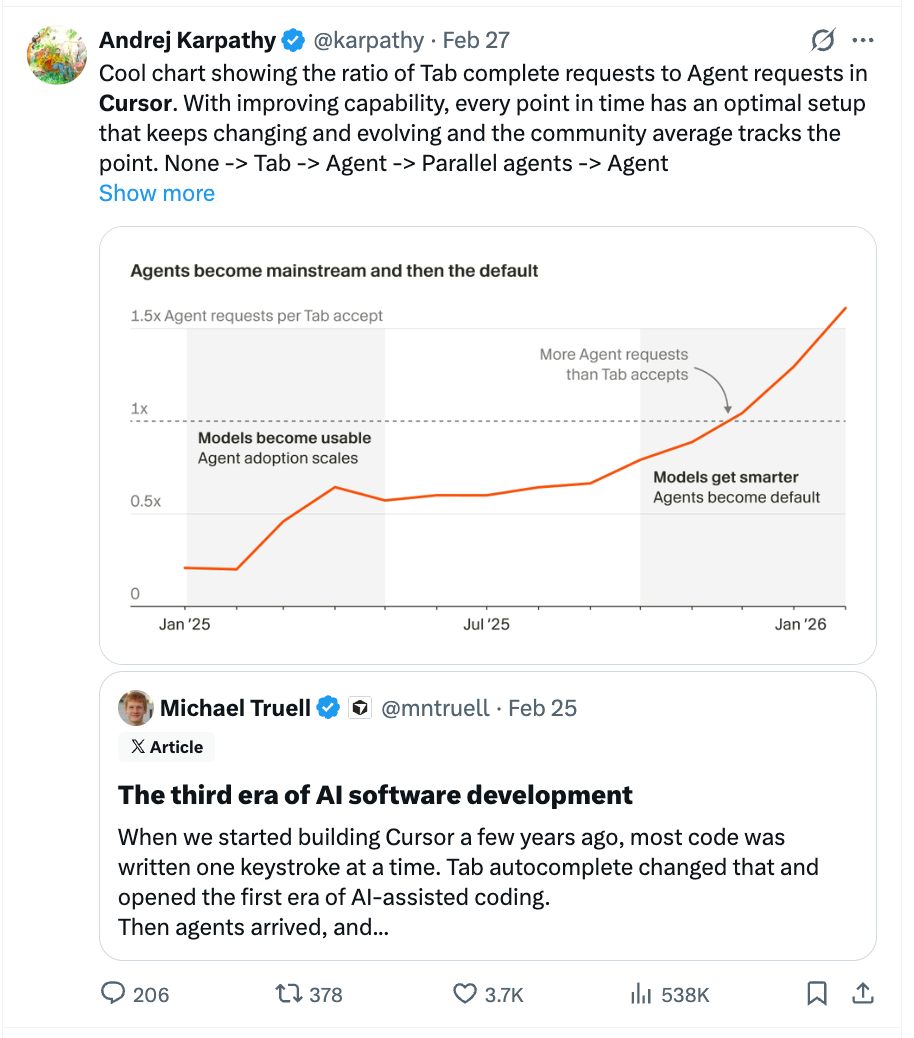
At Cursor, development is increasingly happening in Slack channels. Team members collectively kick off and redirect a cloud agent in a thread, turning development into a collaborative discussion. The IDE becomes a secondary tool, while communication platforms become the primary surface.
While messaging platforms like Slack can serve as an interface for human-to-agent communication, they are fundamentally ill-suited for agent-to-agent collaboration. These tools are designed for human interaction patterns, creating friction when orchestrating multiple autonomous agents and indicating a need for new, agent-native communication protocols.

Using AI agents in shared Slack channels transforms coding from a solo activity into a collaborative one. Multiple team members can observe the agent's work, provide corrective feedback in the same thread, and collectively guide the task to completion, fostering shared knowledge.
User workflows rarely exist in a single application; they span tools like Slack, calendars, and documents. A truly helpful AI must operate across these tools, creating a unified "desired path" that reflects how people actually work, rather than being confined by app boundaries.

The next evolution of agentic work involves massive, collaborative swarms of AIs working together. Current tools like GitHub, designed for human workflows with a single master branch, are ill-suited for this paradigm. The future will require new, agent-native platforms, possibly resembling social networks, to manage thousands of parallel experiments and collaborative branches.

The next evolution for autonomous agents is the ability to form "agentic teams." This involves creating specialized agents for different tasks (e.g., research, content creation) that can hand off work to one another, moving beyond a single user-to-agent relationship towards a system of collaborating AIs.

To maximize an AI agent's effectiveness, treat it like a team member, not just a tool. Integrate it directly into your company's communication and project management systems (like Slack). This ensures the agent has the full context necessary to perform its tasks.