Get your free personalized podcast brief
We scan new podcasts and send you the top 5 insights daily.
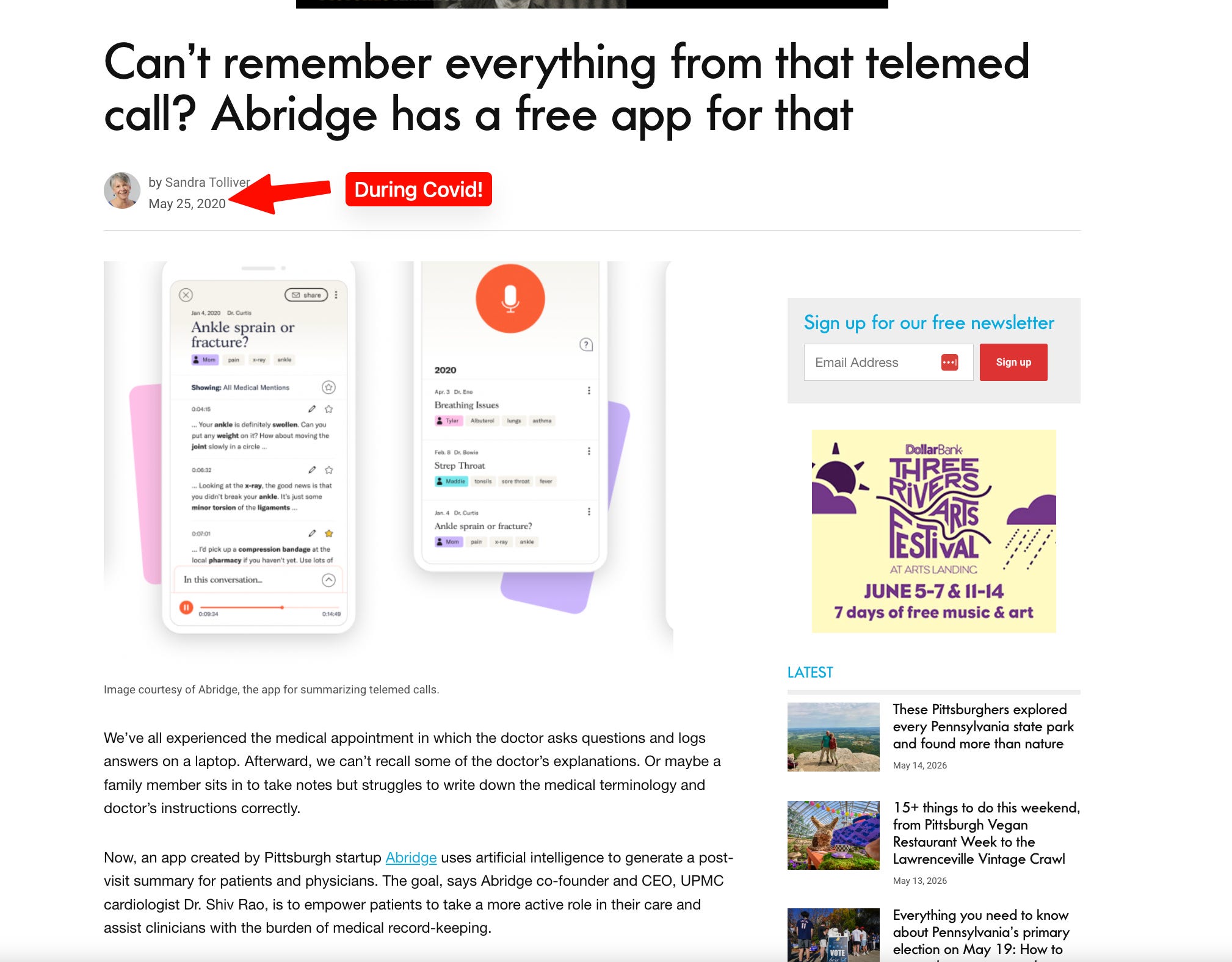
To avoid the "alert fatigue" common in medical software, Abridge's product philosophy is for its AI to be proactive, not reactive. It works seamlessly in the background to prepare clinicians before visits, rather than interrupting them with constant alerts during patient conversations, making the experience helpful but unobtrusive.
Related Insights
Abridge strategically structures its product roadmap beyond initial user benefits. The first act saves clinicians time. The second helps health systems save and make money. The ultimate goal, the third act, is to leverage their platform to save patient lives, creating a powerful long-term vision.
Abridge achieves deep user personalization beyond simple stylistic preferences. It operates at three levels: the individual doctor's phrasing, the specific requirements of a medical specialty (e.g., cardiology), and the unique best-practice guidelines of an entire hospital system, making the tool feel indispensable to all stakeholders.
Current healthcare is a 'sick care' system that reacts to problems after they arise. AI health agents, by continuously integrating data from wearables, environment, and even smart appliances, can identify baseline health and prompt proactive behaviors to optimize wellness and prevent disease from occurring.
An effective AI strategy in healthcare is not limited to consumer-facing assistants. A critical focus is building tools to augment the clinicians themselves. An AI 'assistant' for doctors to surface information and guide decisions scales expertise and improves care quality from the inside out.

The most tangible ROI for AI in healthcare today isn't in complex diagnostics, but in operational efficiency. AI scribes that free up doctors, intelligent call centers that triage patients correctly, and automated claim management are solving major bottlenecks and fighting burnout right now.

Abridge's secret weapon for building clinically relevant products is the "clinician scientist" role. These are team members with clinical backgrounds (e.g., MDs) who are also deeply technical. By embedding them in product teams, the company ensures that clinical usefulness and safety are baked into development and evaluation from day one.
By continuously feeding lab results and treatment updates into GPT-5 Pro, the speaker created an AI companion to validate the medical team's decisions. This not only caught minor discrepancies but, more importantly, provided immense peace of mind that the care being administered was indeed state-of-the-art.

To overcome physician resistance to new technology, the tool integrates as a seamless add-on to existing ambient listening scribe software. This passive screening approach requires no change in clinical workflow, no extra clicks, and no new habits, making adoption frictionless for time-constrained clinicians.

To overcome alert fatigue, AI tools must go beyond simple alerts. Success comes from EMR integration, offering 'next best actions,' explainable AI, and, crucially, allowing clinicians to adjust the model's sensitivity to match their personal risk threshold for different patients.
Instead of replacing clinicians, AI's promise lies in offloading work to virtual assistants. These agents will prepare pre-visit summaries, ask patients questions beforehand, and manage post-visit follow-ups like checking on prescriptions and lab tests, acting as a force multiplier for the human care team.