Get your free personalized podcast brief
We scan new podcasts and send you the top 5 insights daily.
To avoid chaotic spending, enterprises must replicate their "Cloud 2.0" governance models for AI. This means establishing a central platform engineering team to broker access to models, set budgets, and control the tools agents can use. This prevents runaway costs and security risks from decentralized AI development.

Related Insights
The optimal strategy for managing AI costs is neither total restriction nor a free-for-all. It's providing engineers with dedicated "learning budgets" and experimentation pools, coupled with clear visibility into costs. This fosters innovation responsibly without incurring surprise invoices and turns cost into a first-class constraint.
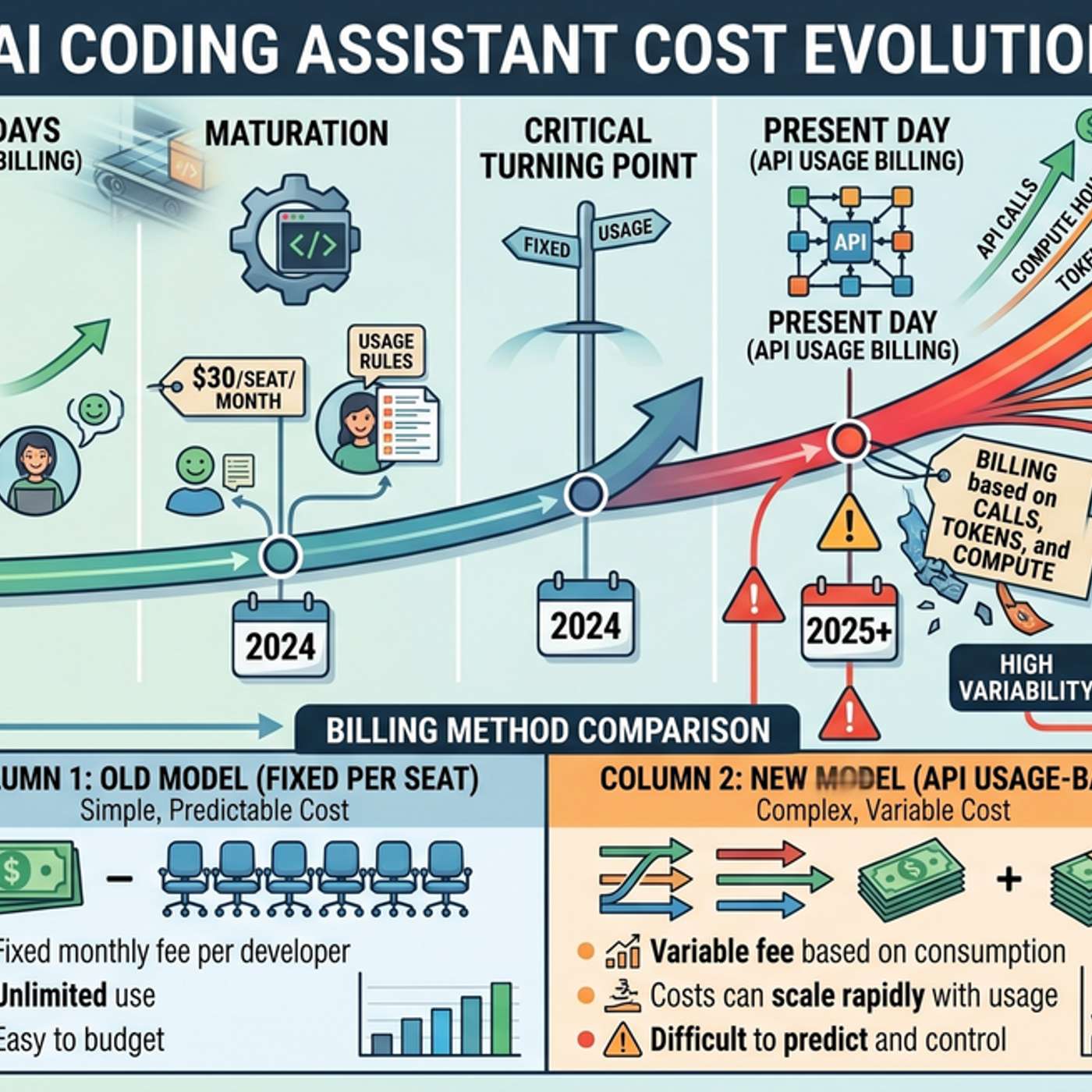
While security and data privacy are huge risks with AI agents, the most immediate and tangible pain point for businesses is cost. An unexpectedly large bill from a runaway agent is often the catalyst for seeking a governance solution, which then leads to addressing deeper security issues.

For regulated industries like banking, Boston Consulting Group and OpenAI advocate for a centralized middleware layer, or 'control plane.' This architectural component acts as a single gateway through which all AI systems must operate, enabling consistent oversight, standardized controls, and auditable governance across the entire organization.

To manage the complexity and risk of AI agents, companies should adopt a centralized model. Rather than allowing individuals to build agents freely, a dedicated internal team should build, govern, and distribute a suite of approved agents to departments, ensuring consistency and control.
The future of work involves potentially millions of AI agents operating within a company. This requires a new governance layer, including agent inventories, inspectable reasoning traces, identity management, and sandboxed execution environments to maintain security and control.

To control costs, security, and governance, enterprises are moving from interactive, ad-hoc agent use to a 'software factory' model. This approach systematizes the entire work lifecycle, automating processes and minimizing the risks associated with inconsistent human operation of powerful AI tools.

AI agents make building prototypes like dashboards and bots incredibly cheap and fast for any employee. This creates a new organizational challenge: managing the explosion of these internal tools, ensuring good governance, and tracking data provenance across derived artifacts. The focus shifts from development cost to IT oversight and control.
The move away from seat-based licenses to consumption models for AI tools creates a new operational burden. Companies must now build governance models and teams to track usage at an individual employee level—like 'Bob in accounting'—to control unpredictable costs.
Just as uncontrolled cloud spending in the 2010s spawned the FinOps field, the shift to consumption-based AI pricing will necessitate a similar discipline. This involves attributing costs to specific workloads, setting granular budgets, and providing real-time visibility to prevent budget overruns and measure ROI accurately.
Running multiple AI agents in parallel quickly leads to "AI sprawl"—losing track of what each agent is doing, what they've accomplished, and how much they're costing. Orchestration tools solve this by centralizing tasks, tracking spend, and providing a unified management dashboard.
