Get your free personalized podcast brief
We scan new podcasts and send you the top 5 insights daily.
The model eschews standard Jinja chat templates, forcing developers to use a proprietary Python reference implementation or a specific toolkit. This creates a steeper learning curve and greater integration overhead compared to models that support common transformer library interfaces, hindering drop-in adoption.

Related Insights
Making an API usable for an LLM is a novel design challenge, analogous to creating an ergonomic SDK for a human developer. It's not just about technical implementation; it requires a deep understanding of how the model "thinks," which is a difficult new research area.

While a multi-model approach—using the best AI for each specific task—is theoretically optimal, its practical implementation is difficult. A major roadblock is the need to create and maintain different optimized prompts for each model. This overhead leads users to default to a single, powerful model for simplicity.

The model allows adjusting reasoning effort on a 1-100 scale, enabling a balance between response quality and cost. However, since all published benchmarks use the maximum setting, the performance at lower, more efficient levels is undocumented, requiring teams to conduct their own extensive testing for production viability.
While trailing on general knowledge benchmarks, the model's core features—1M token context, advanced tool calling, and multimodal capabilities—are explicitly designed for input-heavy, multi-step agentic tasks. This positions it as a specialized tool for coding and automation agents rather than a general-purpose LLM.
Integrating the latest foundation model is complex because new models can break prompt tuning built around the quirks of older versions. Serval has found that a new model's unpredictability can outweigh its intelligence, sometimes forcing them to downgrade to an older, more reliable model to ensure consistent behavior.

The model features a massive 1M token context window, but its performance on the LongBench V2 benchmark is underwhelming compared to competitors. This indicates its ability to reliably retrieve and reason over information across vast contexts is not guaranteed and needs careful validation before deployment in long-context applications.
Despite activating only 8B-16B parameters, the model's total 552B parameter backbone makes it impractical for local deployment without significant infrastructure. The lack of VRAM or hardware requirement documentation further complicates setup, making the "efficiency" claim misleading for non-enterprise users.
Exposing a full API via the Model Context Protocol (MCP) overwhelms an LLM's context window and reasoning. This forces developers to abandon exposing their entire service and instead manually craft a few highly specific tools, limiting the AI's capabilities and defeating the "do anything" vision of agents.
Beyond API integrations, LLMs face significant hurdles in enterprise settings. They struggle to follow complex instructions reliably, can't yet interact with legacy graphical UIs effectively, and are stymied by the absence of clean, centralized knowledge bases, instead facing scattered 'tribal knowledge.'

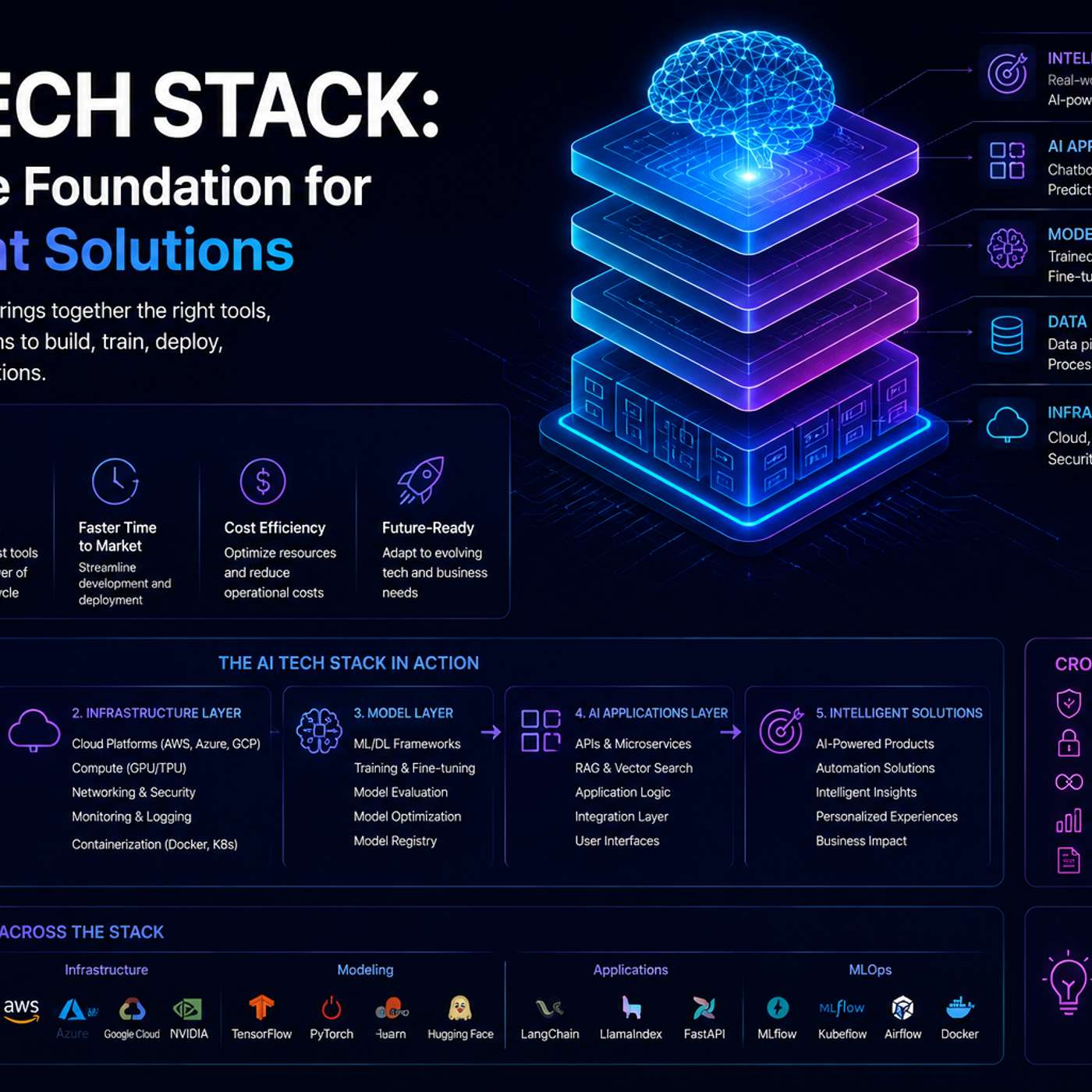
Integrating generative AI is not a simple model upgrade. It demands new architectural components like vector databases (e.g., Pinecone, Weaviate) for semantic search and prompt orchestration frameworks (e.g., LangChain) to manage complex model interactions and proprietary data.