Get your free personalized podcast brief
We scan new podcasts and send you the top 5 insights daily.
Microsoft aims to become the Costco of AI by offering dependable, high-value utility across varied user budgets. This pricing approach attempts to defend its enterprise software footprint as model creators ignite aggressive token pricing wars.

Related Insights
AI's high computational cost (COGS) threatens SaaS margins. Nadella explains that just as the cloud expanded the market for computing far beyond the original server-license model, AI will create entirely new categories and user bases, offsetting the higher costs.
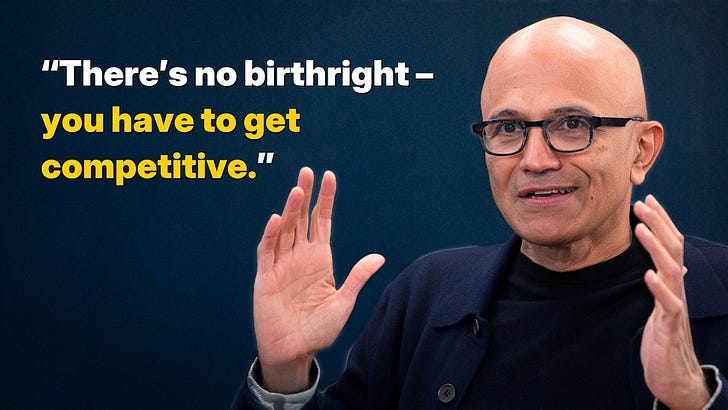
Incumbents like Microsoft rely on bundling to lock in enterprise customers. However, AI's shift to consumption-based pricing means customers pay per use. This allows enterprises to offer multiple specialized tools, letting employees pick the best one for the job and eroding the power of the all-in-one bundle.

Microsoft is bundling AI tools into a "super app" and offering a broad model catalog. This positions them as a neutral platform, aiming to win enterprise clients who prioritize control, cost, and choice over loyalty to a specific AI lab like OpenAI or Anthropic.

Microsoft's decision to promote Anthropic models on Azure as aggressively as OpenAI's reflects a core belief from CEO Satya Nadella. He anticipates AI models will become commoditized, making the underlying intelligence interchangeable and the cloud platform the primary point of differentiation and value capture.
Contrary to typical corporate fears, Microsoft's AI lead views the rapid commoditization of AI models and resulting price wars as a positive outcome for humanity. The ultimate goal is to make intelligence abundant and near-zero cost, with Microsoft's business model focused on value-added software integrations.

Microsoft CEO Satya Nadella has structured a brilliant hedge. If frontier models from labs like OpenAI dominate, Microsoft wins via its significant equity stake. If models commoditize, Microsoft wins by leveraging its unparalleled enterprise distribution channels. The company is positioned to profit from either outcome.

Microsoft is training its sales teams to directly pitch its in-house MAI models over partners' by emphasizing cost, efficiency, and superior security integration within its ecosystem. This strategy leverages Microsoft's distribution power, shifting the sales narrative away from raw model performance to enterprise-specific value propositions like security and cost.
By shifting from fixed per-seat licenses to variable usage-based models for AI, Microsoft forces customers to scrutinize their monthly bills. This breaks the inertia of its bundled offering and invites evaluation of best-of-breed competitors.

Microsoft's forthcoming homegrown AI models are not designed to be state-of-the-art. Instead, their strategy is to offer 'good enough' performance at a significantly lower price point. This classic value-based approach targets developers feeling the pinch from the rising costs of frontier models from competitors like Anthropic and OpenAI.
Microsoft is developing its own AI models from scratch, pitching them as cheaper and more effective for customized enterprise needs than leading models from its partner OpenAI or competitor Anthropic. This signals a strategy to control the full AI stack and compete directly on price.