Get your free personalized podcast brief
We scan new podcasts and send you the top 5 insights daily.
AI's high computational cost (COGS) threatens SaaS margins. Nadella explains that just as the cloud expanded the market for computing far beyond the original server-license model, AI will create entirely new categories and user bases, offsetting the higher costs.
Related Insights
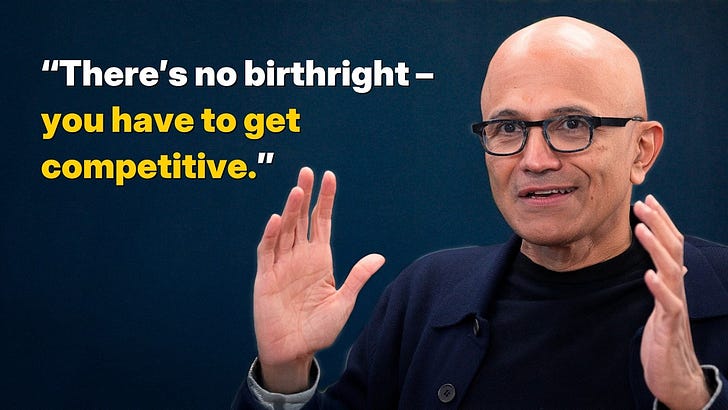
While some competitors prioritize winning over ROI, Nadella cautions that "at some point that party ends." In major platform shifts like AI, a long-term orientation is crucial. He cites Microsoft's massive OpenAI investment, committed *before* ChatGPT's success, as proof of a long-term strategy paying off.
The compute-heavy nature of AI makes traditional 80%+ SaaS gross margins impossible. Companies should embrace lower margins as proof of user adoption and value delivery. This strategy mirrors the successful on-premise to cloud transition, which ultimately drove massive growth for companies like Microsoft.

To navigate the massive capital requirements of AI, Nadella reframes the investment in cutting-edge training infrastructure. Instead of being purely reactive to customer demand, a significant portion is considered R&D, allowing for sustained, order-of-magnitude scaling necessary for breakthroughs.
Satya Nadella suggests a fundamental shift in enterprise software monetization. As autonomous AI agents become prevalent, the value unit will move from the human user ("per seat") to the AI itself. "Agents are the new seats," signaling a future where companies pay for automated tasks and outcomes, not just software access for employees.

Satya Nadella predicts that SaaS disruption from AI will hit "high ARPU, low usage" companies hardest. He argues that products like Microsoft 365, with their high usage and low average revenue per user (ARPU), create a constant stream of data. This data graph is crucial for grounding AI agents, creating a defensive moat.
AI is making core software functionality nearly free, creating an existential crisis for traditional SaaS companies. The old model of 90%+ gross margins is disappearing. The future will be dominated by a few large AI players with lower margins, alongside a strategic shift towards monetizing high-value services.

AI companies operate under the assumption that LLM prices will trend towards zero. This strategic bet means they intentionally de-prioritize heavy investment in cost optimization today, focusing instead on capturing the market and building features, confident that future, cheaper models will solve their margin problems for them.

The dominant per-user-per-month SaaS business model is becoming obsolete for AI-native companies. The new standard is consumption or outcome-based pricing. Customers will pay for the specific task an AI completes or the value it generates, not for a seat license, fundamentally changing how software is sold.
As AI agents become autonomous workers, Microsoft's business model will shift from selling tools to humans to provisioning infrastructure for AI agents. This includes compute (Windows 365), security, and identity for these new digital employees, billed on a per-agent basis.
The traditional SaaS model—high R&D/sales costs, low COGS—is being inverted. AI makes building software cheap but running it expensive due to high inference costs (COGS). This threatens profitability, as companies now face high customer acquisition costs AND high costs of goods sold.
![Dylan Patel - Inside the Trillion-Dollar AI Buildout - [Invest Like the Best, EP.442] thumbnail](https://megaphone.imgix.net/podcasts/799253cc-9de9-11f0-8661-ab7b8e3cb4c1/image/d41d3a6f422989dc957ef10da7ad4551.jpg?ixlib=rails-4.3.1&max-w=3000&max-h=3000&fit=crop&auto=format,compress)