Get your free personalized podcast brief
We scan new podcasts and send you the top 5 insights daily.
Decagon uses powerful frontier models not for high-volume core operations, but for complex, open-ended auxiliary tasks like system-wide performance analysis and model improvement. This hybrid approach optimizes for both efficiency in core tasks and intelligence in strategic ones.

Related Insights
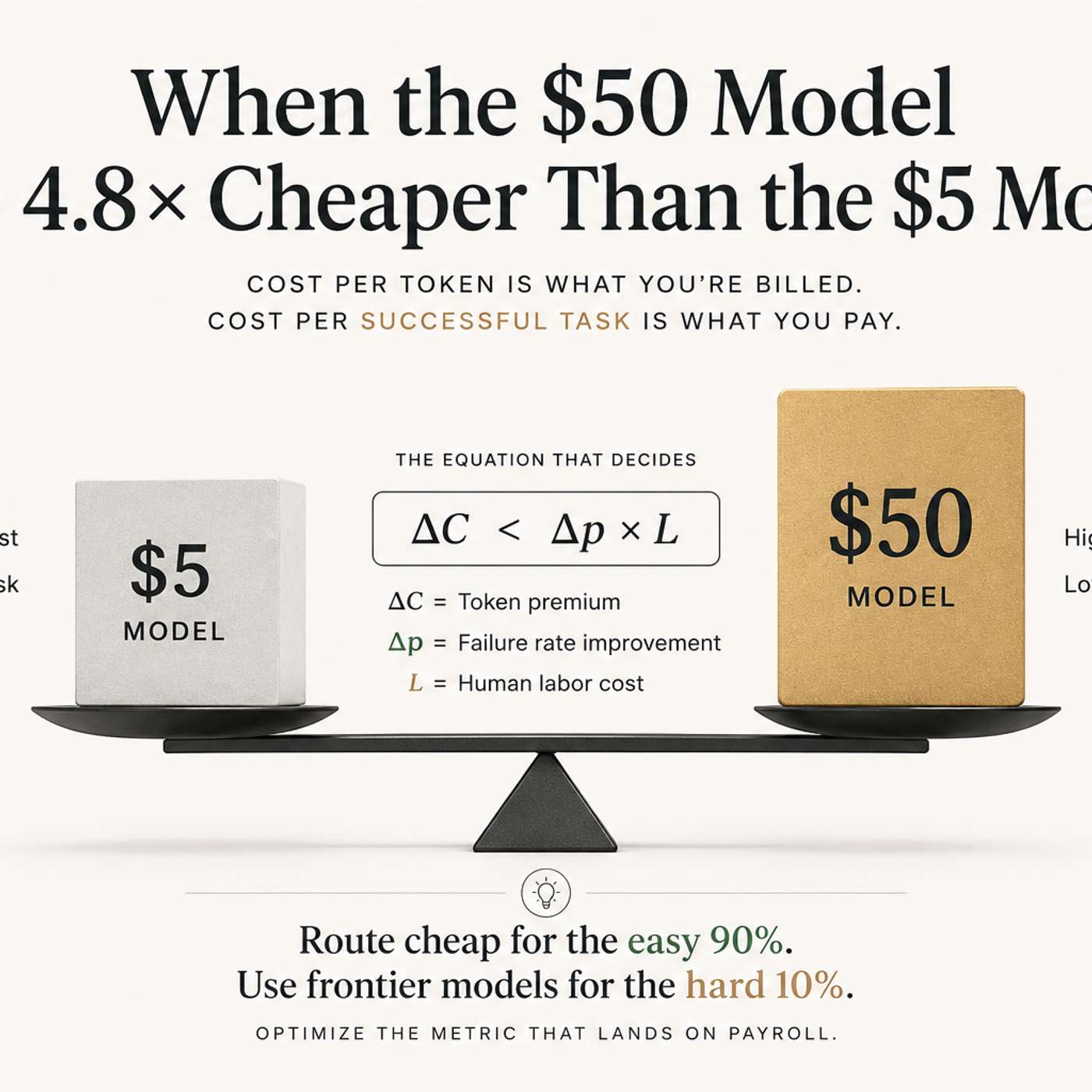
Don't use your most powerful and expensive AI model for every task. A crucial skill is model triage: using cheaper models for simple, routine tasks like monitoring and scheduling, while saving premium models for complex reasoning, judgment, and creative work.

Decagon's CEO explains a paradox: while open-source AI usage grows, its market share shrinks. This is because open-source is ideal for scaled, defined tasks, but most enterprise AI is still in the experimental phase, where powerful, flexible frontier models are preferred.

The choice between expensive frontier models and cheaper open-source ones depends on use case maturity. Enterprises should use powerful, general frontier models to discover new applications. Once a workflow is defined, they can migrate to a smaller, fine-tuned open model for efficiency.

Legal AI firm Harvey proved a hybrid system—using a smaller model as a primary worker and routing selectively to a frontier model as an "advisor"—can beat a frontier-only approach on both quality and cost. This demonstrates that intelligent orchestration is a more effective strategy than simply using the most powerful model for every task.
The open vs. closed model debate is misguided. Citing AI company Decagon, the speaker explains that open-source is superior for production workloads needing low latency and fine-tuning (90% of their use). Frontier models are better for initial use-case discovery, explaining their current market share in an early AI market.

A powerful AI workflow involves using cheap, 24/7 local models for high-volume, initial-pass tasks like finding potential security issues. These 'qualified leads' are then batched and sent to a powerful frontier model like Claude for the final, high-quality analysis.

As enterprises scale AI, the high inference costs of frontier models become prohibitive. The strategic trend is to use large models for novel tasks, then shift 90% of recurring, common workloads to specialized, cost-effective Small Language Models (SLMs). This architectural shift dramatically improves both speed and cost.

The smartest 'AI-pilled' companies adopt a two-tiered model strategy. They use expensive, frontier models for internal, high-leverage tasks like creating new knowledge and optimizing processes. However, they use cheaper, open-weight models in the 'bill of materials' for the customer-facing product to manage costs effectively.

According to NVIDIA's VP, the modern approach to enterprise AI involves mixing models. Use expensive, powerful frontier models for complex, high-value tasks like agentic planning. For more trivial, high-volume tasks like document summarization, use cheaper, fine-tuned open-source models to optimize cost.

An optimal AI architecture routes tasks to different models based on complexity and risk. Simple, low-stakes work like data extraction should go to the cheapest models. Ambiguous, high-stakes work like system design warrants expensive frontier models, where preventing one engineering mistake justifies the premium token cost.