Get your free personalized podcast brief
We scan new podcasts and send you the top 5 insights daily.
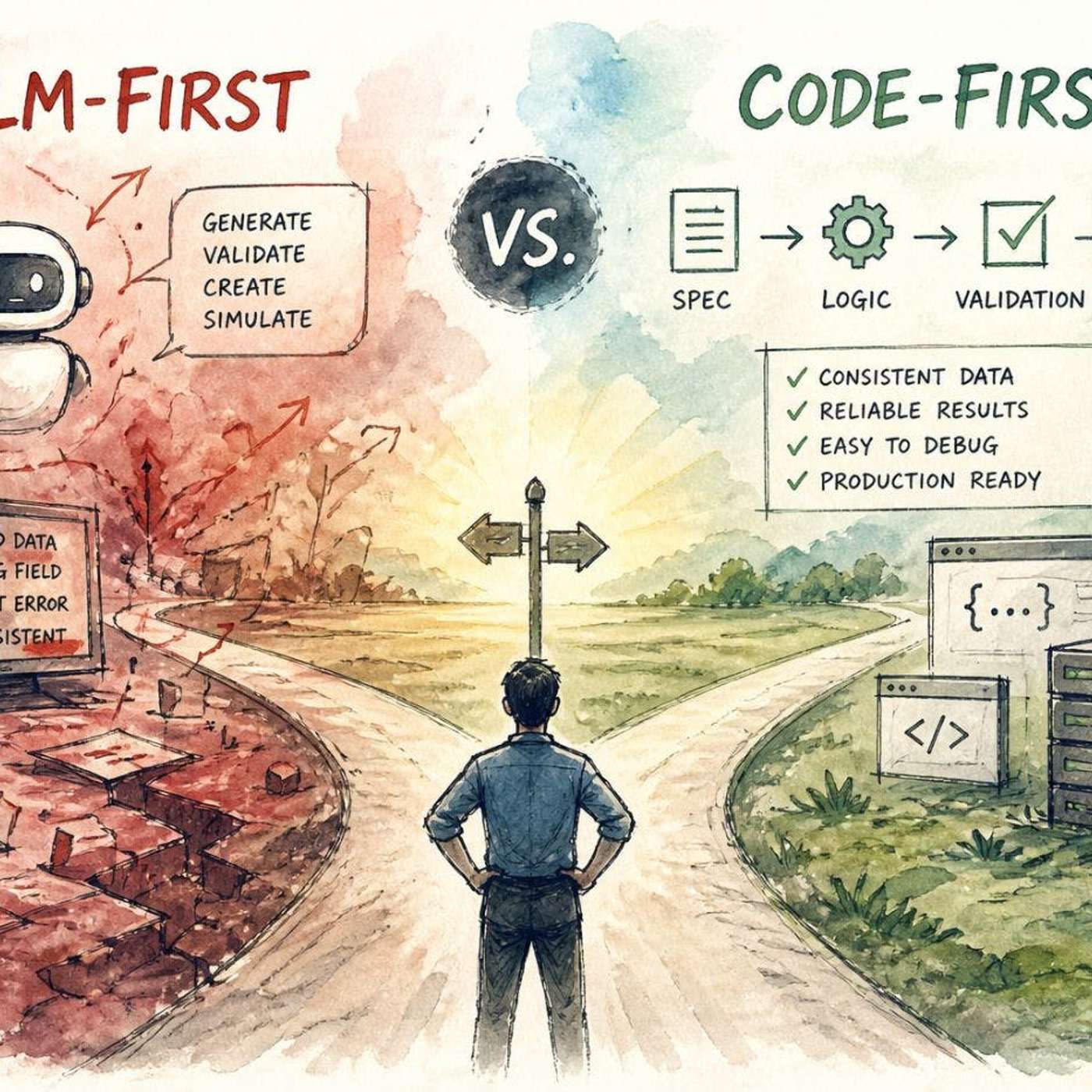
Rather than celebrating generic wins, high-performing engineering teams actively map the precise edges where LLMs fail. Discerning which tasks are computational versus narrative keeps teams from shoehorning tabular or deterministic logic into textual forms that trigger severe signal loss and error propagation.

Related Insights
LLMs shine when acting as a 'knowledge extruder'—shaping well-documented, 'in-distribution' concepts into specific code. They fail when the core task is novel problem-solving where deep thinking, not code generation, is the bottleneck. In these cases, the code is the easy part.

High productivity isn't about using AI for everything. It's a disciplined workflow: breaking a task into sub-problems, using an LLM for high-leverage parts like scaffolding and tests, and reserving human focus for the core implementation. This avoids the sunk cost of forcing AI on unsuitable tasks.

The researchers' failure case analysis is highlighted as a key contribution. Understanding why the model fails—due to ambiguous data or unusual inputs—provides a realistic scope of application and a clear roadmap for improvement, which is more useful for practitioners than high scores alone.
The critical challenge in AI development isn't just improving a model's raw accuracy but building a system that reliably learns from its mistakes. The gap between an 85% accurate prototype and a 99% production-ready system is bridged by an infrastructure that systematically captures and recycles errors into high-quality training data.

Stop aiming for perfect model compliance. Instead, accept that LLMs will fail to follow instructions 1-3% of the time. True system reliability comes from robustly handling this failure spike with fallbacks like heuristics, cached results, or human review queues.

Many product builders overestimate current AI capabilities. Understanding AI's limitations, like the non-deterministic nature of LLMs, is more critical than knowing its strengths. Overstating AI's capacity is a direct path to product failure and bad investments.

When selecting foundational models, engineering teams often prioritize "taste" and predictable failure patterns over raw performance. A model that fails slightly more often but in a consistent, understandable way is more valuable and easier to build robust systems around than a top-performer with erratic, hard-to-debug errors.

LLMs in production don't often crash spectacularly. Instead, they introduce subtle, probabilistic errors—like incorrect enum values or missing fields—that are hard to debug because they lack clear error patterns, unlike deterministic code failures.
When an LLM fails, determine if it was a diligence issue (didn't try hard enough) or a capability issue (didn't know enough). This simple diagnostic framework helps decide whether to increase the model's effort level or upgrade to a larger, more knowledgeable model.

AI is not uniformly capable. It can be brilliant at technical tasks like software programming but produce verbose, clichéd output for nuanced tasks like email writing. Businesses must understand this "jagged" capability frontier to deploy AI where it's genuinely effective, rather than assuming universal competence.
