Get your free personalized podcast brief
We scan new podcasts and send you the top 5 insights daily.
When an LLM fails, determine if it was a diligence issue (didn't try hard enough) or a capability issue (didn't know enough). This simple diagnostic framework helps decide whether to increase the model's effort level or upgrade to a larger, more knowledgeable model.

Related Insights
Standard automated metrics like perplexity and loss measure a model's statistical confidence, not its ability to follow instructions. To properly evaluate a fine-tuned model, establish a curated "golden set" of evaluation samples to manually or programmatically check if the model is actually performing the desired task correctly.

When an AI's response is questionable, go beyond simple re-prompting. Use meta-prompts that explicitly instruct the model to increase its reasoning effort, such as "Think hard about why this is right" or asking for its sources. This can uncover new insights and improve output quality.

When a large language model provides a poor response, a highly effective technique is to treat it like a new employee. Instead of just re-prompting, ask it to explain its reasoning ("Why is that?") to understand the error, then provide clear, corrective feedback.

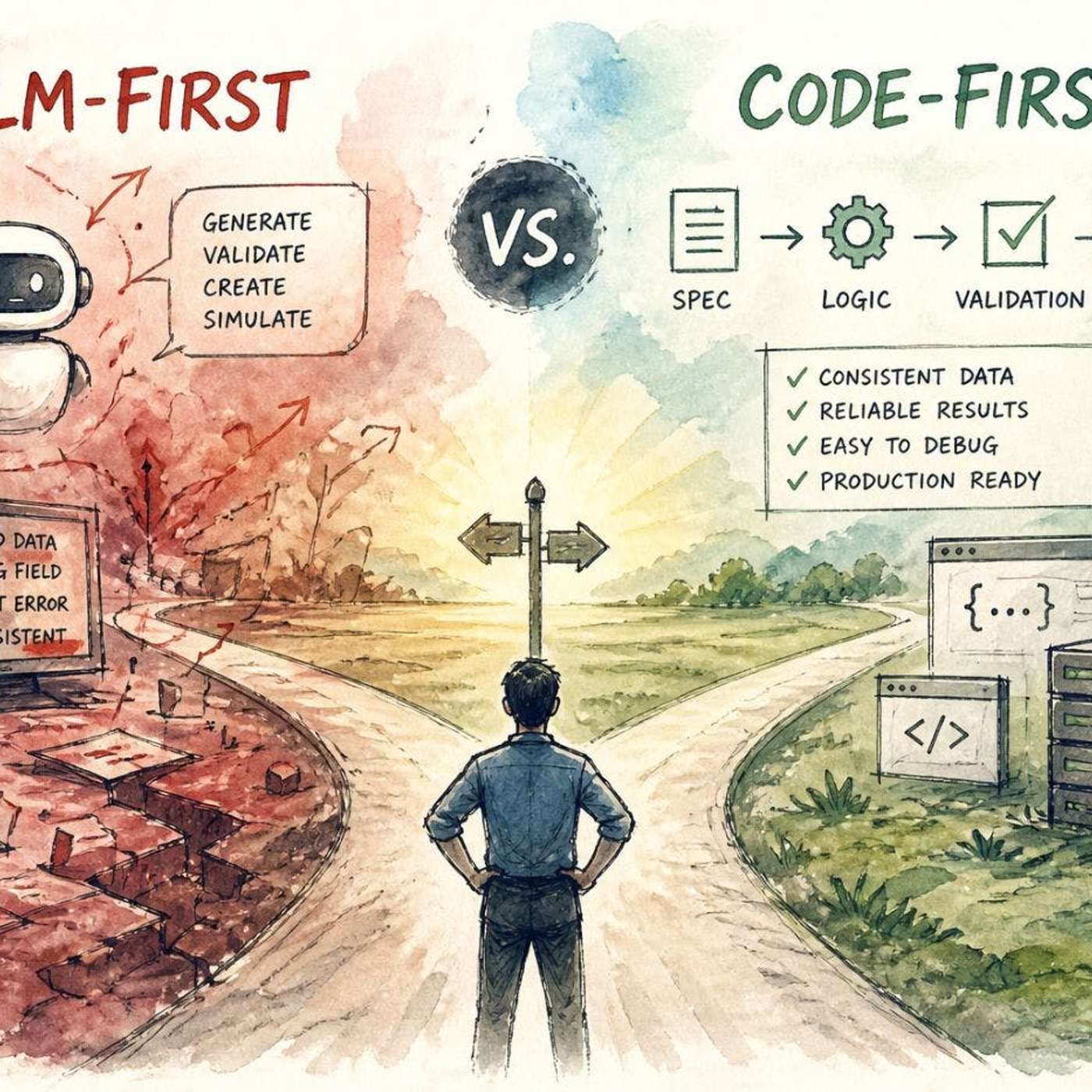
LLMs in production don't often crash spectacularly. Instead, they introduce subtle, probabilistic errors—like incorrect enum values or missing fields—that are hard to debug because they lack clear error patterns, unlike deterministic code failures.
When asked to analyze 100 papers, LLMs often admit they didn't complete the task. This failure stems from outcome-based training, which prioritizes a plausible-looking final output over correctly following the required process, revealing a fundamental flaw in current training paradigms.

When a prompt yields poor results, use a meta-prompting technique. Feed the failing prompt back to the AI, describe the incorrect output, specify the desired outcome, and explicitly grant it permission to rewrite, add, or delete. The AI will then debug and improve its own instructions.

Simply having a large context window is insufficient. Models may fail to "see" or recall specific facts embedded deep within the context, a phenomenon exposed by "needle in the haystack" evaluations. Effective reasoning capability across the entire window is a separate, critical factor.

Even with large advertised context windows, LLMs show performance degradation and strange behaviors when overloaded. Described as "context anxiety," they may prematurely give up on complex tasks, claim imaginary time constraints, or oversimplify the problem, highlighting the gap between advertised and effective context sizes.

Traditional benchmarks incentivize guessing by only rewarding correct answers. The Omniscience Index directly combats hallucination by subtracting points for incorrect factual answers. This creates a powerful incentive for model developers to train their systems to admit when they lack knowledge, improving reliability.

The "effort" setting is not a control for processing time. Instead, it is an input that prompts the model to follow a pre-trained behavior. High effort causes the model to generate more reasoning tokens and tool calls, making it more thorough and certain before it considers a task complete. This behavior is baked into its frozen weights.