Get your free personalized podcast brief
We scan new podcasts and send you the top 5 insights daily.
Stop aiming for perfect model compliance. Instead, accept that LLMs will fail to follow instructions 1-3% of the time. True system reliability comes from robustly handling this failure spike with fallbacks like heuristics, cached results, or human review queues.

Related Insights
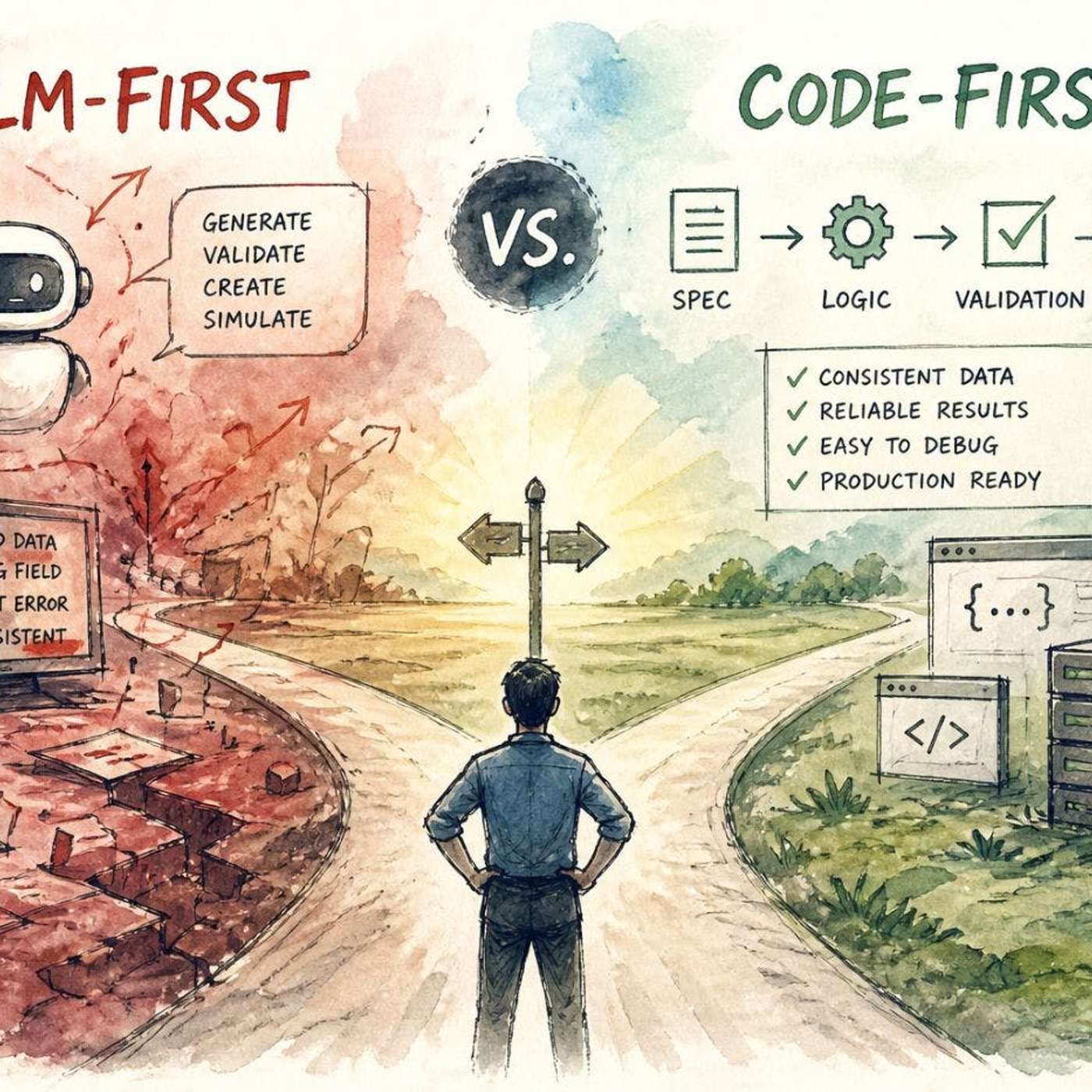
Don't give LLMs full control. Use deterministic code for core logic, validation, and enforcing rules. Delegate only tasks requiring flexibility or understanding of unstructured input to the LLM, treating it as a specialized component, not the entire system.
Lindy dramatically increases agent reliability with a "validator" system. Before an action is taken, a second LLM call acts as a judge, checking the proposed action against an extensive prompt or checklist. Even a simple "Are you sure?" prompt provides a significant reliability bump.

Standard automated metrics like perplexity and loss measure a model's statistical confidence, not its ability to follow instructions. To properly evaluate a fine-tuned model, establish a curated "golden set" of evaluation samples to manually or programmatically check if the model is actually performing the desired task correctly.

LLMs are technically non-deterministic systems designed to guess the next most probable word, not verify facts like a calculator. This inherent design means they will confidently produce incorrect information, making human verification indispensable for high-stakes business decisions.

To ensure model robustness, OpenAI uses a "worst at N" evaluation metric. They sample a model's output multiple times (e.g., 20) on a given problem and measure the performance of the single worst response. This focuses development on eliminating low-quality outliers and ensuring a high floor for safety and consistency, rather than just optimizing for average performance.
LLMs in production don't often crash spectacularly. Instead, they introduce subtle, probabilistic errors—like incorrect enum values or missing fields—that are hard to debug because they lack clear error patterns, unlike deterministic code failures.
Salesforce is reintroducing deterministic automation because its generative AI agents struggle with reliability, dropping instructions when given more than eight commands. This pullback signals current LLMs are not ready for high-stakes, consistent enterprise workflows.

When an LLM fails, determine if it was a diligence issue (didn't try hard enough) or a capability issue (didn't know enough). This simple diagnostic framework helps decide whether to increase the model's effort level or upgrade to a larger, more knowledgeable model.

To deploy LLMs in high-stakes environments like finance, combine them with deterministic checks. For example, use a traditional algorithm to calculate cash flow and only surface the LLM's answer if it falls within an acceptable range. This prevents hallucinations and ensures reliability.

When an AI model makes the same undesirable output two or three times, treat it as a signal. Create a custom rule or prompt instruction that explicitly codifies the desired behavior. This trains the AI to avoid that specific mistake in the future, improving consistency over time.