Get your free personalized podcast brief
We scan new podcasts and send you the top 5 insights daily.
Gokul Rajaram advises that AI agents should adopt the trust-building model used by medical scribe AIs. Instead of assuming user trust, agents should start by requiring human approval for all actions, then gradually earn autonomy as they demonstrate reliability over time. This incremental approach is key to overcoming user skepticism.

Related Insights
To avoid failure, launch AI agents with high human control and low agency, such as suggesting actions to an operator. As the agent proves reliable and you collect performance data, you can gradually increase its autonomy. This phased approach minimizes risk and builds user trust.

Instead of forcing full autonomy, the AI agent allows teams to start with human approvals at key stages. This 'human-in-the-loop' model builds trust and enables organizations to incrementally automate complex support workflows as they grow more confident in the system's reliability.
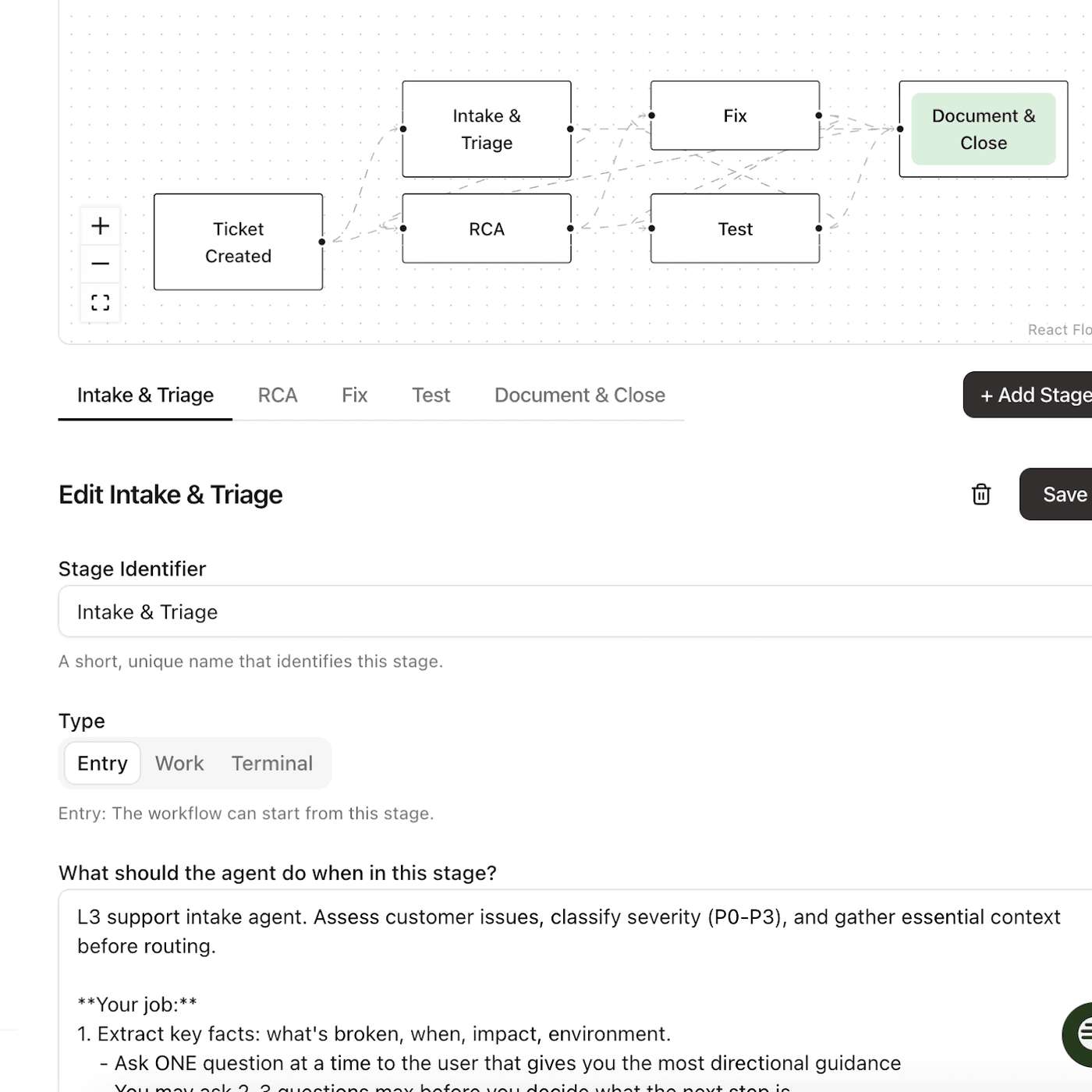
To overcome employee fear, don't deploy a fully autonomous AI agent on day one. Instead, introduce it as a hybrid assistant within existing tools like Slack. Start with it asking questions, then suggesting actions, and only transition to full automation after the team trusts it and sees its value.

Start with a 'Minimal Useful Agent' that performs a simple, bounded task like drafting replies for human approval or triaging inbound requests. This 'draft and approve' model reduces risk, builds customer trust, and allows you to earn autonomy over time.

To overcome user distrust of AI agents having access to personal data, the adoption path must be gradual. The AI should first provide suggestions for the user to approve (e.g., draft emails). Only after consistently proving its reliability and allowing users to learn its boundaries can trust be established for autonomous action.

AI model capabilities have outpaced their value delivery due to a fundamental design problem. Users are inherently scared and distrustful of autonomous agents. The key challenge is creating interaction patterns that build trust by providing the right level of oversight and feedback without being annoying—a problem of design, not technology.

To overcome resistance to AI in critical fields like healthcare, position it first as a supplement, not a replacement. By providing AI-generated summaries that still require clinical review, organizations can demonstrate value and build trust, making clinicians see AI as a tool that frees them for high-value work.

Current AI workflows are not fully autonomous and require significant human oversight, meaning immediate efficiency gains are limited. By framing these systems as "interns" that need to be "babysat" and trained, organizations can set realistic expectations and gradually build the user trust necessary for future autonomy.

The most effective AI user experiences are skeuomorphic, emulating real-world human interactions. Design an AI onboarding process like you would hire a personal assistant: start with small tasks, verify their work to build trust, and then grant more autonomy and context over time.

Granting full autonomy to AI agents from day one is reckless. A safer, more effective approach is a laddered model: start with agents in an "Observation" role, then let them make "Suggestions," then "Act with Approval," and only then grant full autonomy within specific, defined boundaries.
