Get your free personalized podcast brief
We scan new podcasts and send you the top 5 insights daily.
Anthropic's new "Dispatch" feature provides mobile control of desktop agent sessions. For many, it covers most OpenClaw use cases but with better safety and stability. This shows a trend of incumbents integrating agentic features into existing products as a more controlled alternative to powerful open-source tools.

Related Insights
In the emerging AI agent space, open-source projects like 'Claude Bot' are perceived by technical users as more powerful and flexible than their commercial, venture-backed counterparts like Anthropic's 'Cowork'. The open-source community is currently outpacing corporate product development in raw capability.

Perplexity is launching a personal, always-on agent that runs on a local Mac Mini to access user files and apps securely. This mirrors the 'OpenClaw' concept, indicating that persistent, local system access is becoming a key competitive feature for AI agents, not just a niche experiment.
The rapid adoption of features like remote control and scheduled tasks by Anthropic, Perplexity, and Notion is not about copying the open-source OpenClaw project. Instead, it marks the industry's recognition of a new set of fundamental "primitives" for agentic AI: persistent, remotely accessible, and autonomous operation. These are becoming the new standard for AI interaction.
OpenAI has quietly launched "skills" for its models, following the same open standard as Anthropic's Claude. This suggests a future where AI agent capabilities are reusable and interoperable across different platforms, making them significantly more powerful and easier to develop for.

While tech enthusiasts focus on powerful but complex agents like OpenClaw, Meta's Manus is gaining traction by offering a simplified, code-free version. This suggests mass-market adoption for AI agents hinges on ease of use and accessibility, not just technical capability.

Recent updates from Anthropic's Claude mark a fundamental shift. AI is no longer a simple tool for single tasks but has become a system of autonomous "agents" that you orchestrate and manage to achieve complex outcomes, much like a human team.
OpenClaw's viral developer adoption demonstrates a massive demand for truly autonomous AI agents, even if it means breaking safety guardrails. This grassroots movement has forced major AI labs to embrace the trend, as the desire for capability outweighs initial safety concerns.
Clawdbot, an open-source project, has rapidly achieved broad, agentic capabilities that large AI labs (like Anthropic with its 'Cowork' feature) are slower to release due to safety, liability, and bureaucratic constraints.
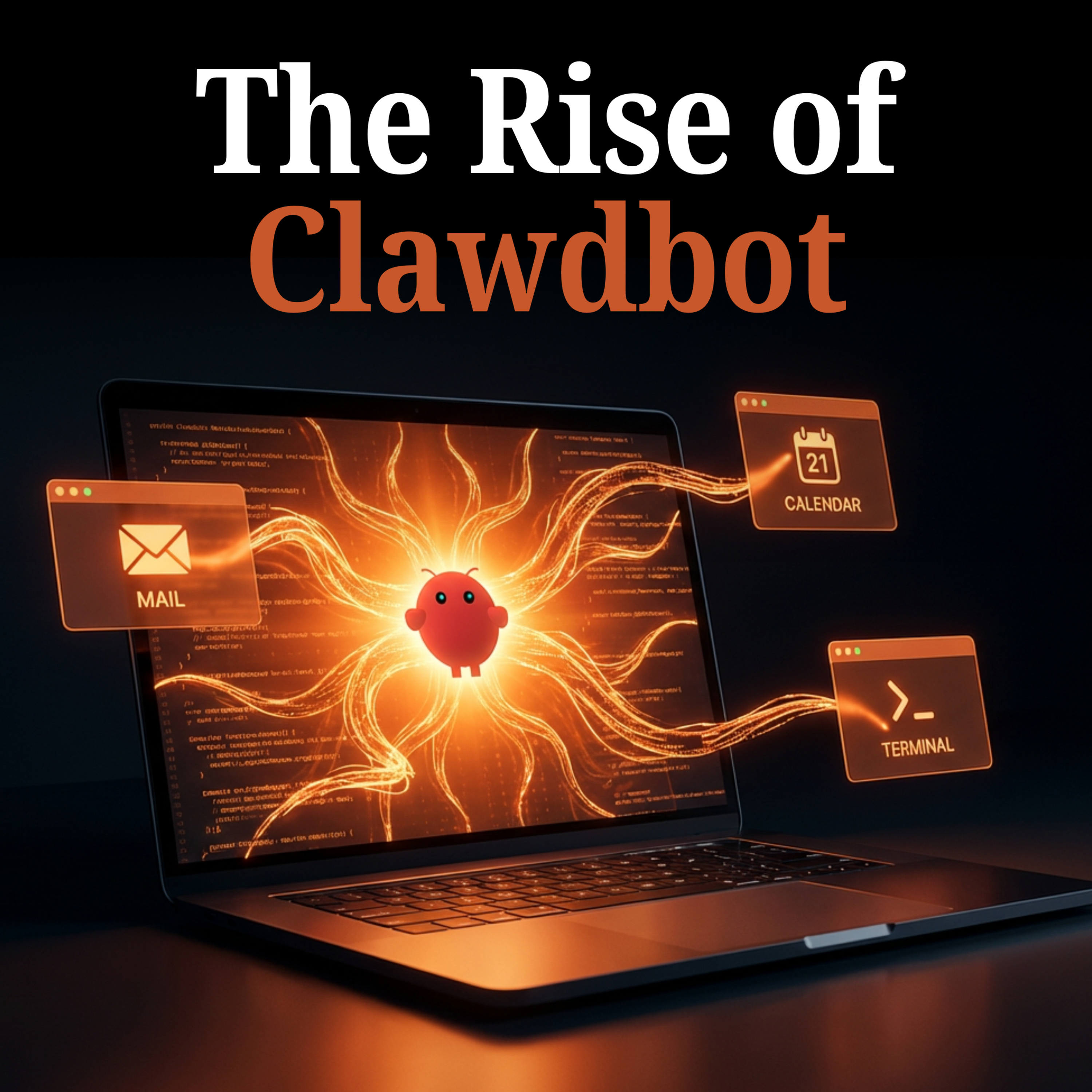
Anthropic has released Claude CoWork, an agentic tool that automates office tasks by directly interacting with local computer files. It's effectively a "no-code" version of their developer tool, signaling the imminent arrival of AI agents in mainstream workflows, though Anthropic explicitly warns users about potential security risks.
Anthropic's upcoming 'Agent Mode' for Claude moves beyond simple text prompts to a structured interface for delegating and monitoring tasks like research, analysis, and coding. This productizes common workflows, representing a major evolution from conversational AI to autonomous, goal-oriented agents, simplifying complex user needs.