Get your free personalized podcast brief
We scan new podcasts and send you the top 5 insights daily.
Anthropic's upcoming 'Agent Mode' for Claude moves beyond simple text prompts to a structured interface for delegating and monitoring tasks like research, analysis, and coding. This productizes common workflows, representing a major evolution from conversational AI to autonomous, goal-oriented agents, simplifying complex user needs.

Related Insights
AI's impact on coding is unfolding in stages. Phase 1 was autocomplete (Copilot). We're now in Phase 2, defined by interactive agents where developers orchestrate tasks with prompts. Phase 3 will be true automation, where agents independently handle complete, albeit simpler, development workflows without direct human guidance.
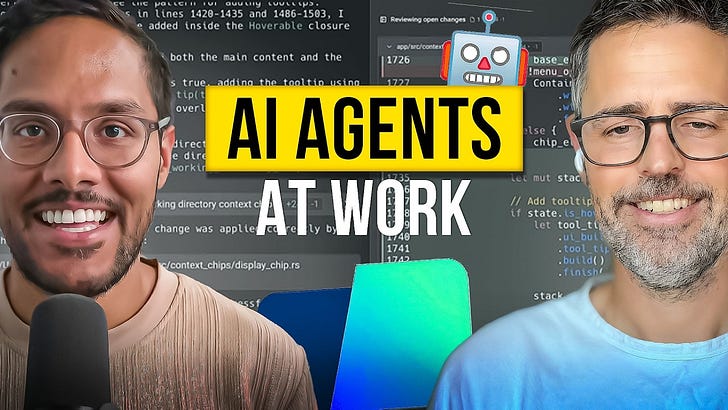
The paradigm is shifting from using AI as a general chatbot to building a team of 'digital employees.' Claude Skills allow users to encapsulate a specific, repeatable workflow—like drafting a newsletter from tweets—into a tool that can be executed on demand, creating a specialized agent for that job.
As AI evolves from single-task tools to autonomous agents, the human role transforms. Instead of simply using AI, professionals will need to manage and oversee multiple AI agents, ensuring their actions are safe, ethical, and aligned with business goals, acting as a critical control layer.

The primary interface for managing AI agents won't be simple chat, but sophisticated IDE-like environments for all knowledge workers. This paradigm of "macro delegation, micro-steering" will create new software categories like the "accountant IDE" or "lawyer IDE" for orchestrating complex AI work.
The best UI for an AI tool is a direct function of the underlying model's power. A more capable model unlocks more autonomous 'form factors.' For example, the sudden rise of CLI agents was only possible once models like Claude 3 became capable enough to reliably handle multi-step tasks.

Elias Torres argues that the current AI paradigm, which focuses on tools that assist humans (e.g., summarizers, drafters), is fundamentally limited. He believes true value is unlocked when you can instruct an AI to perform a task *infinitely* on its own, without requiring a human to type into a chat box for every action.

Craig Hewitt argues ChatGPT is a consumer product. For serious business tasks, agentic AI tools like Manus (built on Claude) are superior, offering web browsing, data aggregation, and code generation that go far beyond a simple chat interface.

The recent leap in AI coding isn't solely from a more powerful base model. The true innovation is a product layer that enables agent-like behavior: the system constantly evaluates and refines its own output, leading to far more complex and complete results than the LLM could achieve alone.
The paradigm shift with AI agents is from "tools to click buttons in" (like CRMs) to autonomous systems that work for you in the background. This is a new form of productivity, akin to delegating tasks to a team member rather than just using a better tool yourself.
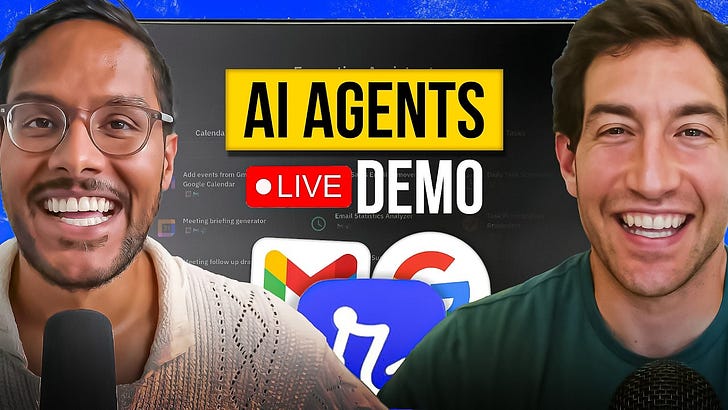
Anthropic's data reveals users are moving beyond AI as a creative partner and are now delegating entire tasks. This "directive automation" behavior jumped from 27% to 39% of conversations in just nine months, signaling rapidly growing trust in AI for autonomous work completion.