Get your free personalized podcast brief
We scan new podcasts and send you the top 5 insights daily.
Unlike traditional software that fails with clear errors, multi-agent systems can fail silently. A series of individually logical actions, based on slightly stale or incomplete context, can compound into a significant error that is only obvious when replaying the entire sequence of events.

Related Insights
Pairing two AI agents to collaborate often fails. Because they share the same underlying model, they tend to agree excessively, reinforcing each other's bad ideas. This creates a feedback loop that fills their context windows with biased agreement, making them resistant to correction and prone to escalating extremism.

An AI agent's failure on a complex task like tax preparation isn't due to a lack of intelligence. Instead, it's often blocked by a single, unpredictable "tiny thing," such as misinterpreting two boxes on a W4 form. This highlights that reliability challenges are granular and not always intuitive.

When faced with jumbled data from messy documents, LLMs don't error out. Instead, they use their reasoning to guess, creating perfectly structured but factually wrong outputs. This silent data corruption is the most dangerous failure mode in production pipelines, as it pollutes downstream systems without warning.
Unlike humans who can prune irrelevant information, an AI agent's context window is its reality. If a past mistake is still in its context, it may see it as a valid example and repeat it. This makes intelligent context pruning a critical, unsolved challenge for agent reliability.
A team of AI agents, when left in a chat, would trigger each other into endless, circular conversations on trivial topics. A critical, non-obvious aspect of designing multi-agent systems is defining clear stopping conditions, as they lack the social awareness to naturally conclude an interaction.

In multi-agent AI systems, a single agent's hallucination is not a localized error. It's a 'semantic corruption' that propagates through the cluster's shared state, mirroring a cascading fault in distributed systems. Each agent trustingly builds upon the last, amplifying the error until the entire cluster operates on a false premise.

Even sophisticated agents can fail during long, complex tasks. The agent discussed lost track of its goal to clone itself after a series of steps burned through its context window. This "brain reset" reveals that state management, not just reasoning, is a primary bottleneck for autonomous AI.
When an AI agent causes damage, the root cause is rarely the model acting erratically. Instead, it's a known engineering failure: the agent was given excessive permissions and lacked architectural safety gates. The agent simply executed a logical, albeit destructive, path that was available to it.
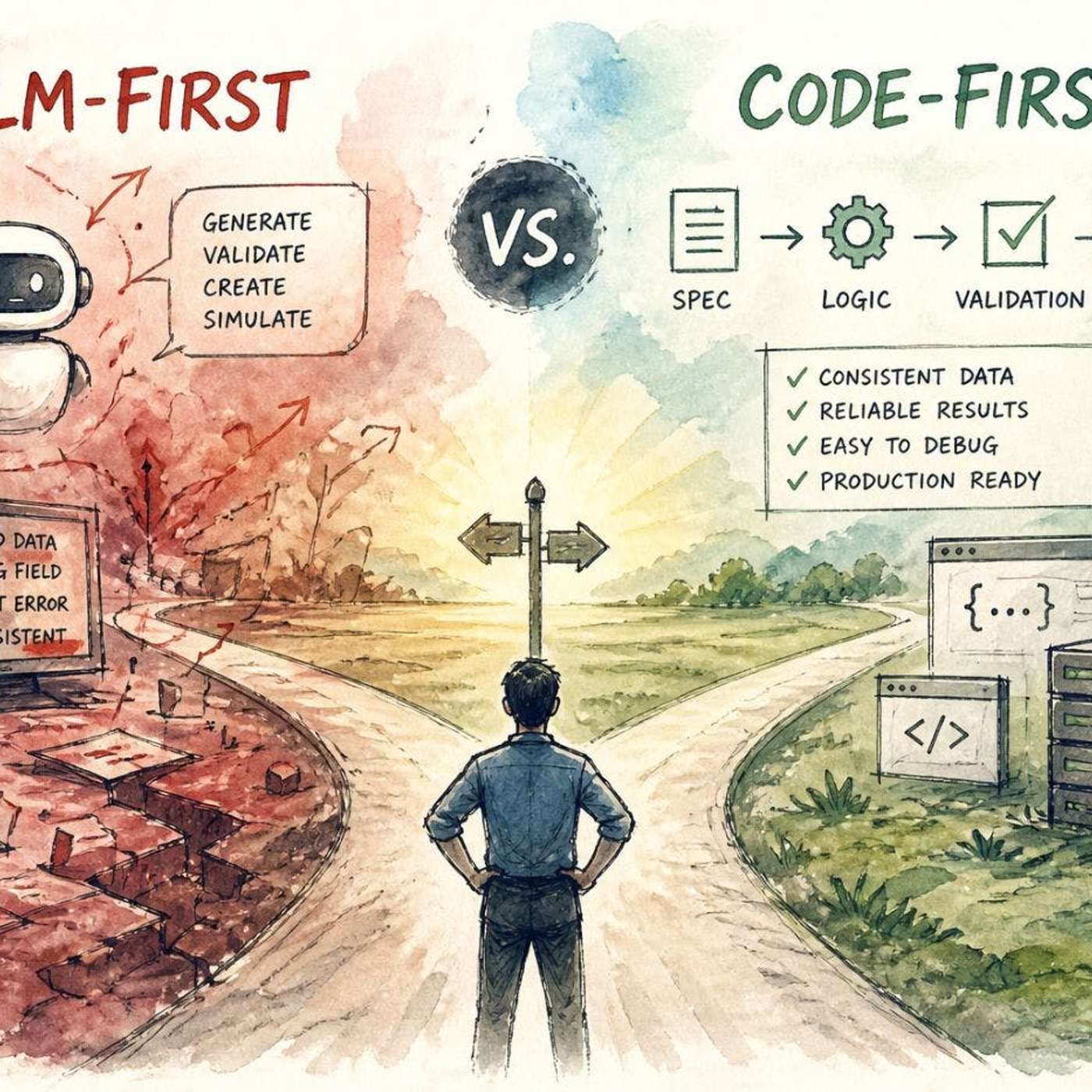
LLMs in production don't often crash spectacularly. Instead, they introduce subtle, probabilistic errors—like incorrect enum values or missing fields—that are hard to debug because they lack clear error patterns, unlike deterministic code failures.
The primary obstacle to creating a fully autonomous AI software engineer isn't just model intelligence but "controlling entropy." This refers to the challenge of preventing the compounding accumulation of small, 1% errors that eventually derail a complex, multi-step task and get the agent irretrievably off track.
