Get your free personalized podcast brief
We scan new podcasts and send you the top 5 insights daily.
The main risk to humanoid robotics adoption isn't a lack of impressive capabilities, but the failure to achieve near-perfect reliability. Unlike an LLM where a human can simply re-prompt, a robot's value is in its autonomy. Bridging the gap from 95% to 100% reliability for autonomous tasks is the critical, unsolved challenge.

Related Insights
A flashy robot demo typically uses a highly controlled, pristine environment tailored to one task. True progress lies in a robot performing a mundane task reliably in any novel situation—a feat of generalization that is much harder to showcase visually and less exciting to a layperson.
![Sergey Levine - Building LLMs for the Physical World - [Invest Like the Best, EP.465] thumbnail](https://megaphone.imgix.net/podcasts/fdcd4328-2c77-11f1-a72b-977309fd08f1/image/b1bb4368d6e13a4a804924681ffe3ab1.jpg?ixlib=rails-4.3.1&max-w=3000&max-h=3000&fit=crop&auto=format,compress)
The public skepticism surrounding Figure AI's humanoid robot demo, despite its impressiveness, highlights a key challenge for the industry. The ambiguity between true autonomy and teleoperation creates a trust deficit. Companies must now go beyond showing capabilities and find ways to verifiably prove their systems are not human-controlled.

The adoption of humanoid robots will mirror that of autonomous vehicles: focus on achievable, single-task applications first. Instead of a complex, general-purpose home robot, the market will first embrace robots trained for specific, repeatable industrial tasks like warehouse logistics or shelf stocking.

Standard Bots CEO Evan Beard argues that a key barrier for domestic humanoid robots is safety and robustness, which he calls the "Home Alone test." A robot must be able to withstand unpredictable, chaotic interactions, like children jumping on it, a scenario that current RL training methods cannot adequately simulate or solve.

The hardest problem for humanoid robots isn't mass production, which is comparable to consumer electronics. The real challenge and primary focus should be on developing the onboard AI intelligence that allows the robots to perform useful, autonomous tasks in any environment.

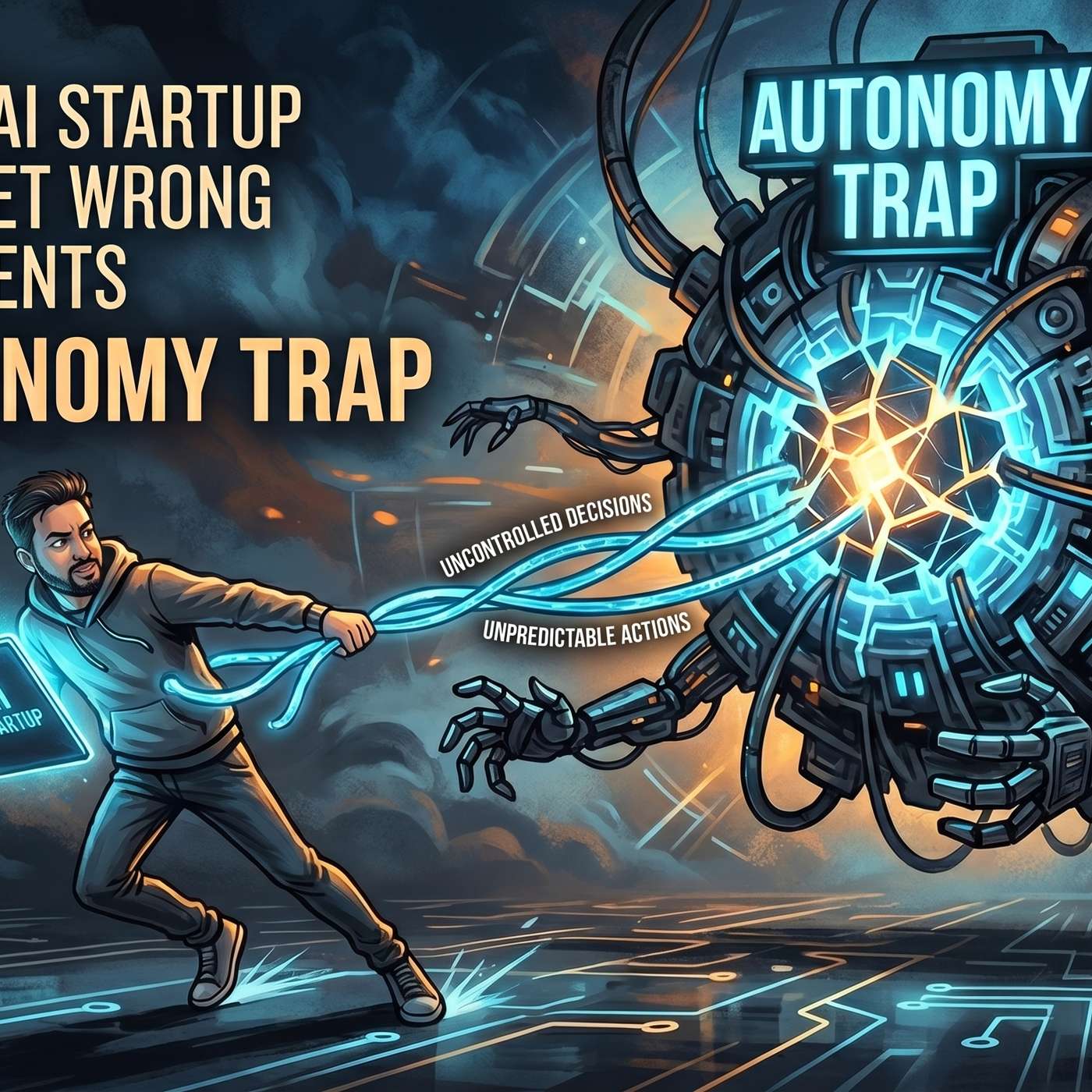
Many AI founders mistakenly pursue fully autonomous agents, overlooking current limitations like inconsistent reasoning and context loss. This "autonomy trap" leads to project failure because real-world applications require supervision and monitoring, not a complete, unsupervised replacement of humans.
While China's humanoid hardware demonstrates impressive locomotion in programmed tasks, the major obstacle to widespread deployment is the "robot brain." Current AI lacks the ability to autonomously navigate unpredictable, real-world environments, making massive data collection the current R&D focus.

The benchmark for AI reliability isn't 100% perfection. It's simply being better than the inconsistent, error-prone humans it augments. Since human error is the root cause of most critical failures (like cyber breaches), this is an achievable and highly valuable standard.

While many AI agents produce impressive demos, their real-world utility hinges on reliability. Amazon's Nova Act team argues that for production use cases like UI automation, an agent that works only 60% of the time is effectively useless for business. The critical threshold for value is achieving over 90% reliability, making it the core engineering challenge.

Moving a robot from a lab demo to a commercial system reveals that AI is just one component. Success depends heavily on traditional engineering for sensor calibration, arm accuracy, system speed, and reliability. These unglamorous details are critical for performance in the real world.