Get your free personalized podcast brief
We scan new podcasts and send you the top 5 insights daily.
Instead of a generic checklist to harden an AI-generated prototype, audit it module by module. Assign one of three verdicts: 'Keep' for sound logic, 'Fix in place' for minor gaps, or 'Rebuild' for flawed foundations. This focuses resources on actual problems, avoiding costly work on parts that are already functional.

Related Insights
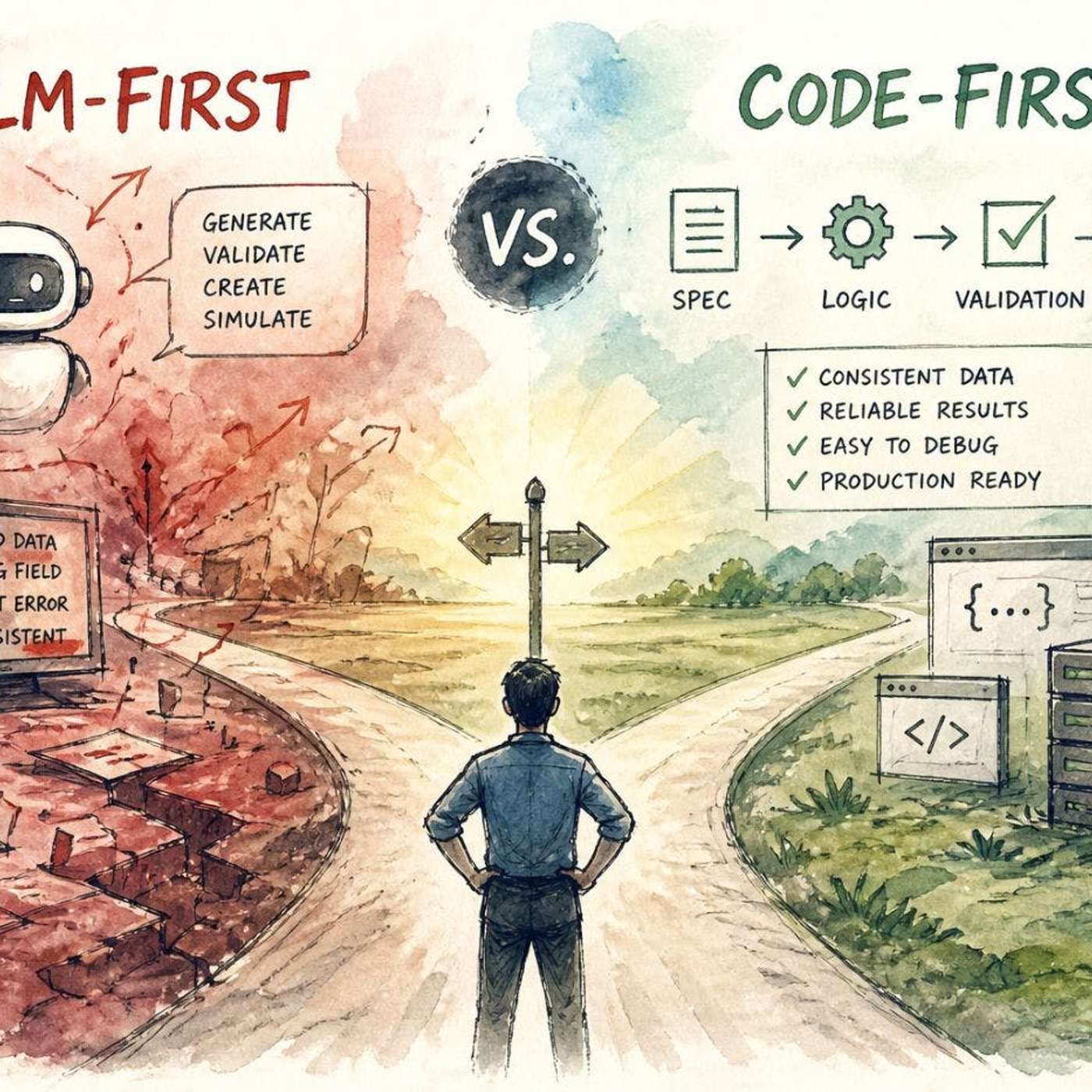
Don't give LLMs full control. Use deterministic code for core logic, validation, and enforcing rules. Delegate only tasks requiring flexibility or understanding of unstructured input to the LLM, treating it as a specialized component, not the entire system.
Instead of creating a massive risk register, identify the core assumptions your product relies on. Prioritize testing the one that, if proven wrong, would cause your product to fail the fastest. This focuses effort on existential threats over minor issues.

After an initial analysis, use a "stress-testing" prompt that forces the LLM to verify its own findings, check for contradictions, and correct its mistakes. This verification step is crucial for building confidence in the AI's output and creating bulletproof insights.

When an AI tool makes a mistake, treat it as a learning opportunity for the system. Ask the AI to reflect on why it failed, such as a flaw in its system prompt or tooling. Then, update the underlying documentation and prompts to prevent that specific class of error from happening again in the future.

You don't need to create an automated "LLM as a judge" for every potential failure. Many issues discovered during error analysis can be fixed with a simple prompt adjustment. Reserve the effort of building robust, automated evals for the 4-7 most persistent and critical failure modes that prompt changes alone cannot solve.

Instead of treating a complex AI system like an LLM as a single black box, build it in a componentized way by separating functions like retrieval, analysis, and output. This allows for isolated testing of each part, limiting the surface area for bias and simplifying debugging.

Instead of fighting for perfect code upfront, accept that AI assistants can generate verbose code. Build a dedicated "refactoring" phase into your process, using AI with specific rules to clean up and restructure the initial output. This allows you to actively manage technical debt created by AI-powered speed.

Borrowing from classic management theory, the most effective way to use AI agents is to fix problems at the earliest 'lowest value stage'. This means rigorously reviewing the agent's proposed plan *before* it writes any code, preventing costly rework later on.

A powerful technique for creating robust software plans is to use AI as an adversarial partner. After drafting a specification, prompt an AI to "tear it apart" by identifying underspecified or inconsistent points. Iterate on this process until the AI's feedback becomes niche, indicating a solid spec.

When an AI-coded feature is flawed, the instinct is to patch the specific output. A more effective, long-term approach is to analyze *why* your agent system produced a bad result and improve the underlying agent, skill, or process that failed.
