Get your free personalized podcast brief
We scan new podcasts and send you the top 5 insights daily.
Standard methods can produce 'blurry' audio by averaging possible speech inflections. Flow matching models the full distribution of how a word can be spoken, allowing it to pick a specific, sharp inflection from that distribution, leading to more natural-sounding speech.
Related Insights
Voice-to-voice AI models promise more natural, low-latency conversations by processing audio directly. However, they are currently impractical for many high-stakes enterprise applications due to a hallucination rate that can be eight times higher than text-based systems.
![Jesse Zhang - Building Decagon - [Invest Like the Best, EP.443] thumbnail](https://megaphone.imgix.net/podcasts/2cc4da2a-a266-11f0-ac41-9f5060c6f4ef/image/7df6dc347b875d4b90ae98f397bf1cb1.jpg?ixlib=rails-4.3.1&max-w=3000&max-h=3000&fit=crop&auto=format,compress)
To create a convincing voice agent, don't use a single LLM. Instead, deploy multiple LLMs that an agent can call upon. Each represents a different state or role of the persona, such as a 'sales hat' versus a 'customer service hat,' ensuring contextually appropriate responses and tone.

While text generation has largely converged on the Transformer architecture, the audio AI domain has no single winning recipe. This lack of a settled standard makes the field highly experimental and exciting for researchers exploring novel approaches like diffusion and flow matching.
By converting audio into discrete tokens, the system allows a large language model (LLM) to generate speech just as it generates text. This simplifies architecture by leveraging existing model capabilities, avoiding the need for entirely separate speech synthesis systems.

While most focus on human-to-computer interactions, Crisp.ai's founder argues that significant unsolved challenges and opportunities exist in using AI to improve human-to-human communication. This includes real-time enhancements like making a speaker's audio sound studio-quality with a single click, which directly boosts conversation productivity.

An AI company is revolutionizing movie dubbing by analyzing the emotion in an actor's voice (e.g., angry, happy) and replicating that tone in the target language. This creates a more authentic viewing experience than traditional dubbing, which often sounds wooden and disconnected.

Paradromics uses LLMs to decode brain signals for speech, much like how speech-to-text cleans up audio. This allows for faster, more accurate "thought-to-text" by predicting what a user intends to say, even with imperfect neural data, and correcting errors in real-time.

A common objection to voice AI is its robotic nature. However, current tools can clone voices, replicate human intonation, cadence, and even use slang. The speaker claims that 97% of people outside the AI industry cannot tell the difference, making it a viable front-line tool for customer interaction.

The system offers two tokenizer options: 25 Hz for high-detail audio and 12 Hz for faster generation. This practical approach acknowledges that different applications have different needs, prioritizing either computational efficiency or acoustic fidelity rather than forcing a one-size-fits-all solution.
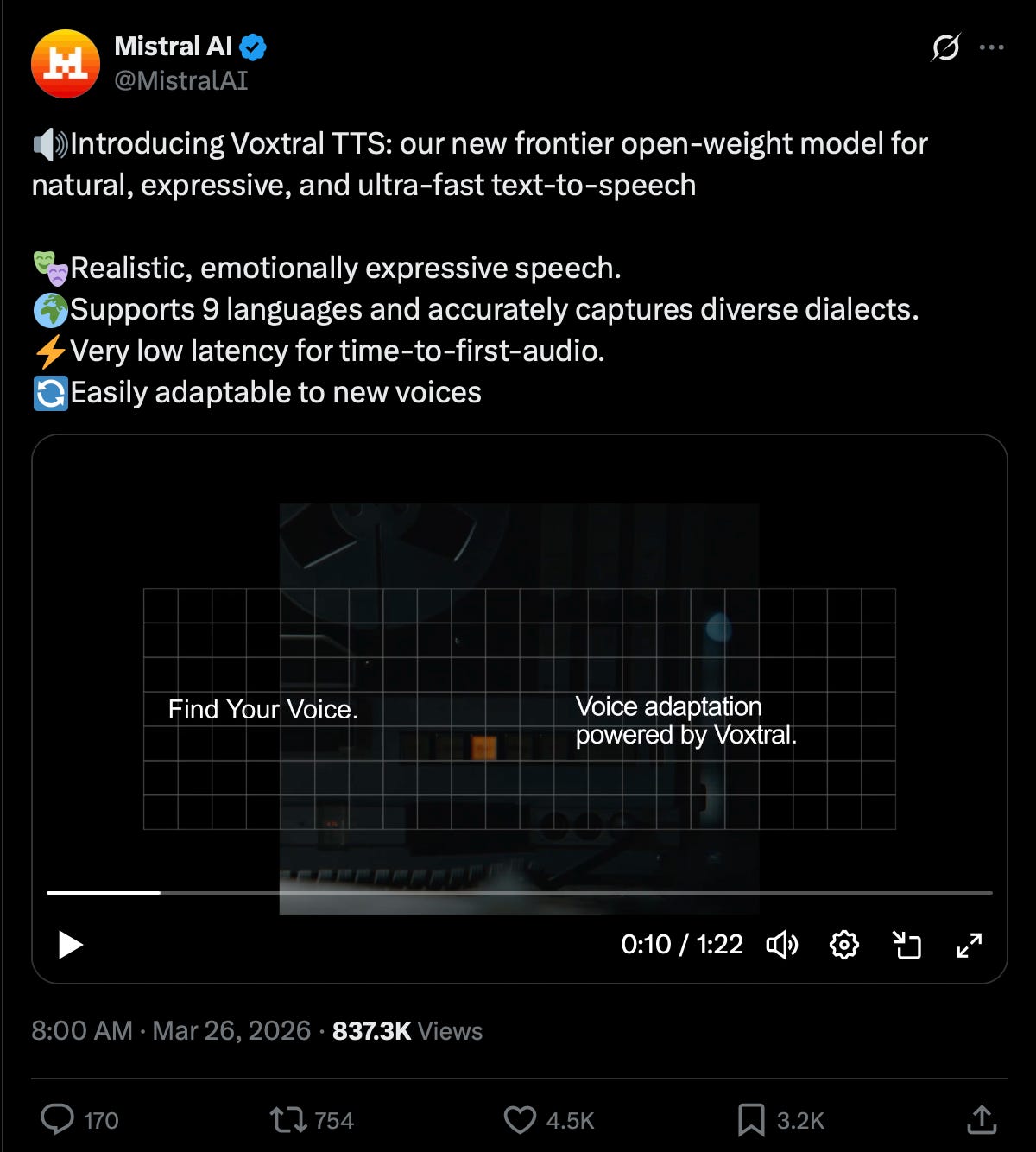
Mistral developed a new TTS architecture combining autoregressive flow matching with a custom neural audio codec. This approach aims to model speech inflections more efficiently than depth transformers or full diffusion models, targeting real-time voice agent use cases.