Get your free personalized podcast brief
We scan new podcasts and send you the top 5 insights daily.
While text generation has largely converged on the Transformer architecture, the audio AI domain has no single winning recipe. This lack of a settled standard makes the field highly experimental and exciting for researchers exploring novel approaches like diffusion and flow matching.
Related Insights
While more data and compute yield linear improvements, true step-function advances in AI come from unpredictable algorithmic breakthroughs like Transformers. These creative ideas are the most difficult to innovate on and represent the highest-leverage, yet riskiest, area for investment and research focus.

The perception of China's AI industry as a "fast follower" is outdated. Models like ByteDance's SeedDance 2.0 are not just catching up on quality but introducing technical breakthroughs—like simultaneous sound generation—that haven't yet appeared in Western models, signaling a shift to true innovation.

By converting audio into discrete tokens, the system allows a large language model (LLM) to generate speech just as it generates text. This simplifies architecture by leveraging existing model capabilities, avoiding the need for entirely separate speech synthesis systems.

With the release of OpenAI's new video generation model, Sora 2, a surprising inversion has occurred. The generated video is so realistic that the accompanying AI-generated audio is now the more noticeable and identifiable artificial component, signaling a new frontier in multimedia synthesis.

Standard methods can produce 'blurry' audio by averaging possible speech inflections. Flow matching models the full distribution of how a word can be spoken, allowing it to pick a specific, sharp inflection from that distribution, leading to more natural-sounding speech.
While text-based AI models struggle with non-English languages, the problem is exponentially worse for audio models. The lack of diverse, high-quality audio training data (across ages, genders, topics) in various languages is a critical bottleneck for companies aiming for global adoption of audio-first AI.

While large language models are a game of scale, ElevenLabs argues that specialized AI domains like audio are won through architectural breakthroughs. The key is not massive compute but a small pool of elite researchers (estimated at 50-100 globally). This focus on talent and novel model design allows a smaller company to outperform tech giants.

Contrary to the prevailing 'scaling laws' narrative, leaders at Z.AI believe that simply adding more data and compute to current Transformer architectures yields diminishing returns. They operate under the conviction that a fundamental performance 'wall' exists, necessitating research into new architectures for the next leap in capability.

Despite its age, the Transformer architecture is likely here to stay on the path to AGI. A massive ecosystem of optimizers, hardware, and techniques has been built around it, creating a powerful "local minimum" that makes it more practical to iterate on Transformers than to replace them entirely.

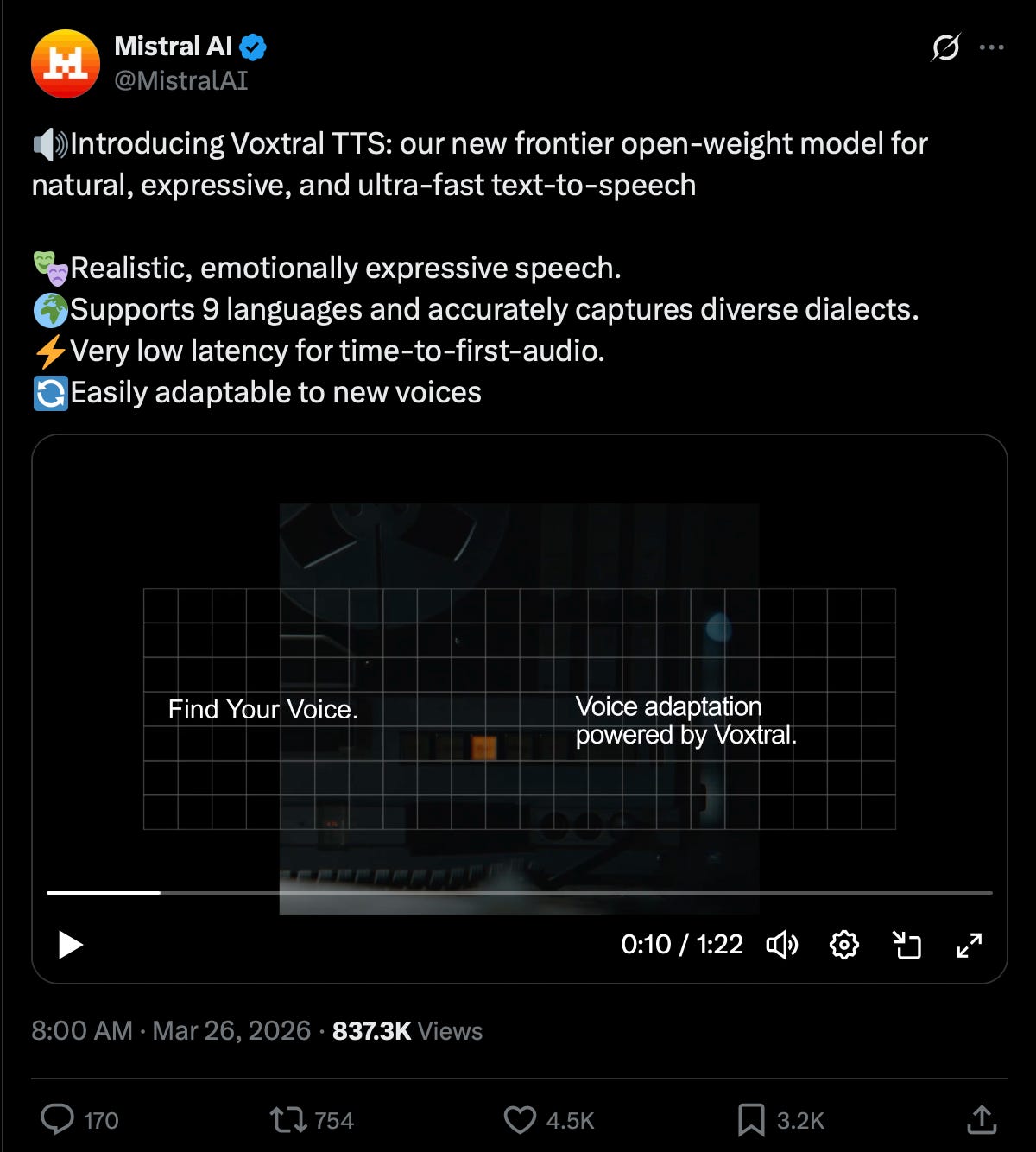
Mistral developed a new TTS architecture combining autoregressive flow matching with a custom neural audio codec. This approach aims to model speech inflections more efficiently than depth transformers or full diffusion models, targeting real-time voice agent use cases.