Get your free personalized podcast brief
We scan new podcasts and send you the top 5 insights daily.
Mockapetris copied the SRI host table into DNS every morning, so DNS held all existing names plus new DNS-only entries. Early adopters got both namespaces, while people who stayed on the old host table missed places where the “cool kids” hung out.

Related Insights
Mockapetris says DNS’s magic had two parts: it let millions of organizations own separate chunks of the namespace indefinitely, yet users experience one contiguous tree. When looking up a name, the first DNS query asks which name server to consult, not for an IP address.
The most critical lesson from integrating 22 acquisitions wasn't about perfecting data migration. Instead, success was determined by spending significant time with acquired teams *before* migrating core systems. This human-centric approach ensures teams feel supported and bought into the new direction, which is more impactful than technical flawlessness.

D-NOW challenges single-system integration dogma by planning to run its legacy SAP ERP alongside the acquired MRC's Oracle ERP. This suggests that for diversified businesses, using the best-fit ERP for each distinct business segment can be more efficient than forcing a unified system.

Mockapetris rejected Xerox PARC’s fixed three-level naming because users want freedom to organize information. He designed DNS so names could nest however many levels people needed, noting hidden applications often go many levels deep. If you allow nesting, he argues, support any reasonable amount.
When rolling out the Odin platform at Uber, the team intentionally avoided a big-bang launch. They started with their own systems, then expanded to friendly teams, using an incremental approach to build momentum and prove value before approaching more resistant groups.

When trying to convince teams to adopt a new technology, the most effective strategy is to implement the solution for them. Presenting a finished, working migration is a much easier conversation than asking them to take on a large, uncertain task themselves.

For a program change of this magnitude, Cisco measured success by how "uneventful" and "quiet" the launch was. They achieved this by testing and exposing partners to new metrics and systems for months beforehand. This ensured the final cutover was a smooth operational event, not a disruptive shock.

The most common and robust method for migrating embedding models is to build a completely new vector index in parallel using the new model. While the old index serves live traffic, the new one is built, validated via shadow scoring, and then traffic is cut over with an alias swap, ensuring zero downtime.
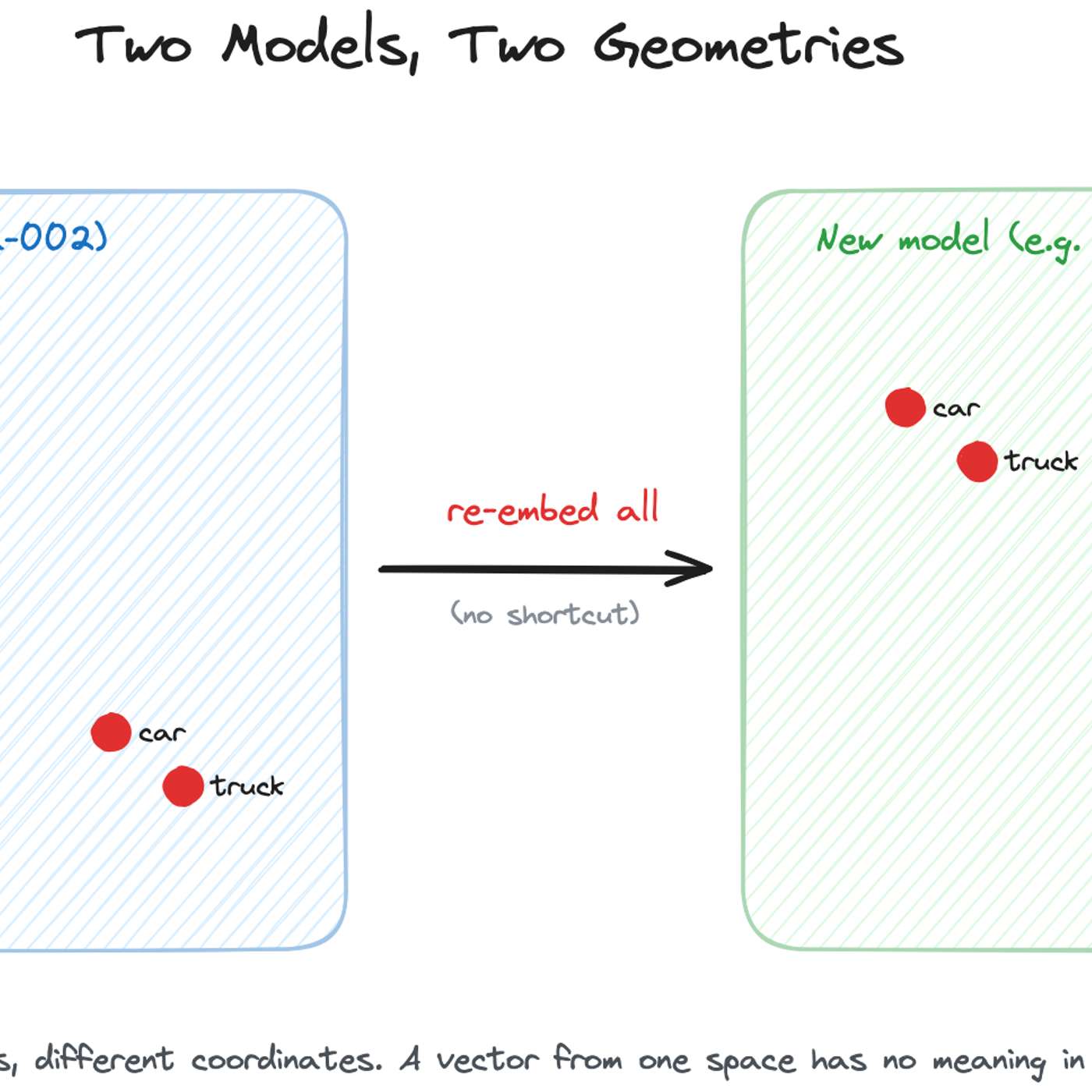
When considering a significant business change, like migrating to a new platform, avoid disrupting your primary revenue source. MarketBeat's founder advises creating a new, separate project to test the change, protecting the "goose that's laying golden eggs."

To overcome the high switching costs for enterprise customers, Linear employs a three-part strategy. First, they prove value. Second, they run a pilot with a few teams to demonstrate success. Finally, they provide migration tooling and resources to ensure a seamless transition.
