Get your free personalized podcast brief
We scan new podcasts and send you the top 5 insights daily.
While techniques like model distillation can reduce costs for near-frontier AI capabilities, this hasn't dampened demand for the absolute best models. The market shows very little desire for the third-best model, but exceptional demand for the top-performing one for any given task, demonstrating a winner-take-all dynamic.

Related Insights
The AI market is becoming "polytheistic," with numerous specialized models excelling at niche tasks, rather than "monotheistic," where a single super-model dominates. This fragmentation creates opportunities for differentiated startups to thrive by building effective models for specific use cases, as no single model has mastered everything.

The 'Andy Warhol Coke' era, where everyone could access the best AI for a low price, is over. As inference costs for more powerful models rise, companies are introducing expensive tiered access. This will create significant inequality in who can use frontier AI, with implications for transparency and regulation.

China is gaining an efficiency edge in AI by using "distillation"—training smaller, cheaper models from larger ones. This "train the trainer" approach is much faster and challenges the capital-intensive US strategy, highlighting how inefficient and "bloated" current Western foundational models are.

The market for AI models follows a power law with a very strong preference for quality. Amodei compares it to hiring employees: people will disproportionately seek out the single best "cognitively capable" model, making price and other factors secondary.

The public-facing models from major labs are likely efficient Mixture-of-Experts (MOE) versions distilled from much larger, private, and computationally expensive dense models. This means the model users interact with is a smaller, optimized copy, not the original frontier model.
![[LIVE] Anthropic Distillation & How Models Cheat (SWE-Bench Dead) | Nathan Lambert & Sebastian Raschka thumbnail](https://substackcdn.com/feed/podcast/1084089/post/189277598/ca7468da5614a246d2906ee8926f6de7.jpg)
Fears of a single AI company achieving runaway dominance are proving unfounded, as the number of frontier models has tripled in a year. Newcomers can use techniques like synthetic data generation to effectively "drink the milkshake" of incumbents, reverse-engineering their intelligence at lower costs.

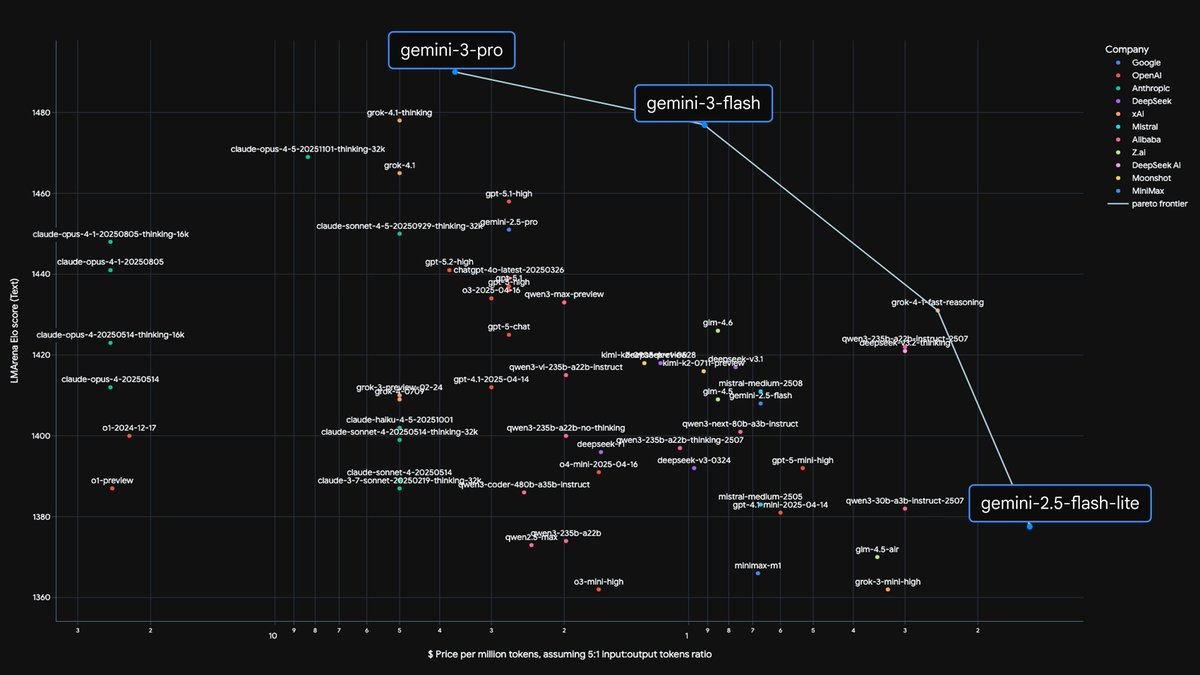
Google's strategy involves creating both cutting-edge models (Pro/Ultra) and efficient ones (Flash). The key is using distillation to transfer capabilities from large models to smaller, faster versions, allowing them to serve a wide range of use cases from complex reasoning to everyday applications.
The current oligopolistic 'Cournot' state of AI labs will eventually shift to 'Bertrand' competition, where labs compete more on price. This happens once the frontier commoditizes and models become 'good enough,' leading to a market structure similar to today's cloud providers like AWS and GCP.
Don't assume that a "good enough" cheap model will satisfy all future needs. Jeff Dean argues that as AI models become more capable, users' expectations and the complexity of their requests grow in tandem. This creates a perpetual need for pushing the performance frontier, as today's complex tasks become tomorrow's standard expectations.
Contrary to the 'winner-takes-all' narrative, the rapid pace of innovation in AI is leading to a different outcome. As rival labs quickly match or exceed each other's model capabilities, the underlying Large Language Models (LLMs) risk becoming commodities, making it difficult for any single player to justify stratospheric valuations long-term.