Get your free personalized podcast brief
We scan new podcasts and send you the top 5 insights daily.
Modern society is defined by 'systemic interdependence' where core sectors like AI, energy, and labor are so intertwined that the failure of one guarantees the failure of all. This interconnectedness means we lack historical models to recognize the warning signs or predict what a modern societal collapse would look like.

Related Insights
The potential for an AI-driven, post-capitalist world of abundance is real. However, the path there will likely be as destructive as a world war, as the rapid upending of the economic order will throw society into chaos before stability is achieved.

The rapid accumulation of hundreds of billions in debt to finance AI data centers poses a systemic threat, not just a risk to individual companies. A drop in GPU rental prices could trigger mass defaults as assets fail to service their loans, risking a contagion effect similar to the 2008 financial crisis.

Predictive technology introduces a fundamental tension. While AI offers unprecedented clarity into future outcomes, its very implementation makes the world more complex and interconnected. This creates a feedback loop where the tool for prediction is also a source of new, unpredictable variables.

The ultimate failure point for a complex system is not the loss of its functional power but the loss of its ability to be understood by insiders and outsiders. This erosion of interpretability happens quietly and long before the more obvious, catastrophic collapse.
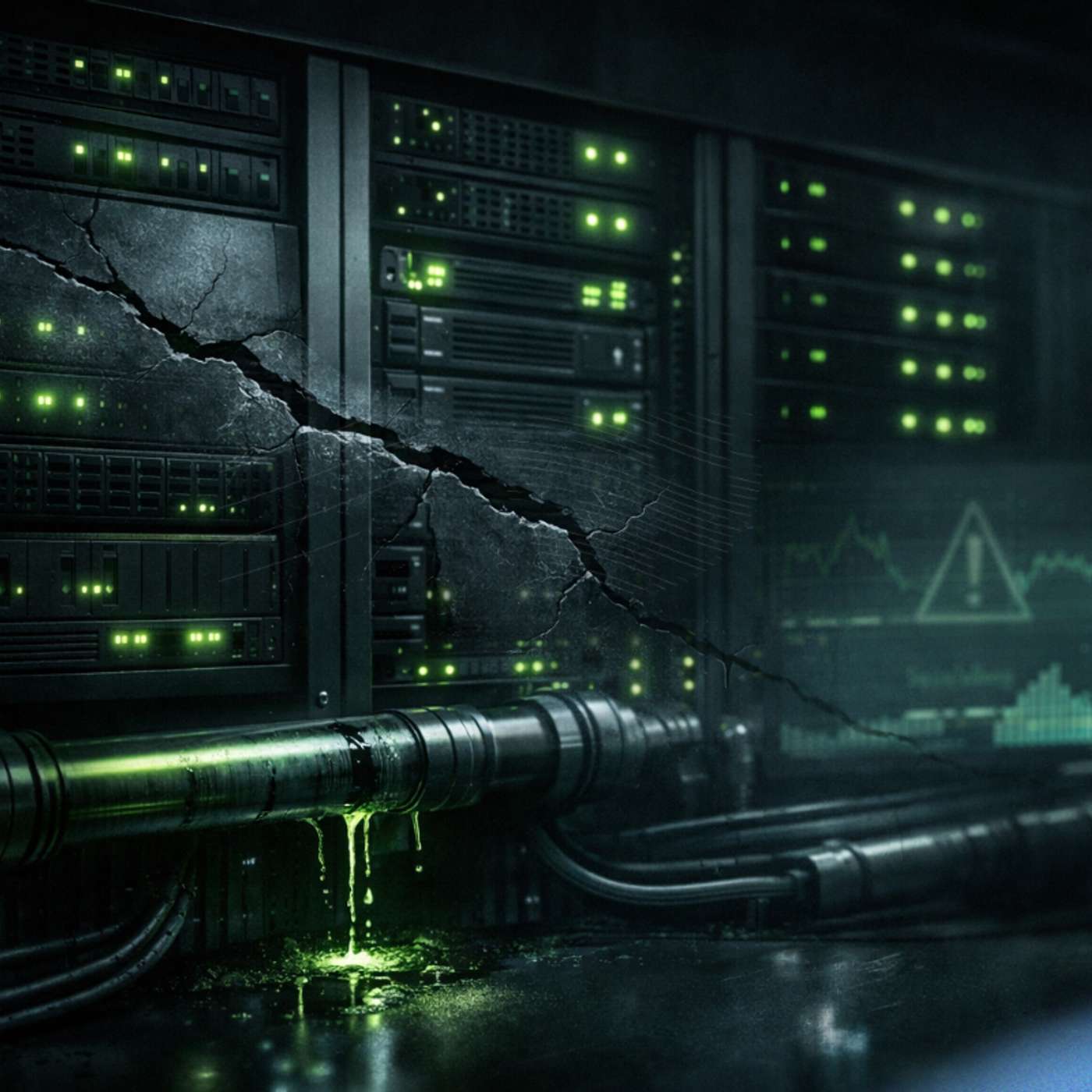
Unlike typical economic cycles with a clear baseline and tail risks, the current environment is defined by radical uncertainty. The combined unknowns of erratic economic policy and AI's transformative potential create a "flat distribution" where extreme outcomes like a depression or an industrial revolution are nearly as likely as a baseline scenario.

The global economy's reliance on a few dominant tech companies creates systemic risk. Unlike a robust, diversified economy, a downturn in a single key player like NVIDIA could trigger a disproportionately severe global recession, described as 'stage four walking pneumonia.' This concentration makes the entire system fragile.

Current instability is not unique to one country but part of a global pattern. This mirrors historical "crisis centuries" (like the 17th) where civil wars, plagues, and economic turmoil occurred simultaneously across different civilizations, driven by similar underlying variables.

AI systems often collapse because they are built on the flawed assumption that humans are logical and society is static. Real-world failures, from Soviet economic planning to modern systems, stem from an inability to model human behavior, data manipulation, and unexpected events.

Unlike gradual agricultural or industrial shifts, AI is displacing blue and white-collar jobs globally and simultaneously. This rapid, compressed timeframe leaves little room for adaptation, making societal unrest and violence highly probable without proactive planning.

Analogizing AI to electricity is too narrow. A better comparison is the shift from feudalism to market capitalism, which fundamentally restructured society over centuries. AI will have a similarly profound, systemic impact but compressed into less than a decade, making prediction and preparation incredibly challenging.
