Get your free personalized podcast brief
We scan new podcasts and send you the top 5 insights daily.
Instead of indexing all data into a vector database, AI agents can connect to standard APIs and run numerous queries in parallel, refining results iteratively. This trades speed and compute cost for flexibility and avoids heavy upfront infrastructure setup, changing the search paradigm.

Related Insights
M0's retrieval system runs four parallel signals: vector and full-text search across both the title and description of knowledge records. This hybrid approach captures semantic similarity for paraphrased queries (vector search) and exact matches for specific terms like API names (full-text), resulting in highly relevant, compact results.

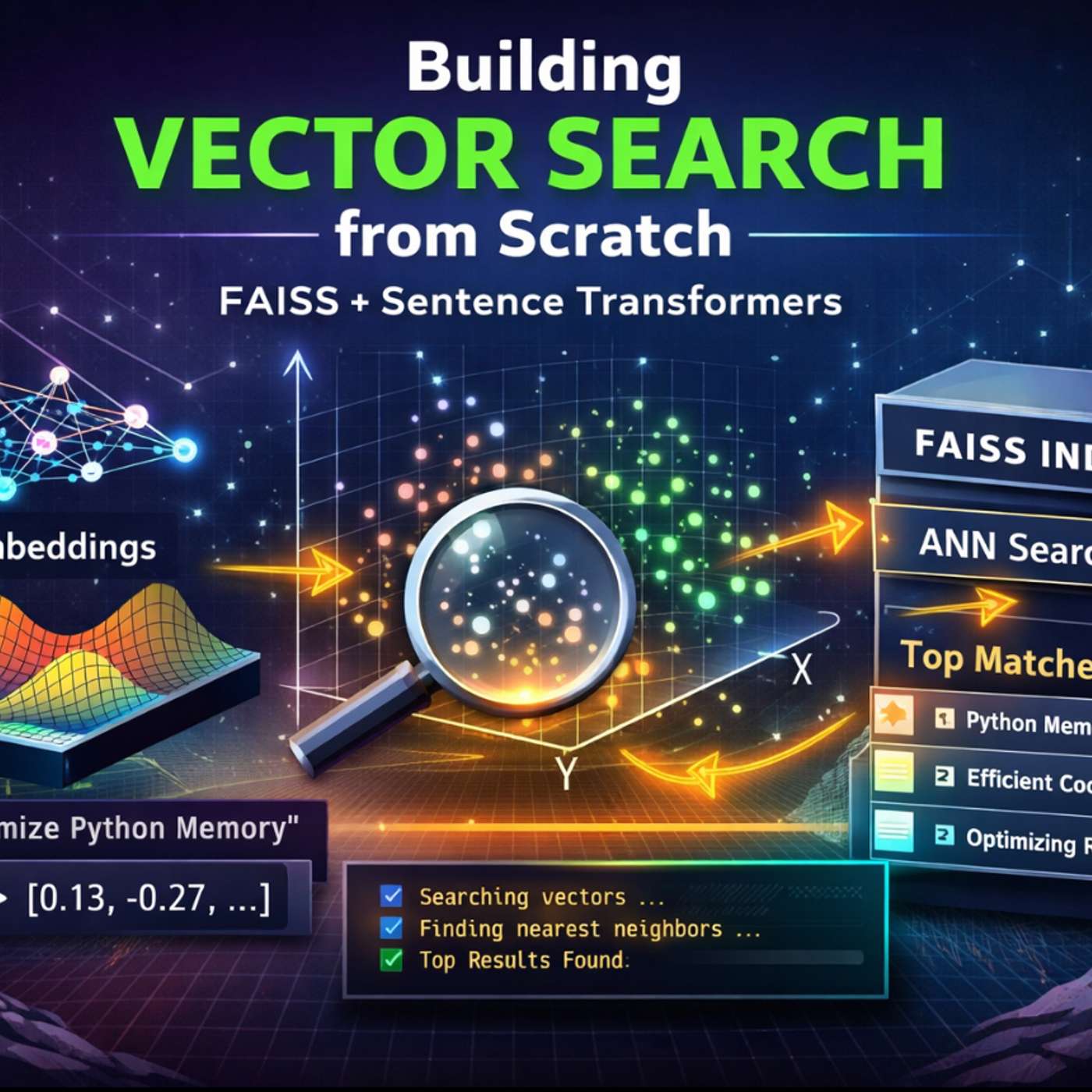
For millions of vectors, exact search (like a FAISS flat index) is too slow. Production systems use Approximate Nearest Neighbor (ANN) algorithms which trade a small amount of accuracy for orders-of-magnitude faster search performance, making large-scale applications feasible.
Google is integrating AI agents directly into search, allowing users to create ongoing tasks like monitoring apartment listings. This transforms search from a tool for one-time information retrieval into a persistent service that works 24/7, a fundamental shift in its core function and user interaction model.

According to Anna Patterson, vector databases struggle with scale, as distinguishing between billions of items requires increasingly long vectors. Their "soft match" functionality also creates relevancy challenges, forcing enterprises to become search experts to tune results, unlike more traditional keyword-based systems.

Unlike humans who type 2-3 words, LLMs generate long, sentence-like queries (e.g., eight words or more) to gather comprehensive context. This shift in user behavior from human to AI requires search engines to be optimized for these detailed, descriptive inputs.
While vector search is a common approach for RAG, Anthropic found it difficult to maintain and a security risk for enterprise codebases. They switched to "agentic search," where the AI model actively uses tools like grep or find to locate code, achieving similar accuracy with a cleaner deployment.

AI agents, unlike humans, need complete and exhaustive information (thousands of results) and use complex, controllable queries. A search engine built for human keyword simplicity and limited results will fail to serve them effectively.

Unlike chatbots that rely solely on their training data, Google's AI acts as a live researcher. For a single user query, the model executes a 'query fanout'—running multiple, targeted background searches to gather, synthesize, and cite fresh information from across the web in real-time.

Classic RAG involves a single data retrieval step. Its evolution, "agentic retrieval," allows an AI to perform a series of conditional fetches from different sources (APIs, databases). This enables the handling of complex queries where each step informs the next, mimicking a research process.

The nature of Retrieval-Augmented Generation (RAG) is evolving. Instead of a single search to populate an initial context window, AI agents are now performing numerous concurrent queries in a single turn. This allows them to explore diverse information paths simultaneously, driving new database requirements.